
Article Summary
A rock display case has to be sized around the specimen, because quartz sits at 7 on the Mohs scale and plate glass at 5.5. The Oqqlin Adjustable 30-Grid is the top pick, with 2.2 inch compartments, the largest verified cell in the category. Cases for Collectibles ranked six cases on compartment size, separation, and closure rather than grid count. Realgar, amethyst, and green fluorite fade in strong light, so placement beats any UV claim on a rock display case listing. Measure the largest rock first, then buy the case that takes it.
This article contains affiliate links. We earn a commission if you make a purchase, at no additional cost to you.
The Oqqlin Adjustable 30-Grid is my pick for most rock collections, because its 2.2 x 2.2 inch compartments are the largest cell I could verify on any grid case sold for this job. Quartz sits at 7 on the Mohs hardness scale, and the same chart puts a glass plate at 5.5.
Your rock is harder than the case you’re about to put it in. Acrylic is softer than glass, so the specimen wins there too.
The Best Rock Display Cases at a Glance
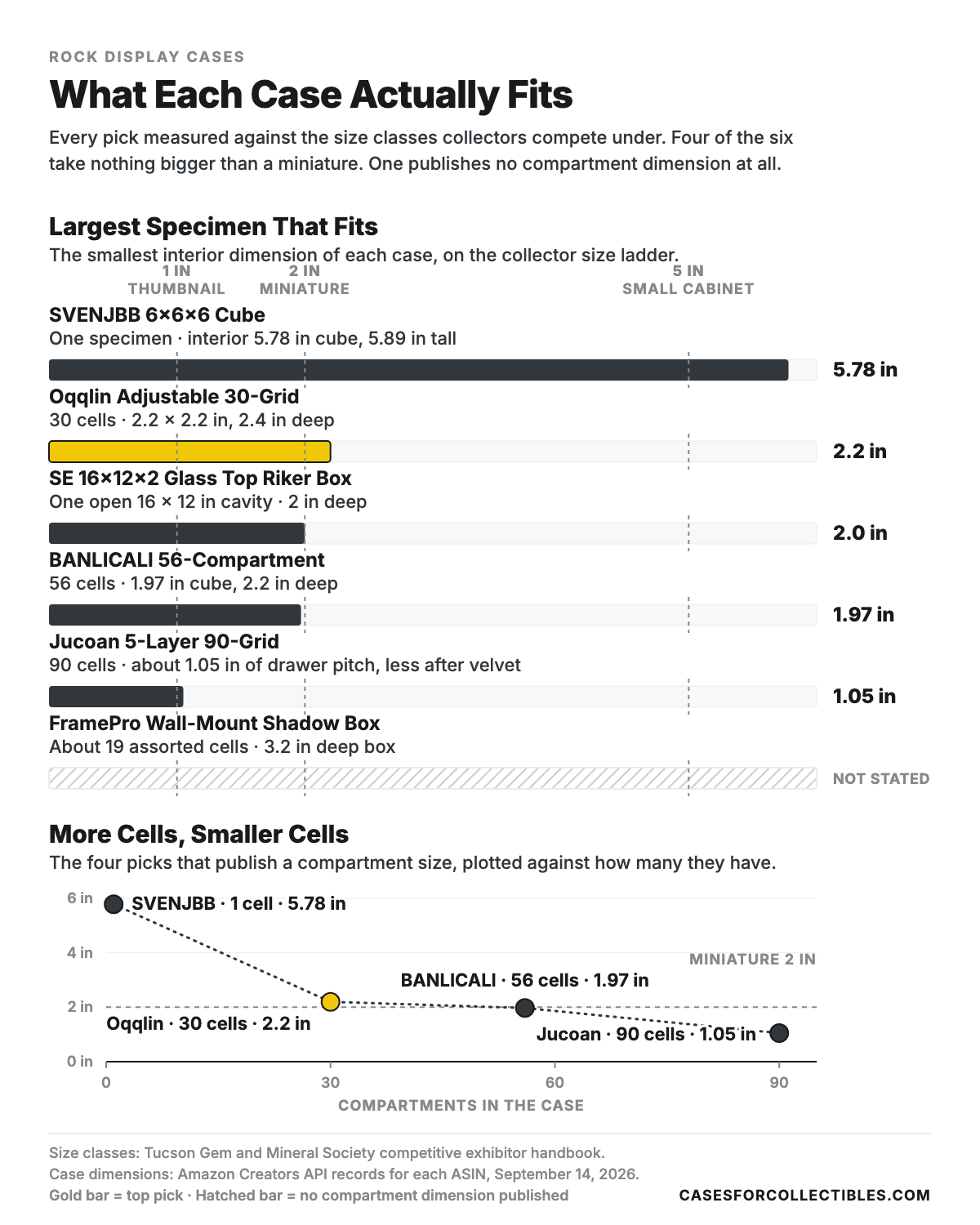
Six cases, five different shapes, ranked, with every dimension off the Amazon Creators API record for that exact ASIN on September 14, 2026.
| Case | Best for | Material | Cells and cell size | Case depth | Largest specimen it takes | Overall |
|---|---|---|---|---|---|---|
| Oqqlin Adjustable 30-Grid | Best overall | Clear acrylic, 3–5 mm wall | 30 cells at 2.2 x 2.2 in | 2.4 in | Miniature (2 in cube) | 8.8/10 |
| FramePro Wall-Mount Shadow Box | Best real-glass case | Wood, real glass door | ~19 cells, assorted, not published | 3.2 in | Miniature, more with dividers out | 8.5/10 |
| BANLICALI 56-Compartment | Best for a growing collection | Clear acrylic | 56 cells at 1.97 in cube | 2.2 in | Miniature, at the limit | 8.2/10 |
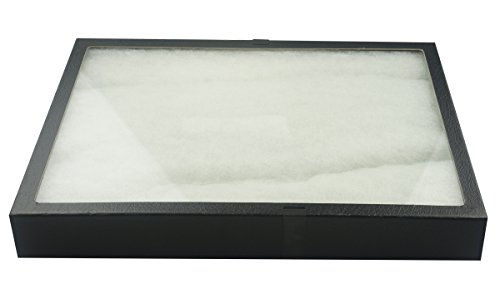
| SE 16x12x2 Glass Top Riker Box | Best for shows and field trips | Glass lid, board body, fill | One open 16 x 12 in cavity | 2 in | Miniature (2 in cube) | 8.0/10 |
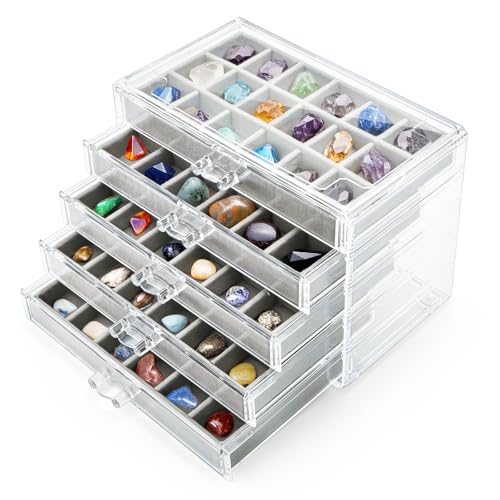
| Jucoan 5-Layer 90-Grid | Best budget and best for kids | Acrylic with velvet inserts | 90 cells at about 1.5 x 1.5 in | 5.25 in tall, ~1.05 in per drawer | Under thumbnail size | 7.6/10 |
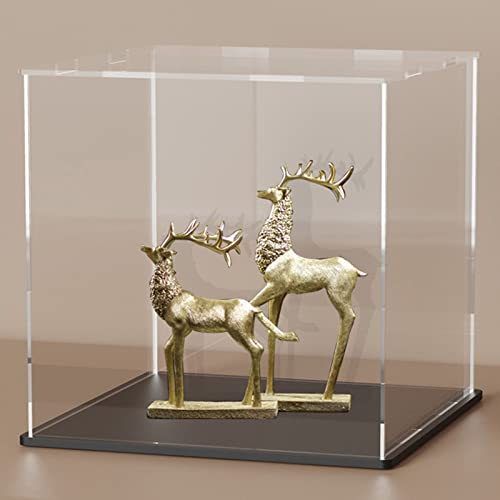
| SVENJBB 6x6x6 Cube | Best for one cabinet-size piece | 1/8 in acrylic, 1/5 in base | One specimen, interior 5.78 in cube | 5.89 in interior | Small cabinet, to about 5.8 in | 7.4/10 |
How I Evaluated These Rock Display Cases
Every pick is scored out of 10 on the six criteria this site uses for every buyer’s guide, re-weighted for what a rock does to an enclosure.
- Build quality: panel thickness, material, closure hardware, load rating.
- Size and fit: interior compartment dimensions against the collector’s size classes.
- Visual appeal: clarity, and whether it reads as furniture or as storage.
- Safety and protection: dust closure, separation, light exposure, panel durability.
- Ease of assembly: assembled out of the box, or a bag of parts.
- Value for money: what it gives you against the tier above it.
The overall score ranks each case as a general-purpose rock display. The SVENJBB cube scores lowest here and it’s still the only one that takes a fist-sized geode half.
I did not physically test these cases. This is a researched, spec-verified evaluation, and that admission carries more weight here than usual. Only one of these six picks has a manufacturer you can look up, and that’s Sona Enterprises, which makes the SE Riker box.
I couldn’t find one independent review of any of the six picks. So specs come from the Amazon Creators API record for each ASIN, and every fit claim is arithmetic you can repeat.
Fit gets measured against the classes collectors already compete under. The Tucson Gem and Mineral Society’s exhibitor handbook puts a thumbnail inside a 1 inch cube, a toe-nail inside 1.5 inches, a miniature inside 2 inches, and a small cabinet piece under 5 inches in any dimension.
The 6 Best Rock Display Cases Reviewed
1. Oqqlin Adjustable 30-Grid — Best Overall
Review
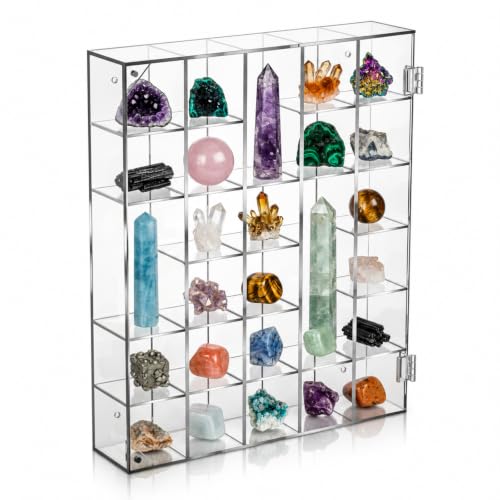
My first choice for a mixed thumbnail-to-miniature collection is the Oqqlin Adjustable 30-Grid, because it publishes the number that decides everything and then beats every other grid case on it. Cells run 2.2 x 2.2 inches, five across and six down, in a 13.8 x 11.6 x 2.4 inch panel weighing 3.37 pounds empty.
Slide a divider out and the two cells behind it open into one bay, wide enough for an arrow-shaped piece, the specimen that usually gets left out of a fixed grid. It hangs on a wall or stands on a desk behind its hinged door. The seller caps a single order at 30 units, the only supply signal a brand with no website gives you.
Overall Ranking and Individual Scores
Overall: 8.8/10
- Build quality: 8.5/10
- Size and fit: 9.5/10
- Visual appeal: 8.5/10
- Safety and protection: 7.5/10
- Ease of assembly: 9.5/10
- Value for money: 9.0/10
Stand-Out Features
- 2.2 inch square cells: the largest verified compartment in this guide.
- Removable dividers: combine cells for a piece that won’t sit square.
- Published 3–5 mm wall: more than almost any competing listing states.
Pros and Cons
Pros
- Biggest verified compartment dimension in the category
- Dividers come out, so the grid adapts to the collection
- Hangs on a wall or sits on a desk, no extra hardware
Cons
- Uncoated acrylic loses to your specimen. Röhm, which makes ACRYLITE sheet, publishes 26.88% haze for uncoated acrylic against 0.23% for plate glass on the Taber test.
- 2.4 inches of depth is a hard ceiling, so nothing at small cabinet size goes in.
- No UV figure is published, and plain acrylic doesn’t filter UV. CCI names Plexiglas UF-5 and Acrylite OP-2 and OP-3 as the grades that do, and ISO 18902 asks framing materials for at least 97% filtering between 300 and 380 nm.
- Wall thickness is published as a 3 to 5 mm range, and CCI’s anti-bowing floor for plastic is exactly 3 mm.
Alternatives
Take the BANLICALI below if the collection outgrows 30 cells, or the FramePro if you want real glass in front of the rock.
2. FramePro Wall-Mount Shadow Box — Best Real-Glass Case
Review
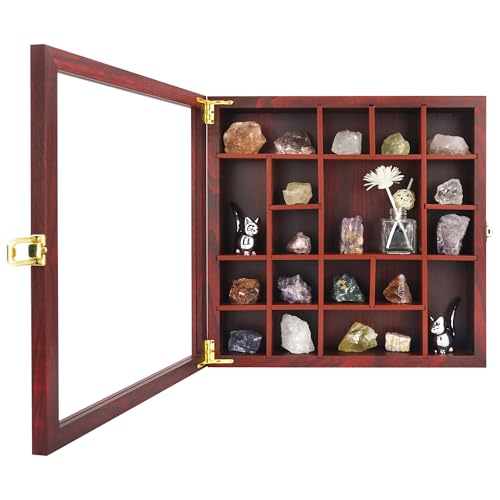
Buy the FramePro Wall-Mount Shadow Box when the display has to read as furniture and the specimens are all different sizes. It’s a cherry-finish solid wood box, 13.5 x 13.5 x 3.2 inches, 5.86 pounds empty, with a hinged real glass door rather than plexiglass. Compartments come pre-divided in assorted sizes, about 19 by the product photo since no count is published, all dividers removable.
Overall Ranking and Individual Scores
Overall: 8.5/10
- Build quality: 9.0/10
- Size and fit: 8.0/10
- Visual appeal: 9.5/10
- Safety and protection: 8.5/10
- Ease of assembly: 9.0/10
- Value for money: 7.0/10
Stand-Out Features
- Real glass door: glass hazes at roughly a hundredth the rate of uncoated acrylic.
- 3.2 inches of interior depth: deepest of the wall-hung picks.
- Assorted pre-divided cells: a mixed collection goes in without reconfiguring anything.
Pros and Cons
Pros
- Real glass rather than acrylic in front of the specimens
- Deepest wall-hung pick in this guide at 3.2 inches
- Compartments already come in several sizes
Cons
- It’s a wood case for a mineral collection, and the conservation guidance runs the other way. NPS documents unsealed wood off-gassing acids that leave powdery coatings on calcareous specimens, called Byne’s disease. Calcite, aragonite, and shell fossils are at risk.
- FramePro claims an “eco-friendly inner coating” and publishes no wood species and no coating spec, so the seal that would make wood safe is the thing you can’t check.
- No compartment dimensions are published anywhere. “Assorted sizes” is the entire spec.
- 5.86 pounds before a single rock goes in, with no mounting hardware rating. Put it on a stud or a rated anchor.
Alternatives
The SmartyRocks Adjustable (SmartyRocks Adjustable Rock Display Case) is the same idea with adjustable divider strips, but its window is plexiglass, which is the trade this pick exists to avoid.
3. BANLICALI 56-Compartment — Best for a Growing Collection
Review
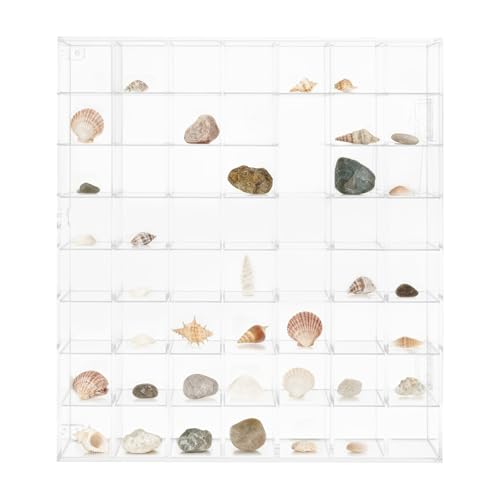
For a collection that keeps arriving, the BANLICALI 56-Compartment absorbs the next two years on one wall panel. It’s 15.35 inches wide and 16.93 tall at only 2.2 inches deep, with 56 cells at 1.97 x 1.97 x 1.97 inches behind a flip-down door. It earns the spot over other high-count panels because BANLICALI rates the case at 33.07 pounds maximum, and NPS guidance is to consult the manufacturer’s weight loads and not exceed them.
Overall Ranking and Individual Scores
Overall: 8.2/10
- Build quality: 8.0/10
- Size and fit: 7.0/10
- Visual appeal: 8.5/10
- Safety and protection: 7.0/10
- Ease of assembly: 9.5/10
- Value for money: 9.0/10
Stand-Out Features
- 56 walled cells on a 15 x 17 inch panel: the most separation per square foot of wall here.
- 33.07 lb published load rating: the only pick in the set that publishes one.
- Removable shelves: pull one and two rows become a single tall bay.
Pros and Cons
Pros
- 56 walled cells, so a hard piece never grinds against a soft one
- Publishes a maximum load figure, which almost nothing here does
- Shelves lift out for a taller specimen
Cons
- The listing’s central claim is contradicted by the people who make the material. The seller writes that the acrylic has “high hardness and excellent wear resistance.” Röhm states it “is not as hard nor as chemically resistant as glass.”
- More compartments buy zero extra specimen size. These cells are 1.97 inches against the Oqqlin’s 2.2, on a bigger panel.
- The 33.07 pound rating covers the whole case, with no per-shelf number, so one shelf of dense pieces puts you outside anything the seller told you.
- One flip door over 56 open cubbies, with no gasket specified. NPS calls settled dust highly abrasive.
Alternatives
The Oqqlin above is the one to take instead if fit matters more than headcount. Smaller panel, bigger cells.
4. SE 16x12x2 Glass Top Riker Box — Best for Shows and Field Trips
Review
Take the SE 16x12x2 Glass Top Riker Box to a club meeting or a gem show and everything is still where you laid it when you arrive. A Riker box is a flat tray packed with polyester fill under a glass lid, and closing the lid presses the fill onto the specimens so nothing shifts. This one is 16 x 12 x 2 inches, closed by two metal clips rather than pins. Two inches matters, because Riker Display Cases publishes depths of 3/4, 1, 1.25, 1.5 and 2 inches and stops there.
Overall Ranking and Individual Scores
Overall: 8.0/10
- Build quality: 7.0/10
- Size and fit: 7.5/10
- Visual appeal: 7.5/10
- Safety and protection: 8.0/10
- Ease of assembly: 9.5/10
- Value for money: 9.0/10
Stand-Out Features
- Glass lid over polyester fill: the fill is compressed onto each specimen when the lid shuts, so the whole display travels as one object.
- 2 inch depth: the deepest the Riker format is made by anyone.
- Two metal clips: a firmer closure than the pins most Riker trays ship with.
Pros and Cons
Pros
- Nothing shifts in transit, so you’re not re-laying the tray on arrival
- Full 2 inch depth, the ceiling for the format
- A named US manufacturer, Sona Enterprises, behind it
Cons
- The body is board and paper by the seller’s own description. Treat it as a travel tray, and don’t expect it to hang on a wall.
- Two inches is the ceiling for the whole format, so a small cabinet piece will never go in a Riker.
- The fill presses down on whatever sits under it. Fine for agate, a real risk for a friable piece, since gypsum is only 2 on the Mohs scale. I’m reading the mechanism here. I didn’t test it.
- No compartments and nowhere to put a label, so every re-arrangement is a full re-lay.
Alternatives
Southern Star Displays makes the same format at 12 x 16 x 2 inches (Southern Star Displays Riker Display Case), pin-secured rather than clipped, with almost nothing published about it.
5. Jucoan 5-Layer 90-Grid — Best Budget and Best for Kids
Review
For a kid’s tumbled-stone and gemstone collection that has outgrown a shoebox, the Jucoan 5-Layer 90-Grid separates 90 specimens in a 9 x 6.5 inch desk footprint for the lowest outlay here. Five drawers, 18 velvet-lined adjustable cells each, 5.25 inches tall.
Divide 5.25 inches across five drawers and you get about 1.05 inches of pitch, before the tray floor, the drawer wall, and the velvet. Usable height lands under the 1 inch thumbnail cube.
Overall Ranking and Individual Scores
Overall: 7.6/10
- Build quality: 6.5/10
- Size and fit: 6.0/10
- Visual appeal: 7.5/10
- Safety and protection: 6.5/10
- Ease of assembly: 9.5/10
- Value for money: 9.5/10
Stand-Out Features
- 90 walled cells in a 9 x 6.5 inch footprint: the most separation per inch of desk here.
- Adjustable velvet inserts: pull a divider and two cells become one.
- Five drawers: sort by locality, by species, or by field trip.
Pros and Cons
Pros
- More separated cells per inch of desk than anything else here
- Dividers move, so a slightly bigger piece still has a home
- Cheapest pick in this guide and light enough for a child
Cons
- The listing contradicts itself on the property that matters. One feature line calls the acrylic “scratch-resistant” and another says to avoid abrasive cleaners to preserve clarity. Röhm’s Taber figures settle which one is true.
- The height arithmetic puts the usable drawer at roughly 1.05 inches, so anything bigger than a tumbled stone sits outside the case.
- The velvet is a dyed textile touching the specimen, and NPS guidance for anything a specimen rests on is to use only materials with no coloring or other additives.
- It’s storage that shows one drawer at a time. Pull a drawer and you see 18 specimens while the other 72 stay in the box.
Alternatives
The Fizocosisto 3-Tier 54-Grid (Fizocosisto 3-Tier 54-Grid) publishes an exact 1.37 x 1.18 inch cell and adds a child-safe lock, though stock was thin when I checked.
6. SVENJBB 6x6x6 Cube — Best for One Cabinet-Size Piece
Review
Every rockhound has one piece that fits nothing. A geode half, a big amethyst cluster, a quartz point the size of a fist. The SVENJBB 6x6x6 Cube is the answer to that specimen and the only pick here that clears the small cabinet line, because it publishes an interior as well as an exterior.
Outside is 6 inches square. Inside is 5.78 x 5.78 x 5.89 inches of clear space, in 1/8 inch acrylic on a 1/5 inch matte black base.
Overall Ranking and Individual Scores
Overall: 7.4/10
- Build quality: 8.0/10
- Size and fit: 9.5/10
- Visual appeal: 8.5/10
- Safety and protection: 5.5/10
- Ease of assembly: 6.0/10
- Value for money: 7.0/10
Stand-Out Features
- Published interior dimensions: 5.78 inches clear in every direction, so fit is a measurement.
- Thickest panel verified here: 1/8 inch walls on a 1/5 inch base.
- Matte black base: kills the reflections that make a clear-base cube look like a lab sample.
Pros and Cons
Pros
- The only pick here that takes a small cabinet specimen
- Publishes interior as well as exterior dimensions
- Thicker acrylic than anything else verified in this guide
Cons
- It ships flat and you assemble it, and the kit tells you why. The seller includes gloves and a cloth to prevent fingerprints during assembly, which admits the panels mark while you handle them.
- 1/8 inch is 3.17 mm, and CCI’s rule is that large plastic panels need 3 mm to avoid bowing. This sits right on that line.
- Acrylic pulls dust toward itself, since CCI notes that acrylics generate static during cleaning, and every wipe that removes it is another abrasion cycle.
- It holds exactly one specimen, the cover lifts off with no latch, and no gasket is specified.
Alternatives
HEMYLU makes the same 6 inch cube in the same 3 mm acrylic (HEMYLU Acrylic Display Case) and publishes a 95% light transmittance figure, but no interior dimension.
How to Choose a Rock Display Case
Five decisions sit between you and the right rock display case. Only one of them is price.
The Five Case Shapes a Rock Collection Goes In
Rock and mineral display cases come in five real forms, and each one answers a different collection’s problem. Listings call them rock collection boxes and crystal display cases more or less at random.
- The vertical acrylic grid panel. Dozens of walled cells behind a door. It’s the same object as the compartment boxes in our diecast display cases guide, with different cell dimensions.
- The wood shadow box with a glass door. Fewer, larger, mixed compartments. Reads as furniture and raises a materials question covered below.
- The Riker tray. A flat board box with a glass top and polyester fill, built to travel, and it won’t hang on a wall.
- The multi-drawer tower. Sorted storage that shows one layer at a time. Cheapest per cell and shallowest per cell.
- The single-specimen cube. One rock, all six sides visible, no compartments.
Two more shapes come up constantly and neither works the way collectors expect. The lit glass curio cabinet is gone, since IKEA discontinued the DETOLF, and the BLÅLIDEN that IKEA names as its successor publishes 7 pounds per shelf. Our statue display cases guide covers that format. A floating wall shelf shows a collection beautifully and seals nothing.
Sizing a Rock Collection Display Case to Your Specimens
Compartment count is the headline number on almost every listing, and it tells you nothing about whether your rocks fit. Compartment dimension does.
Put the two grid picks side by side and the mechanism shows itself. The Oqqlin gives you 30 cells at 2.2 inches. The BANLICALI gives you 56 cells at 1.97 inches on a physically larger panel. Twenty-six more compartments, a quarter inch less cell.
Slice the same face more finely and every piece of it gets smaller, which is why the 90-grid case is usually the one your best specimens won’t go into.
Measure your largest specimen first, then leave room for the label beside it. NPS’s display test for a label is whether it reads without handling the specimen, which sets a minimum cell size of its own.
One more point, and this one’s an opinion. Rock collections grow on a schedule the collector doesn’t set, so buy for today’s count and you’ve bought the month it fills up, which is why removable shelves and stackability deserve real weight.
Acrylic, Glass, Wood, and Aluminum
The case material decides how a rock display ages, and rocks change the usual answer.
Acrylic Rock Display Cases and What Scratching Costs You
Acrylic is what most of this category is made of, and the people who make the sheet document the trade. Röhm’s Taber abrasion figures are 26.88% haze for uncoated acrylic against 0.23% for plate glass. In exchange you get 10 to 20 times the impact strength at half the weight, and shallow scratches buff out of acrylic in a way they never do out of glass. It’s the same sheet our jersey frames guide covers, where the UV-filtering grades matter more than the abrasion does.
Real Glass Cases and the Weight and Breakage Trade
Real glass is harder, holds almost no static charge, and stays clear through years of cleaning. It’s heavier, breakable, and still softer than quartz. Tempered glass carries about four times the breakage strength of annealed glass, though the National Glass Association documents spontaneous breakage as a real risk.
Wood Shadow Boxes and Byne’s Disease
Wood deserves the most thought. CCI’s guidance for mineral collections is blunt about avoiding wood in new display units, because organic acids from wood attack certain mineral ores, with oak and cedar the most acidic species. Sealing the surface is what makes a wood case safe.
Aluminum Compartment Cases for Hand Specimens
Aluminum barely exists on Amazon for this job. SAFE Collecting Supplies publishes interior compartment dimensions including depth, and its 12-compartment aluminum case runs 3.44 x 3.56 x 2.19 inches deep per cell, the only compartment case I found this month sized for a hand specimen. It isn’t a pick here because we aren’t enrolled with that retailer.
Wall-Mounted, Tabletop, or Drawer
Mounting a rock display case is a load question before it’s a taste question.
A rock case gains more weight between empty and full than anything else this site covers. The FramePro is 5.86 pounds empty, and rock is the densest thing that will ever go in it, so the loaded weight is a multiple of that figure with no published hardware rating to check it against.
Adhesive strips won’t carry it. 3M’s limits for Command Picture Hanging Strips top out at 7.2 kilograms with four pairs of the Large size, and 3M separately says they’re not recommended for shadow boxes or shelves. Find a stud or use a rated anchor.
Tabletop and drawer change the calculation completely. A drawer tower like the Jucoan shows one layer at a time, so what you own is sorted storage with a window in it. Open one and 18 specimens are in front of you while the other 72 wait in the dark.
A tabletop pick costs you desk or shelf area and nothing else. There’s no hardware to buy, no stud to find, and no load arithmetic to do. The wall is the only one of the three whose cost is structural.
So take the wall if display area is what you’re short of, the tabletop if you’d rather not drill, and the drawer once the collection has passed the point where everything can be out at once. Our model car display cases guide walks the same decision for a lighter collection.
What a Rock Display Case Costs and Where to Buy One
Rock display case prices run across three tiers before jumping to a different planet. Budget is flat Riker trays, drawer towers, and single cubes, with real closure and shallow cells. Mid-range is the acrylic grid panels where the Oqqlin and BANLICALI sit, and it’s where compartment dimensions start getting published. Upper-mid is wood and real glass like the FramePro, where the money goes into material instead of cell count.
Above that sits museum casework, and iRocks publishes a floor of $8,500 per case delivered and installed.
If none of those tiers fits, NatSCA and the Institute of Conservation recommend clear polystyrene lidded boxes in their geological specimens leaflet, the thumbnail boxes collectors already buy by the dozen.
Amazon sells all six picks here. SAFE sells through its own site, Riker Display Cases sells direct and mostly by the carton, and Etsy and Walmart list the same white-label grid boxes under a rotating set of marks. A gem and mineral show will put more formats in front of you in an afternoon than any listing page will.
How to Display a Rock Collection at Home
Decide first what the arrangement of a rock collection is for. Grouping by locality turns the case into a record of where you’ve been, grouping by species turns it into a reference set, and grouping by size just makes it look tidy. Pick one and stay with it.
Label as you go. Specimens that can’t be written on get a paper label tied on with string, a catalog number in permanent ink on the container, or a Tyvek label in the cell. And don’t wear cotton gloves with rocks. NPS is explicit that gloves make a specimen slippery and that clean bare hands give a better grip, the opposite of the rule for nearly every other collection.
Lighting a Rock Display and Which Minerals Fade
Light is where display and preservation pull against each other. The sunny window ledge that shows a collection off best is the worst place you could put some of it.
Some minerals really do fade. The NatSCA and Icon leaflet names the arsenic sulphides as the most light-sensitive group, including realgar, which converts irreversibly into a powdery orange breakdown product, and it names purple amethyst and green fluorite as minerals that fade in strong light. The Gemological Institute of America backs the amethyst point and adds a second risk, because abrupt temperature changes can fracture amethyst.
Rose quartz is the one nobody agrees on, since CCI lists it among minerals that may fade while GIA calls rose quartz generally stable under light and heat. Keep yours off the window ledge until that argument settles.
LED is the museum answer for the fixture, and CCI’s lamp tables put white LED at 0 to 75 microwatts per lumen of UV against 300 to 600 for daylight, with no heat in the beam. Placement still does more. CCI’s exposure table puts a highly light-sensitive colorant at a just-noticeable fade in five days to two months at 5,000 lux, its example for a window, against 1.5 to 20 years at 50 lux. Moving a case three feet out of the sun beats any UV claim on a listing.
Dust, Humidity, and Whether the Case Really Seals
Dust costs a rock collection more than it costs most collections. CCI says that once a surface like a crystal druse gets dusty it is very difficult and time-consuming to clean, and a druse has no wipeable face at all. The effect is measurable too. CCI’s airtightness bulletin puts an enclosure exchanging its air once a day at about 24% of the dust deposition of the open room, a quarter of what an open shelf collects.
None of the six cases here publishes a gasket spec or an air exchange rate. A hinged door is a cover and a lift-off lid is a dust shield, and neither is a seal in the conservation sense. So judge a case on the closure the seller specifies, and treat the word “dustproof” as marketing.
CCI’s headline case is pyrite, which above roughly 50% relative humidity oxidizes, powders, and liberates sulfuric acid that attacks neighboring specimens and their labels. Humidity is the axis none of these six cases speaks to at all.
NPS targets 45 to 55% relative humidity at 59 to 77°F for a geological collection. CCI also notes that halite liquefies above 75% humidity while borax powders below 50%, so two specimens on one shelf can fail in opposite directions. None of that is the case’s fault, so hang a cheap hygrometer in the room before you shop for a better door, and keep the pyrite on a shelf of its own, which is one more argument for walled compartments.
Displaying Fluorescent Minerals
A closed case can only ever show you longwave fluorescence. The Fluorescent Mineral Society states that shortwave ultraviolet is blocked by most forms of glass or plastic, and that shortwave excites roughly 90% of fluorescent minerals against longwave’s 15%. Glass lid or acrylic lid makes no difference to that, so a product sold as a UV fluorescent mineral display case shows you a slice of what your collection can do.
What works is a 365 nm longwave bar mounted into or beside whichever case you chose. The Sayitwill 365 nm Black Light Bar is a 15-watt aluminum-housed bar with a magnetic mount, linkable in series, and the seller’s note that 365 nm is less visible but more powerful than 395 nm matches the physics. Wear UV-blocking glasses with it. A purpose-built cabinet does exist, the GloBox from MinerShop with a museum-grade OP3 window, but it was backordered when I checked.
Which Rock Display Case to Buy for Your Collection
For most collections of thumbnail and miniature specimens, buy the Oqqlin Adjustable 30-Grid. Its 2.2 inch cells are the largest verified in the category, and the dividers come out when a piece doesn’t cooperate.
For a mixed-size collection that has to look like furniture, the FramePro Wall-Mount Shadow Box gives you real glass and 3.2 inches of depth. The BANLICALI 56-Compartment publishes a load rating nothing else does, and it’s the one for a pile that’s still arriving.
Take the SE Glass Top Riker Box to a show and the fill holds everything in place. For a kid’s collection or a tight budget, the Jucoan 5-Layer 90-Grid separates 90 pieces on a desk corner. And the SVENJBB cube takes the fist-sized geode half that fits nothing else.
Measure the biggest rock first. Then buy the case that takes it, and put it somewhere out of the sun.
Frequently Asked Questions About Rock Display Cases
What is a good way to display rocks?
A good way to display rocks is in a compartmented case with a closing door, grouped by locality or species, labeled so you never pick a specimen up to read it, and lit with LED. Separation matters most, because a hard rock resting on a soft one damages it.
How do you display a large rock collection?
Display a large rock collection by splitting it across formats. Put thumbnail and miniature pieces into a walled grid panel like the BANLICALI 56-Compartment, and give each hand specimen its own cube. No case in this price range takes a 5 inch piece and 50 thumbnails at once.
Are rock collections worth money?
Some rock collections are worth money and most aren’t. Nobody can tell you which yours is from a photograph. The US Geological Survey is direct that rocks and minerals must be examined in person for accurate identification, and it points people to a state survey, a museum, or a local gem and mineral club. Either way, the case that protects a cheap collection protects a valuable one.
Where can you buy a rock display case?
You can buy a rock display case on Amazon, which carries the whole grid-panel and drawer-tower category and sells all six picks in this guide, or direct from specialist suppliers like SAFE Collecting Supplies and Riker Display Cases. A gem and mineral show is the one place you can open one before you buy.
Do rock display cases protect against UV fading?
Almost no rock display case protects against UV fading, and not one of the six cases here publishes a UV figure or names a UV-filtering grade. Plain acrylic isn’t a filter. So treat placement as the control that’s in your hands, and keep realgar, amethyst, and green fluorite out of daylight.
What size compartments do you need for a rock display case?
The compartment size you need is the one that clears your largest specimen’s size class, so shop that dimension and ignore the grid count. Most listings I checked this month cluster around a 1.37 inch cell, which is thumbnail territory. The Oqqlin Adjustable 30-Grid at 2.2 inches square is the biggest verified cell here, and anything over 5 inches needs its own cube.