Article Summary
The best display case for LEGO® sets is the ELEpure 19.7 x 15.7 x 7.9 inch acrylic case, because it publishes an interior measurement. Only two of the seven LEGO® display cases publish an interior figure, and three publish no panel thickness at all. None of the seven names a UV-filtering acrylic grade, and none publishes an air-exchange figure for the open base most cases sit on. I confirmed every pick through Amazon’s product API on September 14, 2026, a spec-and-materials evaluation rather than a teardown. Past about 23 inches long or 15.7 inches tall, a set-specific case or a shelf conversion beats anything generic.
This article contains affiliate links. We earn a commission if you make a purchase, at no additional cost to you. As an Amazon Associate, we earn from qualifying purchases. LEGO® is a registered trademark of the LEGO Group, which does not sponsor, authorize or endorse this site or any product recommended here.
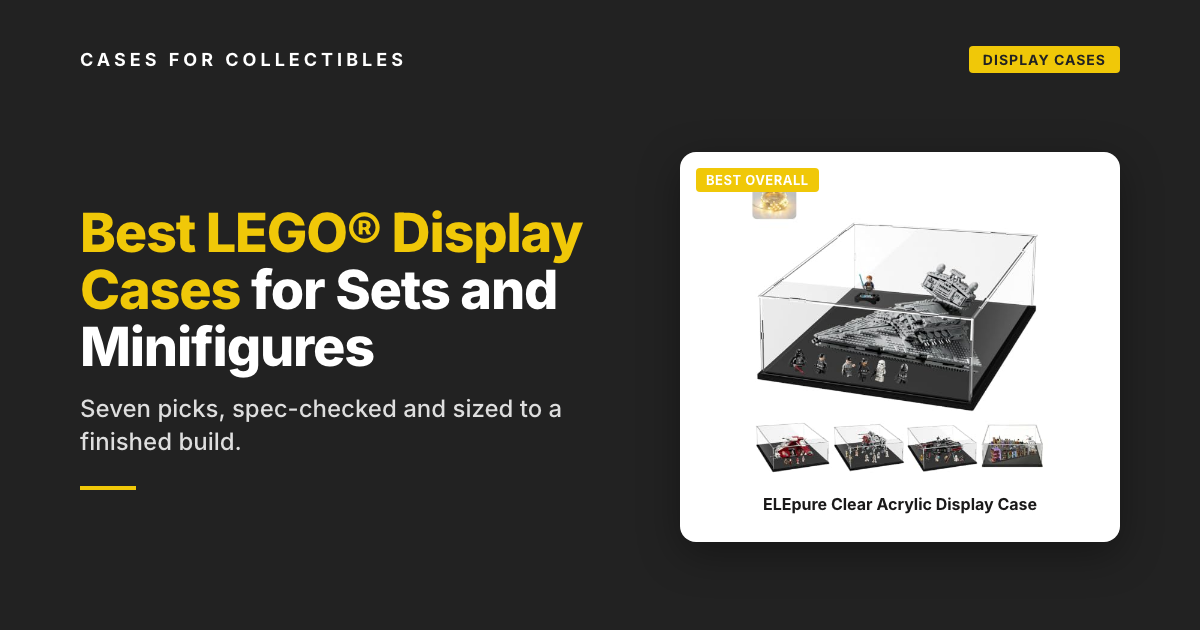
If you want a display case for a finished LEGO® set and you’d rather not read the whole guide, buy the ELEpure 19.7-inch acrylic case. It publishes an interior measurement, so you can size your shelf before you order.
The same listing gives the offset between the inner and outer panels, so the outside size isn’t a guess either. Two of the seven cases here publish an interior figure. The rest print one number and leave you guessing.
Every case below went through the same six criteria and the same spec checks. None was taken apart on a bench. Where a maker publishes a figure I checked it against a standard, and where a maker publishes nothing, I say so.
The 7 Best LEGO® Display Cases at a Glance
Check the table, then read the pick that matches your set. Each overall score is the average of that case’s six criteria scores.
| # | Case | Overall | Material and panel | Published size | Best for |
|---|---|---|---|---|---|
| 1 | ELEpure Clear Acrylic Display Case | 8.5/10 | 3 mm acrylic, wood-plastic base | Interior 19.7 x 15.7 x 7.9 in | A wide, deep finished set |
| 2 | Brickcessories Large Wall-Mount Case | 8.1/10 | 3.0 mm acrylic, metal brackets | 31.42 x 18.11 x 1.97 in, 144 figures | A minifigure wall past 100 |
| 3 | iCUANUTY 360° Wall-Mount Cabinet | 8.0/10 | 3 mm acrylic, maker’s page only | 15.35 x 15.75 x 2.56 in, 60 figures | A growing collection, no flat-pack |
| 4 | Room Copenhagen Minifigure Case, 4 Stud | 7.8/10 | Not published | 7.52 x 1.85 x 7.24 in, 8 figures | Eight favorites, officially licensed |
| 5 | SHIYIJIA 3-Step Acrylic Case | 7.5/10 | “Acrylic,” no thickness | Storage 9.84 x 5.91 x 5.39 in, 35 figures | The cheapest case here |
| 6 | DuvinDD 3-Shelf Case with Sliding Door | 7.3/10 | 3 mm acrylic, wood-composite base | 11.8 x 3.3 x 14.8 in, shelves 4.3 in | Speed Champions and short builds |
| 7 | QIXINDGYH Case for LEGO® 76269 | 7.0/10 | “Scratch-resistant acrylic,” no thickness | None published, set number only | LEGO® 76269 Avengers Tower |
How I Evaluated These LEGO® Display Cases
Nobody handled these cases, so this is a spec-and-materials evaluation rather than a teardown. Twenty-one Amazon listings went into it and seven came out.
I confirmed every pick one listing at a time through Amazon’s own product API on September 14, 2026, which returns the canonical title, brand, structured dimensions, feature bullets and a typed availability state. Amazon’s mobile page renders a whole variation family and has served the wrong variant’s specs before, so it would have put wrong numbers in the table above. Panel thickness then went against ACRYLITE’s published guidance, and UV claims went against the ISO framing bar.
Amazon blocks its review pages and returned no customer-review payload for any of these listings, so there are no star ratings and no “buyers say” lines here. Every con below rests on a published spec, a material property, or a defect in the listing itself.
The six criteria, and what each meant here:
- Build Quality: published thickness, base material, corner joints.
- Size/Fit: interior or exterior figure, and what it holds.
- Visual Appeal: clarity, backing panel, lighting, wasted air.
- Safety/Protection: UV claims against a standard, sealing, wall fixing.
- Ease of Assembly: flat-pack or assembled, tools, scratch risk.
- Value for Money: what the band buys in specs, warranty and reuse.
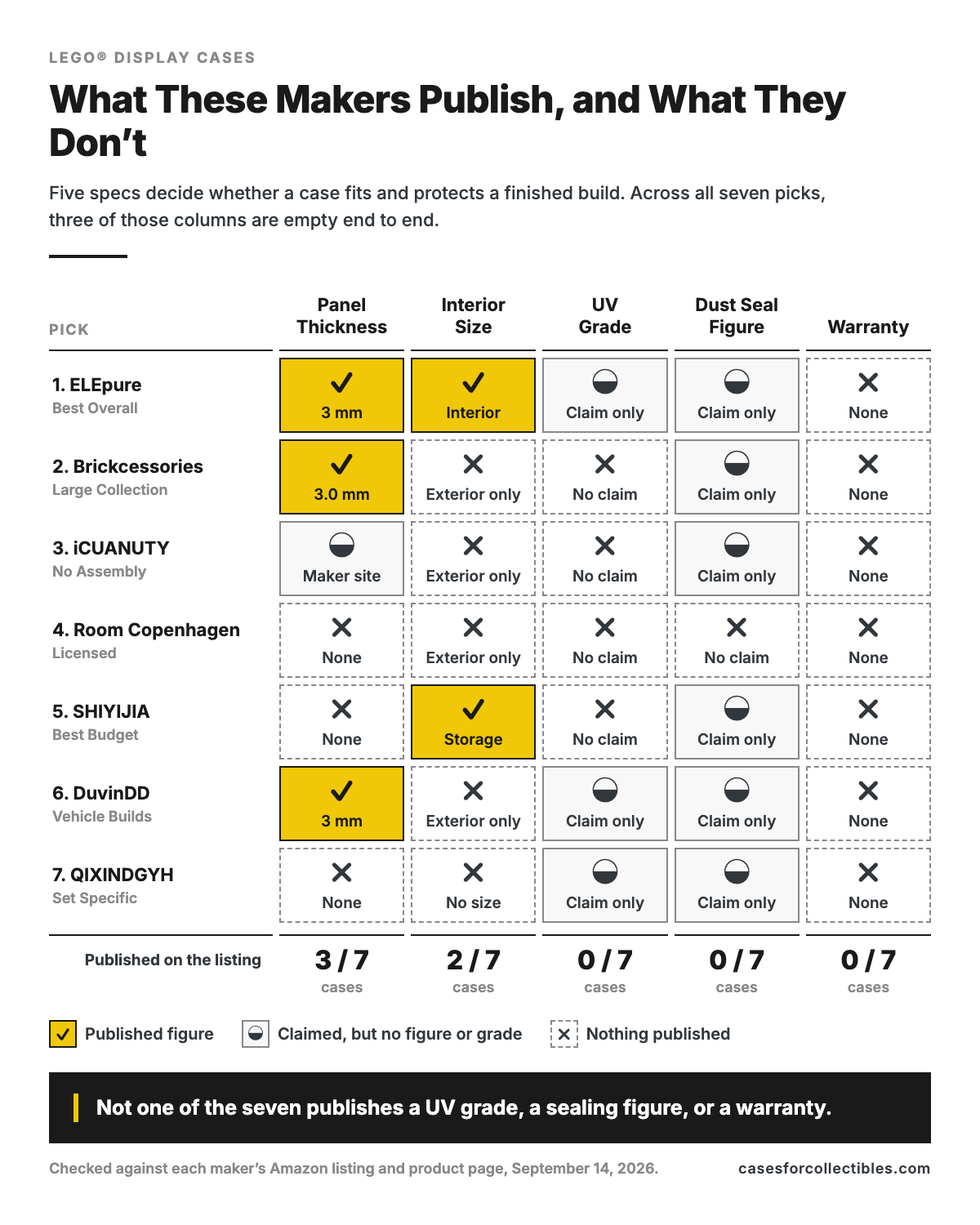
Three of the seven publish no panel thickness anywhere, and a fourth publishes it only on its own site rather than on the listing you’d buy from. Not one names a UV-filtering acrylic grade. Not one publishes a warranty or a sealing figure.
1. ELEpure Clear Acrylic Display Case — Best Overall
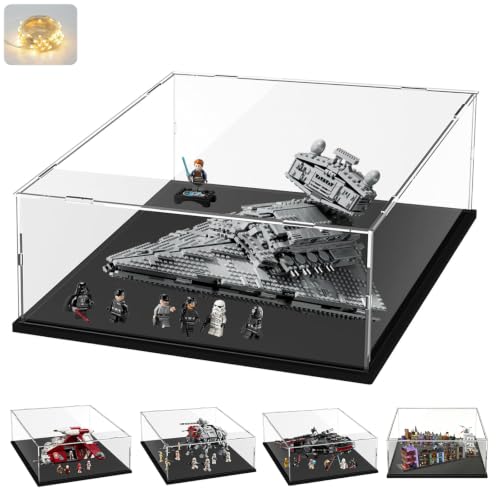
The ELEpure is my first choice for a finished set that’s wider and deeper than it is tall, because it’s one of only two cases here that tells you the inside measurement. ELEpure’s own assembly note says to keep the protective film on both faces until the build is done and to wear gloves, which says a lot about how easily these panels mark.
Overall ranking: 8.5/10
Individual rankings
- Build Quality: 8.5/10
- Size/Fit: 9.5/10
- Visual Appeal: 8.0/10
- Safety/Protection: 8.0/10
- Ease of Assembly: 8.0/10
- Value for Money: 9.0/10
Stand-out features
- Published interior clearance: 19.7 x 15.7 x 7.9 inches inside, with the outer shell 0.8 inches larger every way.
- 3 mm acrylic, wood-plastic base: the largest panel is 2.15 square feet, inside ACRYLITE’s glazing guidance of 1/8 inch up to 12 square feet indoors.
- Stacks: 6.42 lb, light enough to sit on another one.
Pros
- Size a shelf from the listing without guessing
- The roomiest interior I could confirm in stock
- Solid base rather than an open bottom
Cons
- Amazon’s spec box contradicts the listing’s own size bullet, reading 17.3 x 13.4 x 1.57 inches against “19.7 x 15.7 x 7.9 inch Internal.” Size from the bullet.
- “Effectively reduces sunlight and UV radiation” names no acrylic grade and cites no test
- No maker’s site to check the listing against, since elepure.com doesn’t resolve at all
Alternatives: For a longer, lower build like a Technic supercar, the ELEpure 23.6 x 11.8 x 7.9 inch case publishes its interior too.
2. Brickcessories Large Wall-Mount Display Case — Best for a Large Minifigure Collection
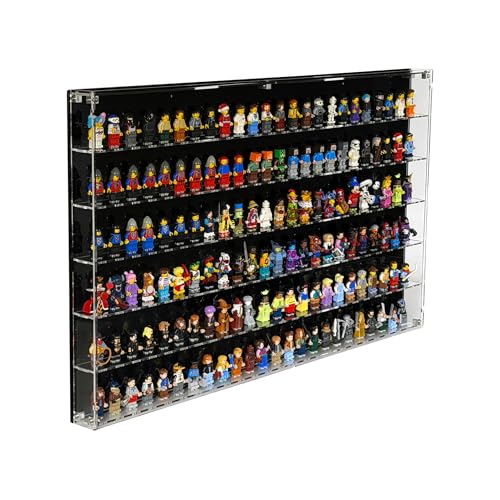
Past about 100 minifigures a shelf stops working and a wall starts making sense, and the Brickcessories wall-mount case is the one I’d put up there. It’s the only maker here that publishes its panel thickness in two independent places.
Overall ranking: 8.1/10
Individual rankings
- Build Quality: 9.0/10
- Size/Fit: 8.5/10
- Visual Appeal: 8.5/10
- Safety/Protection: 8.0/10
- Ease of Assembly: 7.5/10
- Value for Money: 7.0/10
Stand-out features
- 144 figures, 31.42 x 18.11 x 1.97 inches: 7 lb, made in the US, on a glossy black acrylic back panel.
- 3.0 mm acrylic published twice: on the maker’s page and on the Amazon listing.
- Aluminum corner brackets: screwed together where most cases in this class use clips or adhesive.
Pros
- The only thickness figure two sources confirm
- 144 figures is more than double the next-largest wall case here
- Black backing makes small figures read across a room
Cons
- A word of caution on blind-bag figures, because Brickcessories states on its own product page that the case isn’t designed to fit the baseplates they arrive on, and that limit appears nowhere on the Amazon listing.
- Needs studs or real anchors across a 31-inch span. 3M’s Command strip limits reach 7.9 lb (3.6 kg) for two pairs of Large strips, so 7 lb clears them on paper, but the same sheet rules the strips out for shelves and for valuable items.
- Premium band, and the 3.0 mm is nominal. ISO 7823-1 lets that sheet run as low as 2.3 mm across a 31-inch span.
Alternatives: For taller figures with capes and helmets, the Homelodge 40-figure wall case publishes a 3.25-inch figure clearance.
3. iCUANUTY 360° Wall-Mount Cabinet — Best No-Assembly Wall Case
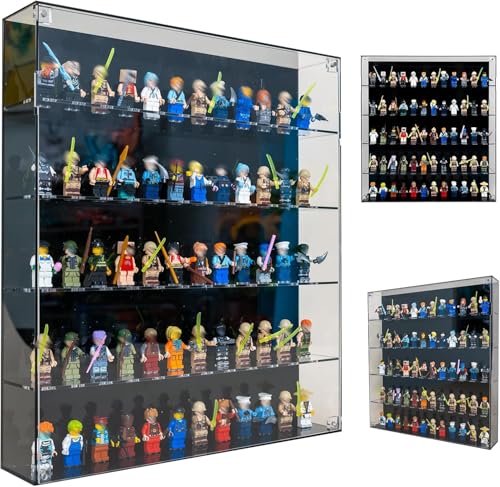
Peeling the protective film off flat-pack acrylic is when panels get scratched, and the iCUANUTY cabinet removes that step by arriving as a single piece. iCUANUTY’s product page also names a 3 mm panel the Amazon listing never mentions.
Overall ranking: 8.0/10
Individual rankings
- Build Quality: 8.0/10
- Size/Fit: 7.0/10
- Visual Appeal: 8.5/10
- Safety/Protection: 8.0/10
- Ease of Assembly: 9.5/10
- Value for Money: 7.0/10
Stand-out features
- 60 figures, 15.35 x 15.75 x 2.56 inches: 5.8 lb, multi-level, on a black acrylic background.
- Ships assembled: no film to peel and no corners to align.
- 360-degree viewing: open from the front, the top and both sides, so back rows stay visible.
Pros
- Ready to hang the day it arrives, with no flat-pack evening
- One of only four picks here with a thickness figure anywhere
- Multi-level shelving keeps 60 figures readable
Cons
- The “requires no assembly, arriving as one piece” claim sits on the Amazon listing alone, and the maker’s own page describes a screw-together structure without repeating it.
- Ships with hooks rather than anchored hardware, which is not enough for 5.8 lb on a wall. 3M’s Command guidance rules out shelf mounting and valuable items, so this one goes into studs or anchors.
- Amazon reports the width as 15.75 inches against the maker’s 15.35. Neither source names a UV grade or a warranty.
Alternatives: Past 60 figures, the Brickcessories 144-figure wall case above is the same idea at more than double the capacity.
4. Room Copenhagen LEGO® Minifigure Display Case, 4 Stud — Best Officially Licensed Case
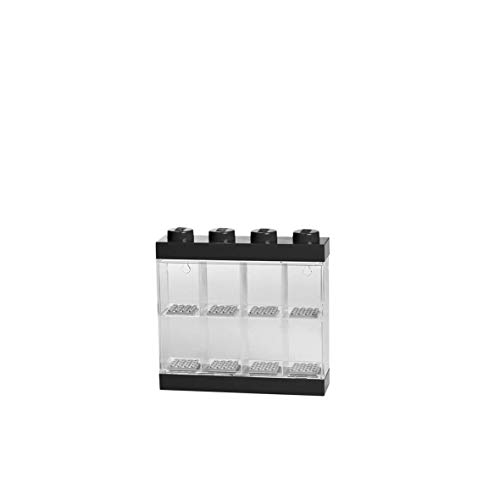
Eight figures on a desk is the job the Room Copenhagen 4-stud case does, and it’s the only genuinely licensed product in the roundup. Room Copenhagen is the LEGO Group’s licensed housewares partner, and the LEGO Group sells this case itself as Display Case 8 – Black.
Overall ranking: 7.8/10
Individual rankings
- Build Quality: 7.5/10
- Size/Fit: 8.0/10
- Visual Appeal: 8.0/10
- Safety/Protection: 6.0/10
- Ease of Assembly: 9.0/10
- Value for Money: 8.5/10
Stand-out features
- 8 figures, 7.52 x 1.85 x 7.24 inches: 0.86 lb, against Amazon’s structured 7.45 x 1.91 x 7.22.
- A baseplate per compartment: figures clutch to studs instead of resting loose.
- Four studs on the lid: units register on each other and stack, on a wall or a desk.
Pros
- The licensed option, sold by the LEGO Group itself
- A knock to the case moves one figure at most
- Budget band, and stacking makes a second unit an upgrade path
Cons
- The weakest spec disclosure in this roundup. Neither the Amazon listing nor the LEGO Group’s own display case range states the panel material, the thickness, a UV claim or a dust-sealing claim, where every third-party pick above at least names a material.
- Eight figures is a hard ceiling, and the fix is buying more units
- The listing and Amazon’s spec box disagree on all three dimensions, with nothing to say which set is real
Alternatives: The Room Copenhagen 16-figure case in Medium Stone Grey doubles the capacity at 15.04 x 7.24 inches. A word of caution there, since stock was down to 16 units when I checked.
5. SHIYIJIA 3-Step Acrylic Minifigure Case — Best Budget
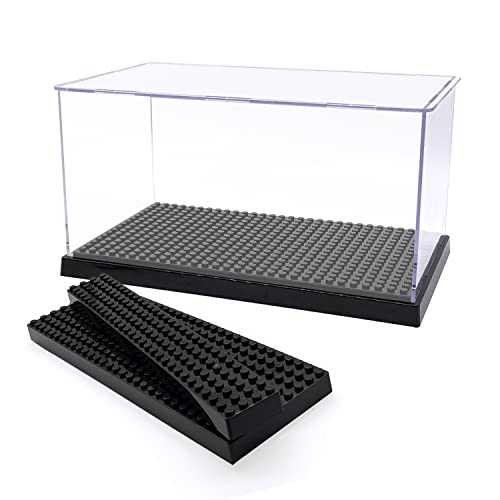
Spend as little as you reasonably can and you land on the SHIYIJIA 3-step case, which is a better landing than the price suggests. Its studded building-block base is what separates it from a plain box, because figures clutch down instead of sliding into a pile whenever the case moves.
Overall ranking: 7.5/10
Individual rankings
- Build Quality: 6.5/10
- Size/Fit: 7.0/10
- Visual Appeal: 7.5/10
- Safety/Protection: 6.5/10
- Ease of Assembly: 8.5/10
- Value for Money: 9.0/10
Stand-out features
- 35 figures, 9.84 x 5.91 x 5.39 inches storage: 1.17 lb, a desk footprint with no wall fixing.
- Three removable steps: tiered so back rows stay visible, and the risers come out for a flat layout.
- A published inside measurement: one of only two picks here that gives you one, once the metric figures are converted.
Pros
- 35 figures on a footprint under 10 inches wide
- A studded base is uncommon at this price
- Light enough to move without dismantling the display
Cons
- The listing’s own unit conversion is wrong. It prints “25 x 15 x 13.7 cm (9.6 x 5.5 x 4.1 in),” but 13.7 cm is 5.39 inches, and Amazon’s structured dimensions confirm the centimeter figures are the real ones. Size from the inch numbers and you understate the height by nearly 1.3 inches.
- No panel thickness is published anywhere, so the spec that decides whether the walls flex can’t be checked
- No wall fixing and no mounting hardware, so it lives on a flat surface
Alternatives: For one build rather than a crowd of figures, the WMM LED case with a magnetic door is a 9.5 x 6 x 7.5 inch case with a door and a light.
6. DuvinDD 3-Shelf Wall Case with Sliding Door — Best for Small Vehicle Builds
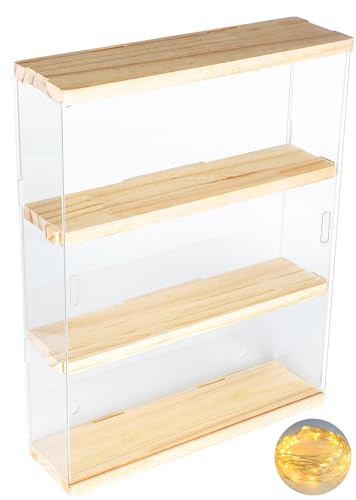
4.3 inches of shelf clearance decides the DuvinDD, and it’s the only per-shelf height any of these seven publishes. Speed Champions cars clear it comfortably. Most figure-scale builds on a stand do not.
Overall ranking: 7.3/10
Individual rankings
- Build Quality: 7.0/10
- Size/Fit: 7.5/10
- Visual Appeal: 8.0/10
- Safety/Protection: 7.5/10
- Ease of Assembly: 7.0/10
- Value for Money: 7.0/10
Stand-out features
- Published shelf height: 4.3 inches, in a case 11.8 long by 3.3 deep by 14.8 inches high.
- 3 mm acrylic, wood-composite lid and base: 2.03 lb, with an LED light string included.
- Sliding door: the only closing door among these seven picks, wall-mounted or standing.
Pros
- Speed Champions cars fit with room to spare
- The sliding door shuts, so dust has one fewer way in
- Light enough at 2.03 lb to mount without heavy anchors
Cons
- A word of caution on the sliding door, which is the panel you touch every day and carries no coating on this listing. ACRYLITE’s Taber abrasion data puts uncoated acrylic at 26.88% haze after 100 cycles, against 1.34% for coated sheet and 0.23% for plate glass.
- 4.3 inches is a hard ceiling. Anything taller doesn’t go in.
- The “much stronger and safer than glass” line holds on impact, at 10x to 20x the impact strength of plate glass, but on scratching the direction reverses
Alternatives: For one small set rather than a row of cars, the ELEpure 15.7 x 7.9 x 7.9 inch case is a closed box with a published interior, though stock was down to 12 units when I checked.
7. QIXINDGYH Display Case for LEGO® 76269 — Best Set-Specific Fit
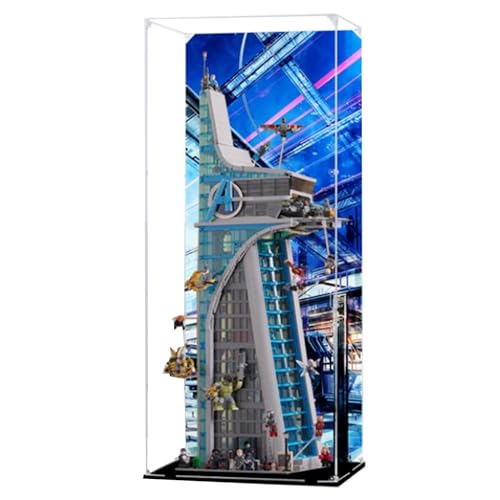
One set justifies the QIXINDGYH case, which is both the whole argument for buying it and the reason it ranks last. LEGO® 76269 Avengers Tower stands over 35.5 inches (90 cm) high, 13 inches wide and 10 inches deep, per the LEGO Group’s own product page, and the tallest generic interior I could confirm in stock was 15.7 inches.
Overall ranking: 7.0/10
Individual rankings
- Build Quality: 6.5/10
- Size/Fit: 9.0/10
- Visual Appeal: 8.0/10
- Safety/Protection: 6.5/10
- Ease of Assembly: 7.5/10
- Value for Money: 4.5/10
Stand-out features
- Cut for one 5,201-piece build: no wasted air on three sides.
- Anti-shake fit: the listing says it “fits the model tightly,” which matters for a top-heavy tower in transit.
- No tools, no glue: the panels seat together, film removed first.
Pros
- The build reads at its real size instead of shrinking inside a box
- The second-highest Size/Fit score of the seven
- No glue, so there’s no 24-hour cure before the build goes in
Cons
- The thinnest spec disclosure of any pick here, at the highest price. Amazon’s structured product-info field comes back empty, no dimensions appear anywhere, and no panel thickness is stated, so you’re trusting a set number.
- A word of caution on shipping, since the listing’s own after-sales bullet concedes that “Acrylic panels may be damaged during transportation,” which is a maker pre-announcing a problem on a premium purchase
- A single-set case has no second life. Rebuild or sell 76269 and it fits nothing, and for the biggest sets a case like this costs roughly half what the set did.
Alternatives: If that ratio kills it for you, the ELEpure 11.8 x 11.8 x 15.7 inch tall case is a generic upright box for tall builds, though it was down to 7 units when I checked.
Are LEGO® Display Cases Worth It?
A display case earns its price when the set sits in daylight or in a room with traffic. It doesn’t earn its price when the set is going back in the box within a year.
Start with dust, because the marketing word is “dustproof” and the measured answer is smaller and more useful. The Canadian Conservation Institute’s Technical Bulletin 38 puts an enclosure at one air exchange per day at a coarse-dust deposition ratio of 24%, so dust settles inside about four times slower than outside. You’ll still dust the build, just far less often.
Light is the stronger argument. LEGO bricks have been made from ABS since 1963, and CCI’s plastics table in caring for plastics and rubbers puts ABS at medium sensitivity to UV and sunlight, with slight discoloration and slight embrittlement as the documented effects.
Acrylic sits a band below, at low. So the brick is more light-sensitive than the box around it. LEGO’s cleaning advice says not to leave bricks in direct sunlight to dry, which is worth hearing from the one company here with no case to sell you.
The base is the panel no product photo ever shows, and it decides whether any of that dust math reaches your build. Most display cases are five-sided boxes standing on an open bottom, so the sixth face is whatever the case is sitting on. Conservators measure sealing as air exchange, and CCI’s bulletin reproduces the bands the US National Park Service set in 1999 and the AIC Wiki updated in 2020. At 0.1 air changes a day a case is very well sealed, 0.3 is well sealed, 1.0 is moderately sealed, and anything above that is unsealed.
Museums Galleries Scotland says what that costs you in its guidance on choosing new display cases, which warns that “Airflow also allows dust to enter, so cases require regular cleaning.” Not one of these seven publishes an air-exchange figure, which makes the base the disclosure gap that matters most. Two picks answer it in the design instead. The ELEpure sits on a solid base rather than an open frame, and the DuvinDD is the only one of the seven whose door shuts.
Where the answer is no. A set you plan to break down and rebuild wants a shelf. A build in a windowless room already has most of the protection a case would give it.
Run that test twice and the question changes shape. A set-specific case for a build like 76269 costs roughly half what the set did, and the collection keeps growing, so the question stops being which case to buy and becomes which of your sets earn one. Most collections have fewer qualifying sets than their owners expect.
Acrylic vs. Glass vs. Plastic Display Cases for LEGO® Sets
Acrylic is the right material for almost every LEGO® display case, and 3 mm is enough for every panel in this size class.
Thickness is a span function. ACRYLITE’s glazing guidance for interior panels gives 1/8 inch (3.0 mm) up to 12 square feet, and the largest panel across all seven picks is the Brickcessories face at 3.95 square feet, so every case here sits inside ACRYLITE’s own guidance.
When one seller advertises 3.0 mm and another 4.5 mm, those are consecutive steps on the same table, and the 4.5 mm step is for interior panels of 12 to 32 square feet.
Then there’s the tolerance. ACRYLITE cast sheet is made to ISO 7823-1, and the published thickness tolerance for cast acrylic lets a nominal 3.0 mm sheet measure 2.3 mm to 3.7 mm.
Per CCI Notes 11/3, glass transmits over 90% of visible light, picks up very little electrostatic charge, and resists scratching better than many plastics. Against it, CCI calls glass heavier than plastic and says it “is sharp, breaks easily, and is a hazard.” The National Glass Association’s Glass Informational Bulletin FB45-14 puts fully tempered glass at about four times the breakage strength of annealed, and still lists spontaneous breakage as a possibility.
ACRYLITE’s acrylic-versus-glass data puts acrylic at 10 to 20 times the impact strength of plate glass, at half the weight, but at 26.88% haze after 100 Taber cycles where plate glass hazes at 0.23%.
Acrylic also holds a static charge that pulls dust toward it. Shallow scratches do come out of acrylic with fine abrasives, and they never come out of glass.
Thin plastic sits below both. Polystyrene is the budget material here, and CCI’s sensitivity table puts it in the same medium band as the ABS brick, so a cheap polystyrene box ages at roughly the rate of the thing it’s protecting.
Now the UV question. Plain acrylic is not a UV filter. CCI names the grades that are, saying “Plexiglas UF-5 has been tested and is recommended for eliminating most UV radiation,” with Acrylite OP-2 and OP-3 as equivalents, and CCI’s Technical Bulletin 32 points to ISO 18902:2007, which asks for at least 97% filtering across 300 to 380 nm.
Not one of the seven cases here names a grade. Three make a general UV claim with nothing behind it, and four make none at all. Read “UV-resistant” as marketing until a grade appears beside it.
Even a genuine UV filter doesn’t stop fading. CCI on light damage is clear that for light-sensitive colors UV usually contributes less than half of the fading and often only a tenth. Moving the build out of the window is the first move and the case is the second. UV-protected display frames put the same grade question to fabric rather than plastic.
How to Size a Display Case to Your LEGO® Set
Take the finished build’s measurements, add an inch of clearance on every side, then work out whether the case’s published number is interior or exterior. That last step is where most of the wrong purchases in this category happen.
ELEpure prints the interior plus the 0.8-inch offset, SHIYIJIA prints a storage size, and everyone else prints an exterior measurement or, in the QIXINDGYH case, nothing at all. An exterior number always overstates what fits.
Size also settles the custom-versus-generic question. LEGO Icons Minas Tirith, set 11377, stands over 23.5 inches high, 24.5 inches wide and 14.5 inches deep according to the Minas Tirith press release.
The roomiest interior by volume was 19.7 x 15.7 x 7.9 inches, the longest single side anywhere was 23.6 inches on a case only 11.8 deep, and the tallest interior was 15.7 inches. So “fits most sets” holds to about 23 inches on the longest side, as long as the build stays low. Over 16 inches tall is off the generic shelf entirely, and Minas Tirith is past all three.
Below those numbers a generic box is the better buy, and above them you’re choosing between a set-specific case and building something. A case cut for one set leaves no wasted air, and wasted air is why a build in a generic box looks smaller than it does on an open shelf.
What a case cut for one set costs you is reuse. Drop to 1/64 or 1/24 and the interior-versus-exterior gap decides the purchase, which is why model car display cases get sized from the inside out.
Wall-Mounted, Shelf, and Tabletop LEGO® Displays
Settle where the case is going before you compare panels. Depth is what sorts wall from shelf. A wall cabinet here is 2 to 3.3 inches deep, which is a minifigure display and nothing more, while a finished set wants 8 inches or better. There’s no wall-mount workaround for a Millennium Falcon.
The wall-capable cases here weigh between 0.86 lb and 7 lb, and every one sits under 3M’s lighter published limit. Command Picture Hanging Strips are rated to 7.9 lb (3.6 kg) for two pairs of Large strips and 15.9 lb (7.2 kg) for four, so weight is not what rules the adhesive route out. The same document does, saying the strips are “Not recommended for mounting shelves” and “Do not hang valuable or irreplaceable items.” A minifigure wall is both, so it goes into studs or proper anchors.
Tabletop is where stacking earns its keep, because the next set is usually already on a wishlist. ELEpure stacks, and the Room Copenhagen units register on each other through the studs on the lid. For small vehicles that wall-or-shelf call comes down to depth, and diecast display cases are the shallow end of it.
The Consumer Product Safety Commission’s 2023 tip-over report counted an annual average of 17,800 emergency-department-treated injuries from tipping televisions, furniture and appliances between 2020 and 2022. Anchor whatever the case sits on to the wall.
Building a DIY LEGO® Display Case or Converting an IKEA Shelf
Build your own case in two situations, and buy in every other one.
Building wins when the set is too big for anything generic. Past about 23 inches on the longest side, or 15.7 inches tall, the market offers a set-specific case at close to half the price of the set, or nothing, and panels cut to size cost a fraction of that.
Building also wins when you’re housing a whole collection at once. An IKEA Kallax gives you openings 30 1/8 inches wide, 15 3/8 inches deep and 16 1/8 inches high, rated to 29 lb per shelf, per IKEA’s own figures for unit 903.015.55. No acrylic box here gives you that much volume per dollar.
Two things about the Kallax route matter more than those numbers. The unit is particleboard and fiberboard with a honeycomb paper filling, and IKEA prints “WARNING! Tipping hazard – this product must be securely anchored” on the same product page, so put the anchor into a wall stud rather than the back panel.
And a Kallax cube is open at the front, so it seals against nothing until you add doors. As a display shelf it’s excellent. As dust protection it’s a bookcase.
The Detolf deserves a specific warning, because it’s still the most-recommended IKEA conversion in LEGO circles and it’s gone from the US range. Its product page returns a 404, and IKEA’s stated successor is the smaller BLÅLIDEN, which carries a 7 lb per-shelf limit and its own anchoring warning.
The joints and the base are where a DIY acrylic box falls down. Edge quality decides the joint, and ACRYLITE’s cementing manual says edges “must be cleanly cut and/or properly machined” and that polishing them “will produce a convex edge with rounded corners and will result in an unsightly, weak joint.”
Cure time runs longer than a weekend assumes, with an initial bond in five to ten seconds and high strength only at 24 to 48 hours. Internal stress also causes crazing, the fine surface cracks that show up when acrylic meets glass cleaner, which ACRYLITE fixes by annealing at 180°F for one hour per millimeter of thickness. Nobody is doing that on a kitchen table.
The base is the second problem, and it applies to bought cases with wooden bases too. CCI’s Technical Bulletin 32 names acidic emission from wood as the main problem with wooden enclosures, and oak and cedar as the worst species. Seal the wood or buy it laminated, because raw plywood or MDF inside a closed box does your build no favors.
So if you can get panels cut to size and you’re covering a big build, build it and keep the savings. Otherwise, buy one.
Which LEGO® Display Case to Buy for Your Situation
For a finished set wider and deeper than it is tall, the ELEpure 19.7-inch case is the one I’d order, because you can size your shelf before the box arrives.
For a minifigure collection past 100 figures going onto a wall, the Brickcessories 144-figure wall case is the strongest build here, as long as your figures aren’t on blind-bag baseplates and you’re mounting into studs.
For Speed Champions cars and short builds, the DuvinDD 3-shelf case publishes the 4.3-inch shelf height behind the one door in this roundup that shuts.
For a single huge build like 76269, the QIXINDGYH set-specific case is the only thing that fits, and it’s worth buying once for a build you’ll leave standing for years.
And if the set is coming apart in six months, or it lives in a room the sun never reaches, keep your money. A shelf and a soft brush will do.
Frequently Asked Questions About LEGO® Display Cases
What is the best display case for LEGO sets?
The best display case for most finished LEGO sets is the ELEpure 19.7 x 15.7 x 7.9 inch acrylic case, because it publishes an interior measurement and the 0.8-inch offset to the outer shell, so you can confirm the fit before buying. It uses 3 mm acrylic on a wood-plastic base and it stacks. For loose minifigures, a multi-compartment wall case is the better shape.
Where can I find a cheap display case for my LEGO sets?
The cheapest verified option here is the SHIYIJIA 3-step acrylic case, which holds 35 minifigures on a studded base for a fraction of what the wall cases cost. Size it from the listing’s 25 x 15 x 13.7 cm, which is 9.84 x 5.91 x 5.39 inches, not the 9.6 x 5.5 x 4.1 inches the listing also prints.
Where can I buy display cases for LEGO sets?
You can buy display cases for LEGO sets from Amazon, which carries the broadest range and is where every pick in this guide is sold. The LEGO Group sells cases on its own store, though every one is a minifigure or Play and Display case. Specialist sellers including Wicked Brick, BrickShell Cases, Brickcessories, iDisplayit, shopPOPdisplays and Kingdom Brick Supply sell direct, several of them cut to individual set numbers. IKEA is the usual start for a shelf conversion.
Does LEGO make display cases for built sets?
No, the LEGO Group doesn’t make a display case for a built set of any size. A direct check of its display cases category found exactly seven products, and every one is a minifigure or Play and Display case.
The closest official product is the Room Copenhagen minifigure case, made by the LEGO Group’s licensed housewares partner. A case for a finished build is a third-party product by definition.
What size display case do I need for my LEGO set?
The display case size you need is your finished build plus about an inch of clearance on each side. Then check whether the listed size is interior or exterior, because most listings publish the exterior and that overstates what fits. Generic cases run to about 23 inches on the longest side and 15.7 inches tall, and past either number you need a set-specific case or a build of your own.
Is a LEGO display case safe in a kid’s room?
A display case is safe in a kid’s room if the furniture under it is anchored and the case sits below climbing height. The cases are light, between 0.86 lb and 7 lb, so the hazard is the shelf or dresser rather than the acrylic. Pick a case with a closing door if small hands are involved. If bigger figures share the room, reach height decides statue and figure cases too.