This article contains affiliate links. We earn a commission if you make a purchase, at no additional cost to you.
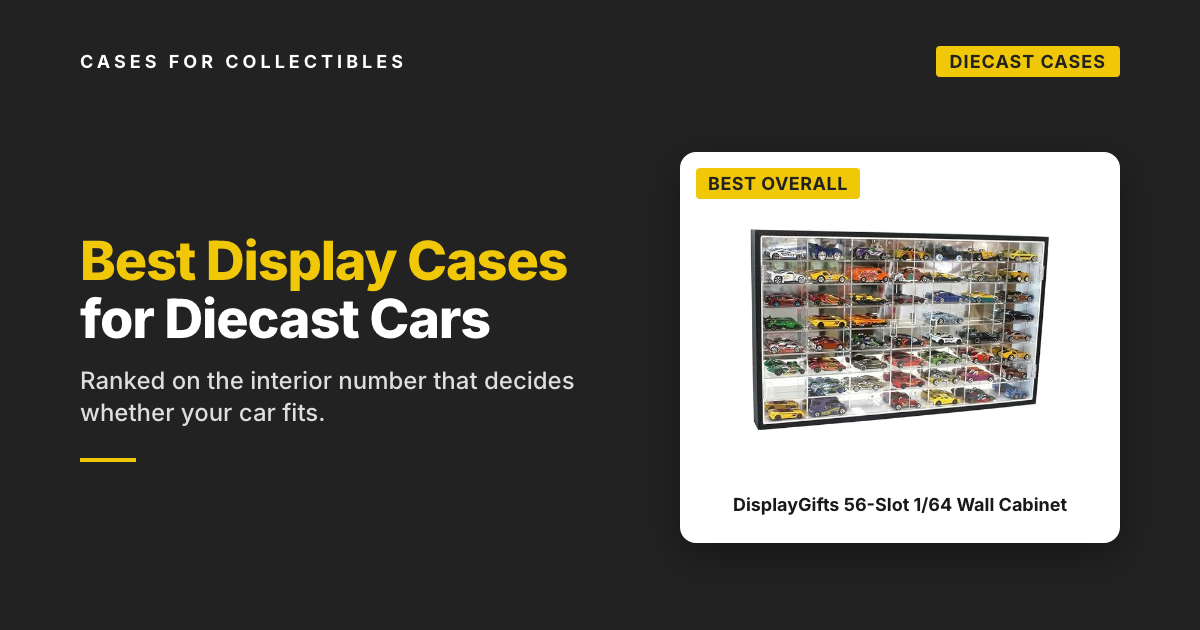
The best display case for diecast cars is the DisplayGifts 56-slot 1/64 cabinet, at a published compartment of 3.25 W x 1.75 D x 1.75 H inches with 98% UV acrylic. The compartment figure decides whether a car fits.
Every display case for diecast cars is sold on a photograph of a full cabinet, and the number that decides whether your car goes in is the compartment behind the door. Listings publish the outside instead and hold back whatever spec decides the purchase. DisplayGifts never publishes its acrylic thickness, and Mascar publishes no material and no UV rating at all. You can read one carefully, order correctly on every figure shown, and still end up with a cabinet your 1/24 car won’t enter.
So this ranking runs on interior dimensions first, then on whether the door closes and whether the panel carries a real UV figure. My first choice is the one that publishes that compartment figure. The other six are sorted by scale and format, from a hardwood 1/18 cabinet that locks to a single-car box Pioneer molds down to 1/64.
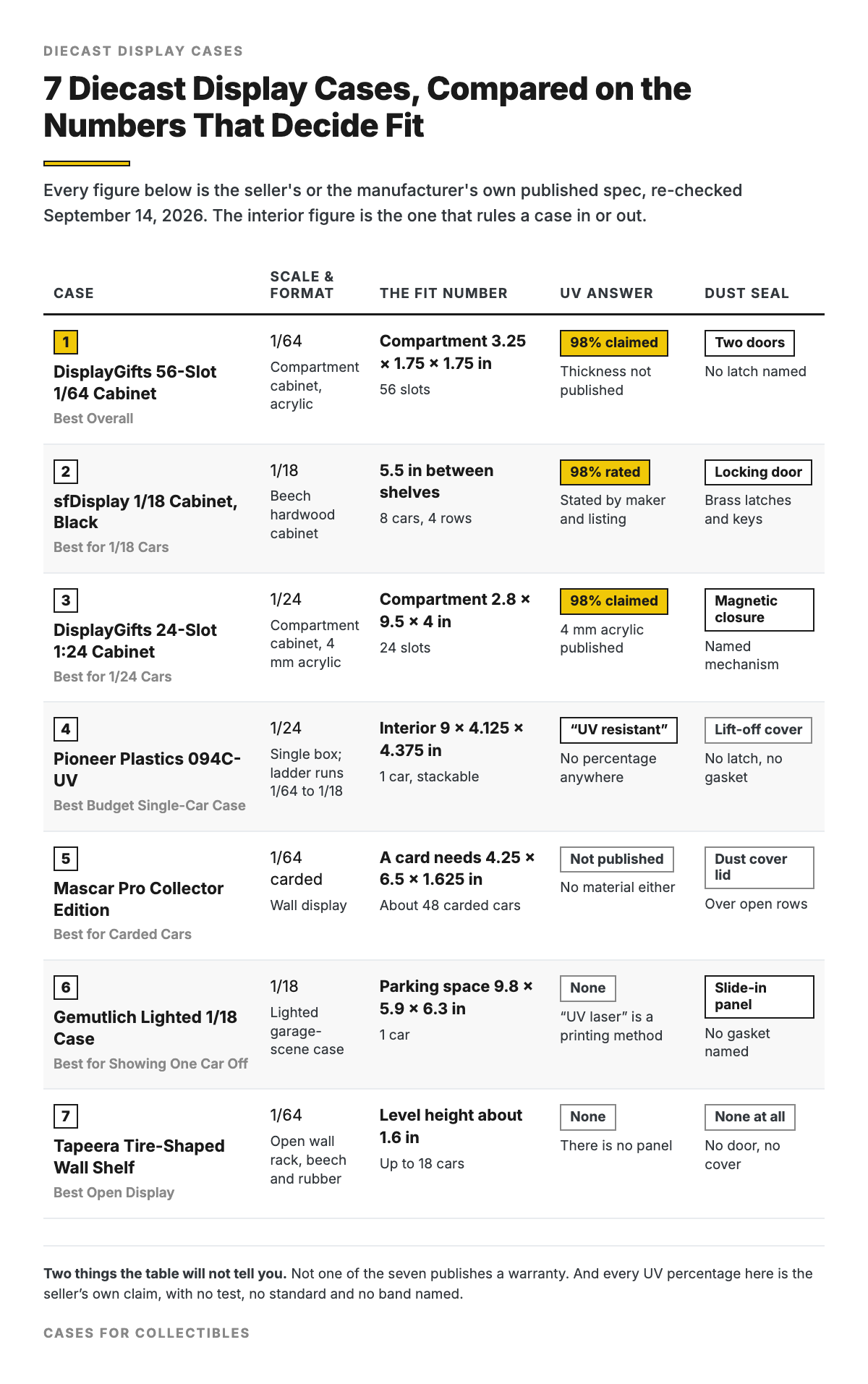
Display Cases for Diecast Cars at a Glance
| Product | Ranking | Scale & Format | The Fit Number | UV & Dust Seal | Best For |
|---|---|---|---|---|---|
| DisplayGifts 56-Slot 1/64 Cabinet | 9/10 | 1/64 compartment cabinet, acrylic | Compartment 3.25 W x 1.75 D x 1.75 H in | 98% claimed; two doors, no latch | 50+ loose 1/64 cars |
| sfDisplay 1/18 Cabinet, Black | 8.8/10 | 1/18 cabinet, beech hardwood | 5.5 in between shelves | 98% rated door; locking latches | Eight 1/18 models, locked |
| DisplayGifts 24-Slot 1:24 Cabinet | 8.6/10 | 1/24 compartment cabinet, 4 mm acrylic | Compartment 9.5 W x 4 D x 2.8 H in | 98% claimed; magnetic closure | Two dozen 1/24 road cars |
| Pioneer Plastics 094C-UV | 8.4/10 | 1/24 single box; ladder runs 1/64 to 1/18 | Interior 9 W x 4.125 D x 4.375 H in | “UV resistant,” no figure; lift-off cover | One prized car, or a stack |
| Mascar Pro Collector Edition | 8.1/10 | 1/64 carded wall display | A card needs 4.25 W x 1.625 D x 6.5 H in | Nothing published; dust cover lid | Hot Wheels kept on the card |
| Gemutlich Lighted 1/18 Case | 7.8/10 | 1/18 lighted garage-scene case | Parking space 9.8 W x 5.9 D x 6.3 H in | No UV; slide-in front panel | One car lit on a desk |
| Tapeera Tire-Shaped Wall Shelf | 7.3/10 | 1/64 open wall rack, beech and rubber | Level height about 1.6 in | None, and no door | The look, dusting accepted |
How I Ranked These Diecast Display Cases
Six criteria decide the order, the same six I use on every case at Cases for Collectibles: build quality, size and fit, visual appeal, safety and protection, ease of assembly, and value for money. Does the clearance match your scale, does the door close, and does the panel carry a UV figure or just the letters?
This is a spec-and-materials evaluation and I’d rather say so plainly.
Every dimension, capacity, material, and UV claim below comes from the seller’s current listing or the manufacturer’s own page, re-checked on September 14, 2026, with stock confirmed through Amazon’s Creators API. Amazon blocks automated access to its review pages and returned no review text for any of the eleven listings I pulled, so six of the seven picks carry no owner feedback. sfDisplay is the exception, publishing named owner reviews on its own site.
Material carries a lot of the scoring. Acrylic is light, clear, and won’t shatter, though the Canadian Conservation Institute’s glazing materials note records that it scratches easily, holds an electrostatic charge that pulls dust onto it, and needs 3 mm of thickness before a large panel bows. The same note calls glass sharp, easy to break, and a hazard, which is why no pick here uses it. Hardwood buys the vintage look and the weight with it, and polystyrene at the cheap end is the weakest.
What Scale You Collect Decides Which Case Fits
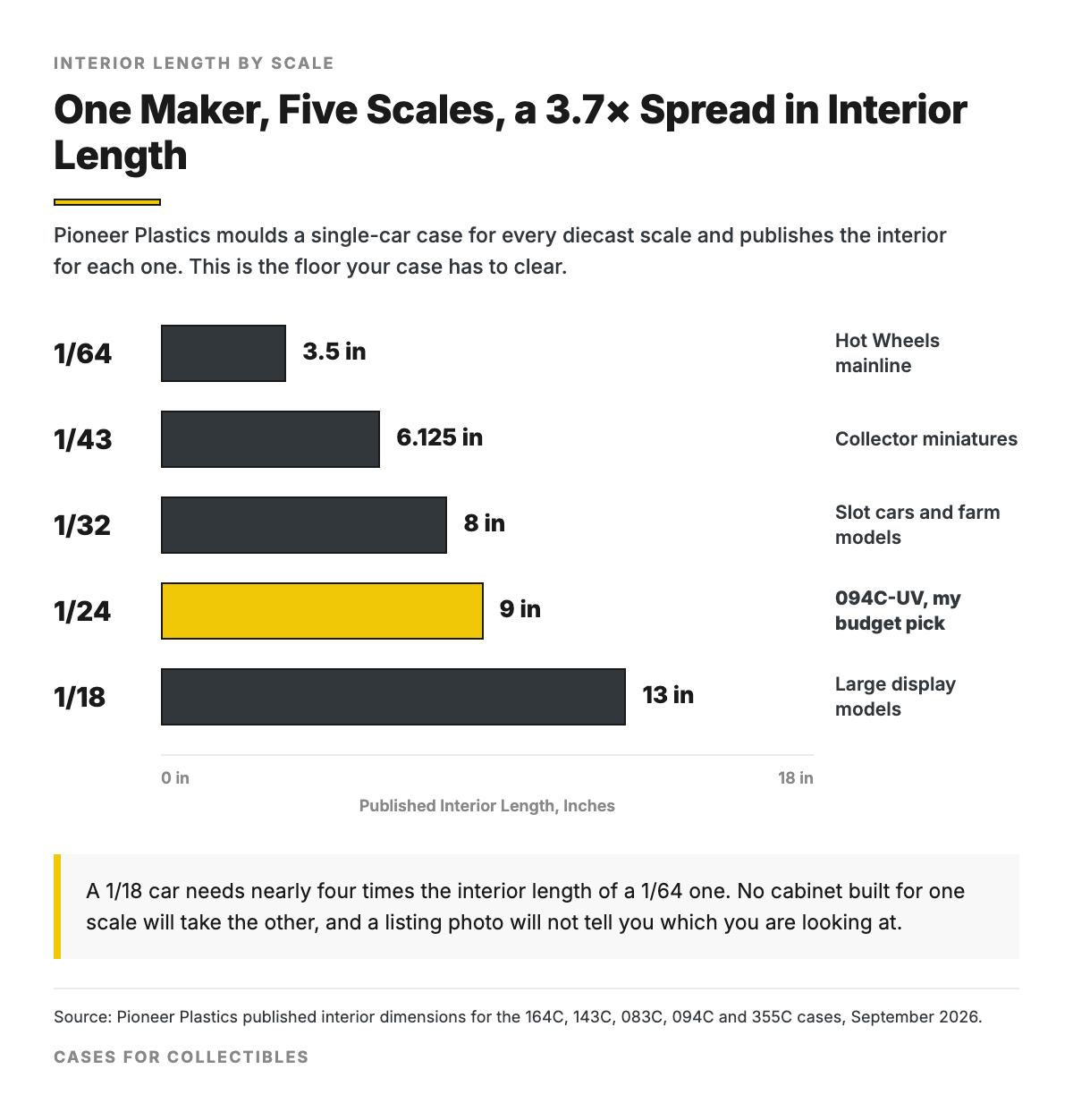
Check the compartment dimension before anything else, because scale rules a case in or out before price, finish, or capacity gets a vote. Pioneer molds a 3.5-inch interior for a 1/64 car and a 13-inch interior for a 1/18 one, and that spread is the whole problem. No cabinet built for one will take the other, and the compartment size is what tells you which is which.
Pioneer Plastics is the only maker here publishing an interior figure for every scale it molds, so its diecast case range is the cleanest sizing reference available.
| Scale | Pioneer case | Published interior (W x D x H) |
|---|---|---|
| 1/64 | Pioneer 164C-UV | 3.5 x 1.625 x 1.75 in |
| 1/43 | Pioneer 143C-BC-UV | 6.125 x 2.625 x 2.25 in |
| 1/32 | Pioneer 083C | 8 x 3.75 x 3.5 in |
| 1/24 | 094C-UV, my pick below | 9 x 4.125 x 4.375 in |
| 1/18 | Pioneer 355C-UV | 13 x 5.5 x 5 in |
Treat that ladder as the floor your case has to clear. If you collect 1/43 or 1/32, those single boxes are the answer, because almost nobody builds a compartment cabinet for either.
Pioneer prints the ladder’s three figures in a different order on its own site than on its listings, so confirm which is the height. And on the 1/32 case the sources disagree, at 3.5 inches of height on Amazon against 3-7/8 inches in Pioneer’s catalog.
A scale isn’t one size either, since Pioneer molds two 1/18 heights at 5 inches and 7 inches. Measure the car you own rather than the scale you collect.
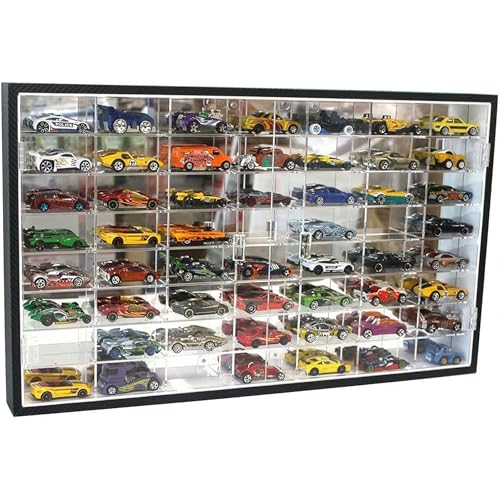
A 56-slot 1/64 cabinet holds Hot Wheels and nothing else, so it quietly sets the scale of everything you buy after it. Moving up a scale costs more wall for fewer cars, since that 56-slot cabinet covers 23.5 x 15 inches while the 24-slot 1/24 cabinet covers 23.9 x 29.4 inches for less than half as many models.
1. DisplayGifts 56-Slot 1/64 Wall Cabinet, Best Overall
Review
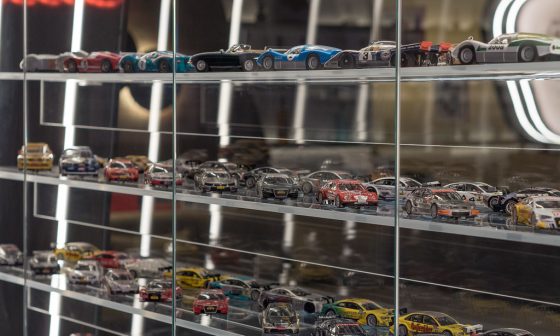
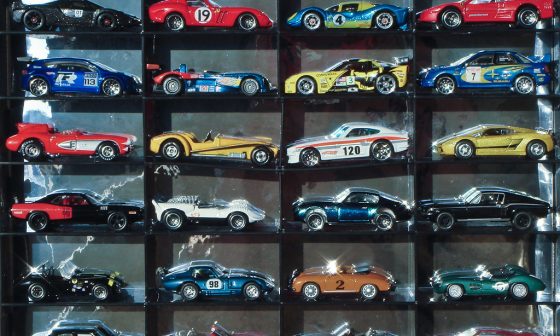
The DisplayGifts 56-slot cabinet is my first choice for a loose 1/64 collection, because it publishes the compartment size and hardly anything else in this aisle does. Each slot is 3.25 inches wide, 1.75 high, and 1.75 deep, a quarter-inch shorter than the 3.5-inch interior Pioneer molds for the same scale, so measure a long casting before you commit. Two doors close over it, and the acrylic is sold as 98% UV protection.
Overall Ranking
9/10
Individual Rankings
- Build Quality: 8.5/10
- Size & Fit: 9.5/10
- Visual Appeal: 8.5/10
- Safety & Protection: 9/10
- Ease of Assembly: 9.5/10
- Value for Money: 9.5/10
Stand-Out Features
- 56 compartments at 3.25 x 1.75 x 1.75 inches (W x H x D), one car per slot
- “High quality UV Protection clear acrylic,” claimed at 98%
- Two center-opening doors with a knob, over a 2-inch interior depth
- Hangs on a wall or stands on a shelf
Pros & Cons
Pros
- Publishes the compartment dimension, which is the figure that decides fit
- 56 slots at a mid-range price, the best cars-per-dollar here
- Ships in one piece, with no assembly stated
Cons
- The acrylic thickness is never published, though the UV percentage is. DisplayGifts prints “4mm thick acrylic” on its 1:24 cabinet and its single-door 1/64 version, so the silence is a choice.
- The listing text calls the case 23.5 x 15 x 2 inches while Amazon’s item-dimension field on the same page says 28 x 14 x 2 inches
- The maker states outright that it won’t fit 1/64 Monster Trucks
Alternatives
The DisplayGifts single-door 56-slot cabinet states 4 mm acrylic at 24 x 14 inches if a published thickness matters more. The sfDisplay 1/64 hardwood cabinet is the premium version, holding at least 60 cars behind locking latches, though its shelves sit 1.5 inches apart.
2. sfDisplay 1/18 Scale Cabinet in Black, Best for 1/18 Cars
Review
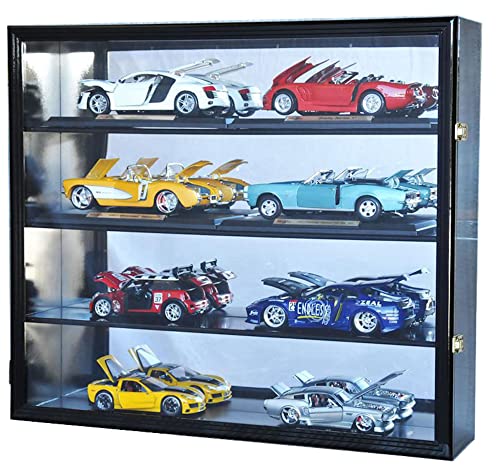
sfDisplay’s hardwood cabinet is the one I’d buy for 1/18 models worth locking up, and it’s the only pick here that takes a key. Inside it measures 23 x 26.5 x 5.5 inches with 5.5 inches between shelves, the clearance a 1/18 casting needs, and four rows hold eight cars. The manufacturer’s page and the Amazon listing publish identical figures, and the sfDisplay 1/18 hardwood cabinet arrives fully assembled.
Overall Ranking
8.8/10
Individual Rankings
- Build Quality: 9.5/10
- Size & Fit: 9/10
- Visual Appeal: 8.5/10
- Safety & Protection: 9.5/10
- Ease of Assembly: 9/10
- Value for Money: 7/10
Stand-Out Features
- Interior 23 x 26.5 x 5.5 inches (H x W x D), with 5.5 inches between shelves
- Four rows holding eight 1/18 models, in a unit weighing 25 pounds
- Australian beech hardwood frame, mirrored back, and a 98% UV protection rated door
- Locking brass latches with keys, shipped assembled with a mounting kit
Pros & Cons
Pros
- The only pick in this group that locks
- Every published figure agrees across two independent sources
- Ships assembled, so the job is mounting it
Cons
- The screws in the box aren’t enough for 25 pounds of hardwood. On sfDisplay’s own product page, owner William Bereczky says the case “is too heavy for the drywall screws provided” and swapped in anchors rated to 75 pounds. Another owner, Jim, found the hangers on the back “would not accept any type of screws heads.”
- Jim also couldn’t fit his cars on the shelves with their base plates attached, though the listing photos show them fitted
- Eight cars for premium money, and the mirrored back isn’t optional. Bereczky calls the reflections in it distorting.
Alternatives
If slot count beats the lock, the DisplayGifts 1:18 12-slot cabinet runs the same 4 mm acrylic and 98% UV claims across 12 compartments.
3. DisplayGifts 24-Compartment 1:24 Wall Cabinet, Best for 1/24 Cars
Review
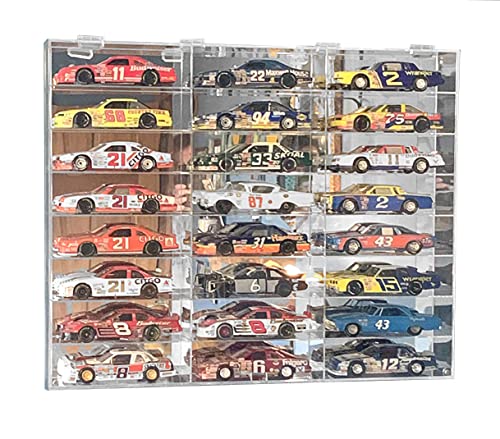
For 1/24 cars the DisplayGifts 1:24 Wall Cabinet is the only compartment cabinet here publishing a panel thickness and a named closure together. Its 24 slots each measure 2.8 inches high, 9.5 wide, and 4 deep, the acrylic is 4 mm and sold as 98% UV protection, and a magnetic closure holds the door shut against dust. It’s the premium end of this market.
Overall Ranking
8.6/10
Individual Rankings
- Build Quality: 9/10
- Size & Fit: 8/10
- Visual Appeal: 9/10
- Safety & Protection: 9/10
- Ease of Assembly: 9/10
- Value for Money: 7.5/10
Stand-Out Features
- 24 compartments, each 2.8 x 9.5 x 4 inches (H x W x D), over a 4-inch inside depth
- Exterior 23.9 x 29.4 x 4.25 inches (H x W x D), at about 24.6 pounds
- “Super clear 98% UV protection Acrylic,” made with 4 mm thick acrylic
- Magnetic door closure, mirrored background, and pre-drilled mounting holes
Pros & Cons
Pros
- The only pick publishing a UV percentage and a panel thickness together
- A named closure mechanism rather than a door that rests shut
- Both dimension sets printed on one listing, exterior and compartment
Cons
- The seller won’t promise the cars fit. Its own bullet reads “24 slots to hold most other 1:24 scale cars! Might not fit all. Please measure you cars.” No maker publishes a 1/24 casting length to check that against, not Lionel Racing, which holds the NASCAR die-cast license, and not the official NASCAR store. Even Pioneer, the one maker here printing interiors, gives its NASCAR 1:24 cases the same 9 inches as its general 1:24 box.
- About 24.6 pounds going onto a wall through pre-drilled holes, with no anchor rating named anywhere
- Premium money for 24 cars
Alternatives
Nothing else here covers 1/24 as a compartment cabinet, so the alternative is the single-box route. A Pioneer 094C plain box per car gives 9 x 4.125 x 4.375 inches inside, over an inch more height than these 2.8-inch compartments, though half an inch narrower.
4. Pioneer Plastics 094C-UV, Best Budget Single-Car Case
Review
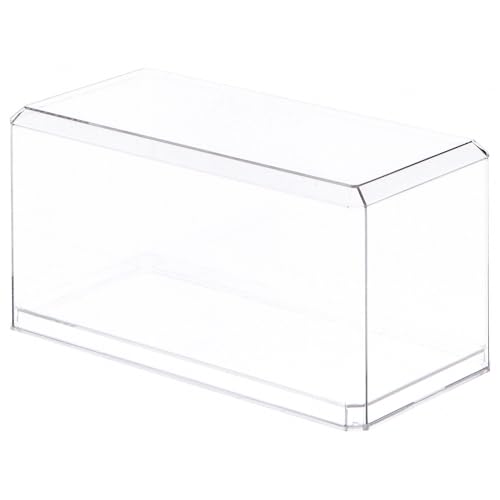
If you own three prized models rather than 60, the Pioneer Plastics 094C-UV Case is the honest recommendation, and it costs a small fraction of any cabinet on this page. One car, one box, an interior of 9 x 4.125 x 4.375 inches, and it stacks. Pioneer molds the same case in every scale from 1/64 to 1/18.
Overall Ranking
8.4/10
Individual Rankings
- Build Quality: 7/10
- Size & Fit: 9.5/10
- Visual Appeal: 7/10
- Safety & Protection: 7.5/10
- Ease of Assembly: 10/10
- Value for Money: 9.5/10
Stand-Out Features
- Interior 9 x 4.125 x 4.375 inches (W x D x H) as the Amazon listing labels it, holding one 1/24 car
- Stackable, so a shelf of them grows with the collection
- Sold in a UV-treated version alongside an untreated one, molded in the USA
Pros & Cons
Pros
- The only maker here publishing an interior figure for every scale it sells
- The only way to buy one car’s worth of case, at the lowest price on this page
- Nothing to assemble and nothing to mount
Cons
- Pioneer says “UV resistant” and never says how resistant, where DisplayGifts and sfDisplay both publish 98%. It sells the protectant as a separate line of SKUs, so the cheaper 094C is an untreated box.
- The material is polystyrene, which the Canadian Conservation Institute rates high sensitivity to UV and sunlight, with discoloration and embrittlement as the damage. Several Amazon URL slugs for these cases say “Acrylic.” They aren’t.
- A lift-off cover over a base, with no door, gasket, or latch, and 1/64 cases are hard to buy singly because Pioneer sells that scale in 6-packs
Alternatives
At 1/64 the Pioneer 164C 6-pack is the cheapest per-car protection here, with one caution the maker prints itself: those cases carry a visible mold mark on top.
5. Mascar Pro Collector Edition, Best for Carded Cars
Review
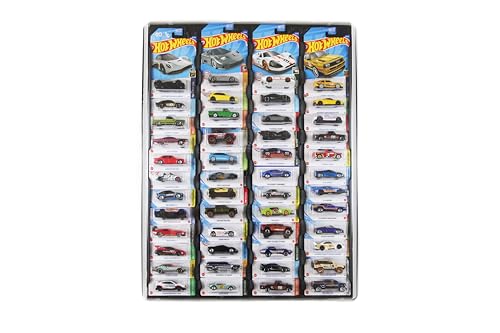
Cars kept sealed on the card are a different purchase, and the Mascar Pro is the one pick built for it. It’s a 26 x 20-inch display holding roughly 48 carded cars flat against the wall, it ships with a clear dust cover lid, and it needs no assembly. Buy it if your Hot Wheels and Matchbox stay in their packaging.
Overall Ranking
8.1/10
Individual Rankings
- Build Quality: 6.5/10
- Size & Fit: 8.5/10
- Visual Appeal: 8.5/10
- Safety & Protection: 7/10
- Ease of Assembly: 10/10
- Value for Money: 7.5/10
Stand-Out Features
- 26 x 20 inches, holding 48 to 50 unopened cars on a wall
- Supplied with a clear dust cover lid over the rows
- No assembly, and compatible with most standard Hot Wheels and Matchbox packaging
Pros & Cons
Pros
- The only format here serving a mint-on-card collection
- Arrives ready to hang with the dust cover in the box
- Card capacity published by the maker, along with the caveat that moves it
Cons
- For a product whose whole job is protecting printed cardstock, Mascar publishes no material, no thickness, and no UV figure anywhere. I checked its own site and both Amazon listings.
- Capacity moves with your cards, since Mascar’s own line is “capacity may vary depending on blister card size” and oversize cards eat the count.
- A cover over open rows rather than a sealed cabinet, and Mascar’s other listing for the same product contradicts itself, with a title reading 48 to 50 cars and bullets reading 65
Alternatives
Measure a card first. Carney Plastics publishes the inside space of its protector for a standard carded Hot Wheels at 4.25 inches wide, 6.5 high, and 1.625 deep. Mascar’s Ultima display and Tapeera’s acrylic carded 5-pack were both out of stock.
6. Gemutlich Lighted 1/18 Case, Best for Showing One Car Off
Review
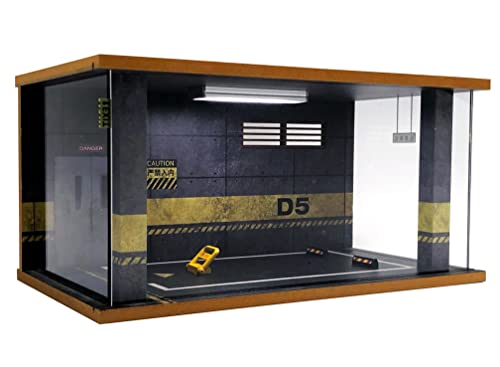
One 1/18 model on a desk, lit from the ceiling and staged against a printed garage backdrop, is what the Gemutlich Lighted 1/18 Case is for. The parking space inside measures 9.8 W x 5.9 D x 6.3 H inches, the exterior is 14.1 x 8.2 x 7, and the acrylic front panel slides in and out.
Overall Ranking
7.8/10
Individual Rankings
- Build Quality: 7.5/10
- Size & Fit: 7.5/10
- Visual Appeal: 9.5/10
- Safety & Protection: 7/10
- Ease of Assembly: 7/10
- Value for Money: 8/10
Stand-Out Features
- Parking space 9.8 W x 5.9 D x 6.3 H inches, inside an exterior of 14.1 x 8.2 x 7 inches
- Holds one 1/18 diecast car or one 1/12 motorcycle
- Ceiling-mounted LEDs over a printed garage backdrop, behind a sliding acrylic front panel
Pros & Cons
Pros
- Publishes both its exterior and its parking space, which is the figure that decides whether a 1/18 casting fits
- LED lighting is the safe kind for an enclosed case, with no heat in the beam
- The one pick that makes a single car look staged rather than stored
Cons
- The word “UV” on this listing means nothing protective. It appears once, in “the picture for back panel and ceiling are pringted by UV laser,” describing how the backdrop was printed. No UV rating and no panel thickness is published.
- Every specification comes from the seller’s listing, because Gemutlich has no manufacturer website to check it against
- 9.8 inches of interior length leaves little margin for a long 1/18 casting, assembly is required, and the LEDs need a socket nearby
Alternatives
For 1/24 cars the kivcmds 1:24 lighted scene does the same job across three tiers at 15.5 x 9.2 x 14.9 inches. It repeats the “UV laser printing” wording too, so the phrase is a category habit.
7. Tapeera Tire-Shaped Wall Shelf, Best Open Display
Review
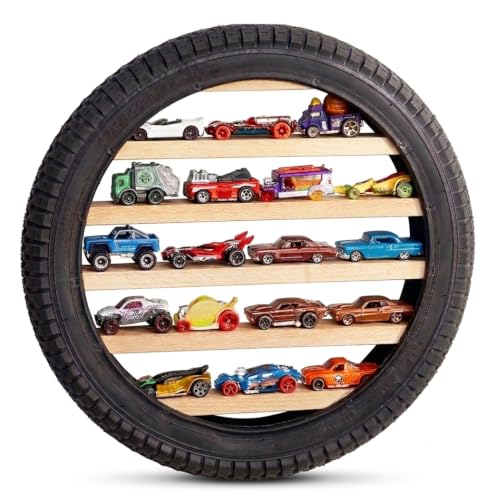
An open rack and a sealed cabinet are two different purchases, and the Tapeera Tire-Shaped Wall Shelf is squarely an open rack. Five beech wood slabs sit inside a 16-inch rubber wheel, holding up to 18 1/64 cars with about 1.6 inches of clearance per level. It ranks seventh because it has no door and no cover, so it does nothing to slow dust. Buy it knowing exactly that.
Overall Ranking
7.3/10
Individual Rankings
- Build Quality: 7.5/10
- Size & Fit: 7.5/10
- Visual Appeal: 9/10
- Safety & Protection: 4/10
- Ease of Assembly: 9.5/10
- Value for Money: 7/10
Stand-Out Features
- Five levels of solid beech wood inside a 16-inch rubber wheel, about 16 x 16 x 2.1 inches
- Holds up to 18 model cars at 1/64 scale, at a published level height of about 1.6 inches (4 cm)
- Ships ready to hang on a hook fixed to the back
Pros & Cons
Pros
- The maker publishes the level height, which decides fit on an open rack
- Ready to hang out of the box, with no hardware to source
- The only pick where the display itself is part of the display
Cons
- No door and no cover, so dust settles at the full room rate. The Canadian Conservation Institute notes that dust on metal “can contain salts and particulates that are hygroscopic and cause local corrosion.”
- The rubber wheel smells strongly out of the box. Tapeera says so itself and recommends leaving it in the sun to speed the odor up. Don’t. The CCI’s guidance for plastics and rubbers is to avoid all exposure to UV and sunlight.
- Vulcanized rubber sits against painted metal here, and the CCI records that degrading rubber gives off sulfur oxides that turn acidic in humid air
Alternatives
There’s no closed version of this shape worth recommending. For covered cars, the DisplayGifts 56-slot cabinet at the top does the same wall for a similar spend and three times the capacity.
Wall Cabinets, Acrylic Boxes, and Carded Displays
Diecast cases come in three formats. A wall-mounted compartment cabinet is the answer for volume, since it turns a wall into storage and display with a door in between. An acrylic box suits a handful of models, and it’s the only format that scales one car at a time. A carded wall display serves collections that never leave the packaging.
Capacity is where the cabinets separate. Fifty-six 1/64 cars fit inside 23.5 x 15 inches of wall, about a small picture frame, while 56 1/24 cars would need most of a wall. That’s why the 1/24 cabinet holds 24 and the 1/18 cabinet holds eight. Bigger exists, since Carney Plastics builds 108-car and 144-car 1/64 cabinets and Collecting Warehouse sells by the carton of 12.
Price splits the same way. Single boxes are the budget tier at a few dollars each, which is why they ship in 6-packs at 1/64. Cabinets, lighted cases, and open racks sit in the middle, and hardwood cabinets and carded displays are the premium end, where you pay for the lock, the finish, and the assembly.
A glass display case for diecast cars is rare at this size because glass is heavy, sharp, and breaks, so the vintage look comes in hardwood. For an oversize 1/18 that no compartment takes, taller acrylic display boxes are the better search.
UV Protection and Fading on a Diecast Display
Four different UV answers sit across these seven picks, and a product photo won’t distinguish them.
- A rated percentage. DisplayGifts and sfDisplay both publish 98%.
- A word with an upcharge behind it. Pioneer says “UV resistant” and sells the treatment as a separate line.
- Silence. Mascar publishes nothing.
- Two letters about printing. Gemutlich uses “UV” for how its backdrop was printed.
Even a real percentage needs reading carefully. Röhm’s ACRYLITE knowledge base says standard acrylic grades filter about 90% of UV between 200 and 390 nanometers, while against real sunlight general-purpose sheet “only filter out a small amount of the UV-light present in solar radiation.” Its UV-filtering sheet absorbs roughly 98%. The band a panel is scored over is what lets both statements be true. The Canadian Conservation Institute names the grades that genuinely filter, Plexiglas UF-5 and Acrylite OP-2 and OP-3, but no pick here names one.
Filtering UV doesn’t stop fading either. The CCI’s light and UV guidance is blunt about it, since for colors sensitive to light “UV usually contributes less than half of the fading and often only one tenth.” Visible light does the rest, so placement is the lever you control. The same source puts a just-noticeable fade on a sensitive colorant at 1 day to 2 weeks in average daylight, 5 days to 2 months beside a window, and 1.5 to 20 years at around 50 lux.
Fading matters most on a carded car. Baked enamel over zinc alloy holds up. The printed cardstock behind it doesn’t, and the CCI’s paper guidance records that UV’s main damaging effect on paper is “yellowing, weakening, chalking and/or disintegration of media.” A mint-on-card display is a paper-protection job, so the UV rating on the front panel is worth more than anything behind the car, the same way UV-protected acrylic panels matter on a framed jersey.
How to Display a Diecast Collection and Keep the Dust Off
Keep the case off a windowsill, away from a radiator, and out of a bathroom. An interior wall at eye level beats a sunny wall, and grouping by scale beats grouping by color.
Dust is the daily job, and a door is what reduces it. The CCI’s airtightness bulletin grades an enclosure at one air exchange a day as moderately sealed, 0.3 as well sealed, and 0.1 or less as very well sealed, and at that rate coarse dust still settles inside at about a quarter of the outside rate. So a closed cabinet slows dust roughly fourfold, but none of these stops it.
The CCI’s metals guidance gives a seal test you can run at home, where a well-sealed enclosure is one you can’t slip a sheet of paper into at any joint.
Lighting is the easier call. White LED emits 0 to 75 microwatts of UV per lumen, which the CCI’s light and UV tables rate very low and mark as needing no UV filter, against 300 to 600 for daylight, and it puts no heat into the beam. So the LED upcharge buys visibility rather than protection, and mirrored backs, diorama panels, and rotating spinners are the same sort of buy.
Mounting matters too, since the 1/24 cabinet weighs about 24.6 pounds and the sfDisplay unit 25, and neither publishes an anchor rating. Anchor into studs or use rated drywall anchors, because in the U.S. Consumer Product Safety Commission’s 2023 tip-over report, 1,000 of the 6,400 annual furniture tip-over injuries to children involved shelving or a bookcase.
Which Diecast Display Case to Buy for Your Scale
For a loose 1/64 collection, the DisplayGifts 56-slot cabinet is my pick, and the published compartment size is why.
Two readers should ignore that. Hot Wheels sealed on the card won’t go into a compartment cabinet, so the Mascar Pro is the only pick built for them. If you own three prized models rather than 60, Pioneer single boxes in the right scale beat any cabinet here.
Most of us go looking for a case once the collection outgrows a shelf and a shoebox. Measure the car you own first. Everything after that is a preference.
Frequently Asked Questions About Display Cases for Diecast Cars
How do you display diecast cars?
You display diecast cars in a case sized to their scale, out of direct sunlight, with a door between them and the room. Compartment cabinets suit loose collections of 20 cars and up, acrylic boxes suit a few favorites, and carded displays suit anything still packaged. For loose 1/64 cars the DisplayGifts 56-slot 1/64 cabinet covers the most cars in the least wall. Building your own works too, as long as the box closes and clears your tallest casting.
Are display cases worth it for diecast cars?
A display case is worth it if the cars are kept rather than played with, and it isn’t if they aren’t.
Dust on painted metal carries salts that cause local corrosion, sunlight fades paint and cardstock, and neither reverses. If your cars are loose play pieces in a toy box, a case is decoration. If they’re mint on the card, boxed, rare, or meant to last, it’s the cheapest protection you’ll buy. Mattel reported Hot Wheels and Matchbox billings of $1,995 million in full-year 2025, up 11%.
What is the best way to store diecast cars for long-term storage?
The best way to store diecast cars long term is dry, dark, and unstacked. Zinc-alloy corrosion needs moisture to start, so humidity matters more than temperature, and the Canadian Conservation Institute’s metals guidance puts metals comfortable below about 55% relative humidity and at risk above 65%. Keep cars off each other so paint doesn’t transfer, use a card protector for anything carded, and don’t seal degrading plastics or rubbers in an airtight bag.
What size display case do you need for 1/18 scale cars?
A 1/18 car needs about 5.5 inches of interior depth and roughly 13 inches of length, which is why 1/18 cases are larger than they look in a photo. Pioneer publishes 13 x 5.5 x 5 inches inside its Pioneer 355C-UV single box, and the sfDisplay 1/18 Hardwood Cabinet runs 5.5 inches between shelves. Pioneer’s oversize 1/18 molding runs 15.5 x 7 x 6 inches inside.
How do you display Hot Wheels that are still on the card?
Carded Hot Wheels go on a display built for the card, because a compartment cabinet is sized for a loose casting and a blister card won’t go in. A standard mainline card needs about 4.25 inches wide, 6.5 high, and 1.625 deep, the published inside space of Carney Plastics’ protector. The Mascar Pro carded display holds 48 to 50 of them flat on a wall under a clear dust cover. Premium and oversize cards run larger, so the count drops.