
Article Summary
The best display case for pocket watch collection buyers is the one whose interior opening clears 48 mm. Dueber’s 3 x 4 inch glass dome publishes 70 mm of interior width, which makes it the pick for one watch. The FindingKing 83-1CBK glass-top case holds 8 to 20 watches in drop-in trays with 79 x 86 mm compartments. The widely repeated 3 to 3.5 inch opening describes the outside of a small dome, not the hole a watch sits in. Size a pocket watch display case by the number of watches owned, because stacked watches scratch each other.
This article contains affiliate links. We earn a commission if you make a purchase, at no additional cost to you.
For one watch that matters, my pick is the Dueber 3 x 4 inch glass dome. If you own more than four watches, go straight to the FindingKing glass-top case, because no dome will hold your collection.
The opening the watch sits in decides whether a pocket watch display case fits, and most listings publish only the outside of the glass. eBay’s pocket watch display case category tells shoppers that an opening of 3 to 3 1/2 inches fits most watches, and Google’s AI summary repeats the range. The published interiors are smaller.
Dueber’s 3-inch dome gives you 70 mm of usable width, which is 2.76 inches, and Plymor’s gives 2.75. A current production hunter case measures 48 mm. So I ranked these seven cases on the numbers their makers publish.
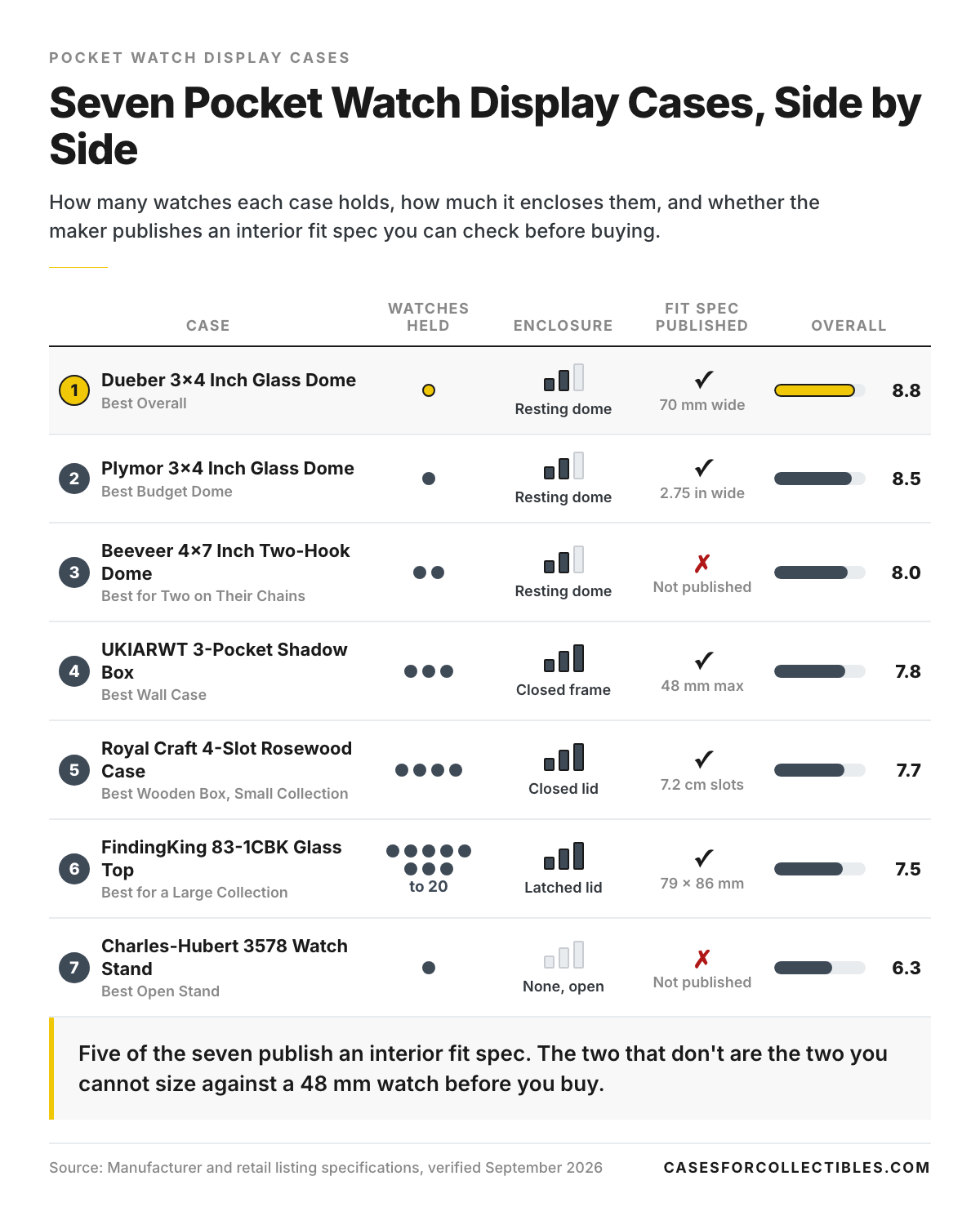
The 7 Best Pocket Watch Display Cases at a Glance
| # | Case | Best for | Format | Holds | Interior opening | Overall |
|---|---|---|---|---|---|---|
| 1 | Dueber Watch Co 3 x 4 Inch Glass Dome | One treasured watch | Glass dome | 1 | 70 mm wide, 80 mm max height | 8.8/10 |
| 2 | Plymor 3 x 4 Inch Glass Dome | Checking fit on paper | Glass dome | 1 | 2.75 x 3.875 in, arches at 2.5 in | 8.5/10 |
| 3 | Beeveer 4 x 7 Inch Two-Hook Dome | A pair on their chains | Tall glass dome | 2 | Not published (4 in exterior) | 8.0/10 |
| 4 | UKIARWT 3-Pocket Shadow Box | Three watches on a wall | Wall shadow box | 3 | Up to 1.89 in (48 mm), 1.18 in deep | 7.8/10 |
| 5 | Royal Craft Expertise 4-Slot Rosewood | Four watches, flat | Hinged-lid box, wall or tabletop | 4 | 7.2 x 7.2 cm slots, 7 cm deep | 7.7/10 |
| 6 | FindingKing 83-1CBK Glass Top Case | A growing collection | Glass-top showcase | 8 to 20 | 79 x 86 mm compartments | 7.5/10 |
| 7 | Charles-Hubert, Paris 3578 Stand | A watch you carry | Open stand | 1 | Not published | 6.3/10 |
How I Evaluated These Pocket Watch Display Cases
Nobody has physically tested these seven pocket watch display cases, including me, and I’d rather say so than fake a teardown. The category has no lab tests, no specialist reviews, and no per-product owner reviews I could reach in a citable form. So the ranking rests on published manufacturer and listing specs, checked against the maker’s own page where one exists, plus conservation evidence from the Canadian Conservation Institute and Icon, the Institute of Conservation, and format-level reports from NAWCC collectors.
I score each case on the six criteria this site uses for any display case.
- Build quality: materials and construction, and what the maker won’t state.
- Size and fit: interior opening, slot dimensions, depth, and headroom.
- Visual appeal: how the case shows the watch, and from which angles.
- Safety and protection: dust seal, UV figure, glazing, and lock.
- Ease of assembly: what arrives built and what you have to mount.
- Value for money: cost per watch against what it protects.
Every percentage on a listing here is the seller’s own claim rather than a tested figure, and I’ve flagged them that way.
What Size Opening a Pocket Watch Display Case Needs
The number that decides fit is the diameter of the cased watch, and it lands around 48 mm. A pocket watch’s traditional size, 18s or 16s or 12s, gives the diameter of the movement’s pillar plate, which you never see once the case is shut. Pocket Watch Database puts an 18-size movement at 44.87 mm and a 16-size at 43.18 mm, and then the case goes around it. Charles-Hubert, Paris publishes 48 mm for its current hunter cases, and two purpose-built wall cases from unrelated sellers, UKIARWT and WLFUJIN, cap their listings at the same figure of 1.89 inches.
So 48 mm is the number to check against, and here’s how the published interiors compare.
- Dueber’s 3 x 4 inch dome: 70 mm (2.76 in) of interior width, with an 80 mm ceiling on hanging height.
- Plymor’s 3 x 4 inch dome: 2.75 x 3.875 inches inside, arching in at about 2.5 inches of height.
- A purpose-built wall case: 48 mm maximum diameter, in 1.18 inches of depth.
- Royal Craft’s rosewood box: 7.2 cm (2.83 in) square slots, 7 cm deep.
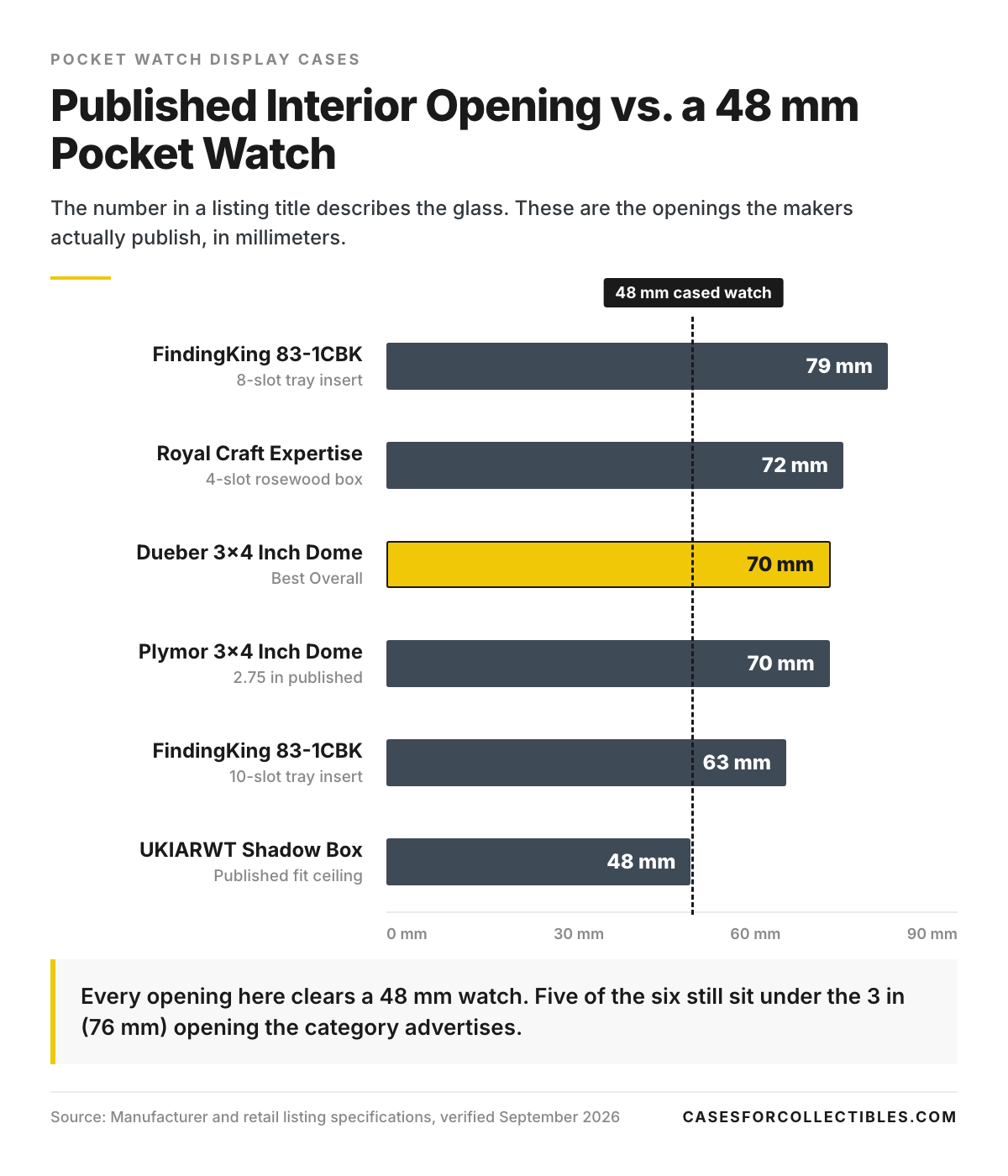
All of those clear a 48 mm watch, but none has a 3 to 3.5 inch opening, because that range describes the outside of a small dome rather than the hole the watch goes into. Every time I open one of these listings, the number in the title is the glass, and the glass takes an eighth of an inch a side.
Two more measurements decide real purchases and rarely show up in a spec table. A hunter case propped open needs clearance for its lid, which is why 1.18 inches of wall-case depth won’t do it. And the chain has to go somewhere, which is what Plymor’s published 3 inches of hook drop is telling you. It’s the same discipline that decides model car display cases, where a case that fits 1/64 cars won’t take 1/18.
Match the Display Format to How Many Watches You Own
Four display formats cover pocket watch collections, and the count you own rules most of them out before taste gets a vote.
Pocket Watch Glass Domes and Cloches for One or Two Watches
A glass dome or cloche holds one watch hanging from its bow, or two if the dome is tall and carries a second hook. It’s what collectors reach for when one piece matters most.
Wooden Pocket Watch Boxes with a Hinged Lid
A hinged-lid wooden box holds four to 12 watches laid flat under a closed lid, and it’s the format that also sells as a pocket watch storage box. This format gets it wrong most often, because almost every box at this capacity was designed for wristwatches. Lifomenz’s 12-slot box publishes a large pillow of 2.9 by 2 by 1.6 inches, which is a 2-inch-wide cylinder shaped to hold a strap open, and a 48 mm cased watch trailing a chain has nowhere to sit on one. Royal Craft’s 7.2 cm square slots, at pick 5 below, are what the same box looks like when it was drawn around a round case.
Pocket Watch Wall Display Cases and Shadow Boxes
A wall shadow box or cabinet takes three watches in a small frame or a few dozen in a deep custom case. On the NAWCC board, bkerr describes one holding about 30 watches, screwed to the wall, with a second still needed.
Open Pocket Watch Display Stands
An open stand holds one watch, shows it from both sides, and protects it from nothing. It suits a watch you wind and carry, and on a skeleton or double-glass case it’s the only format that puts the movement and the dial on show at once.
If you own 20 watches and came here for a dome, the dome is the wrong buy. Size a multiple pocket watch display case by its slot count, because 12 slots bought for 20 watches means stacking, and stacked watches rub each other in exactly the spot the case was meant to protect.
1. Dueber Watch Co 3 x 4 Inch Glass Display Dome (Best Overall)
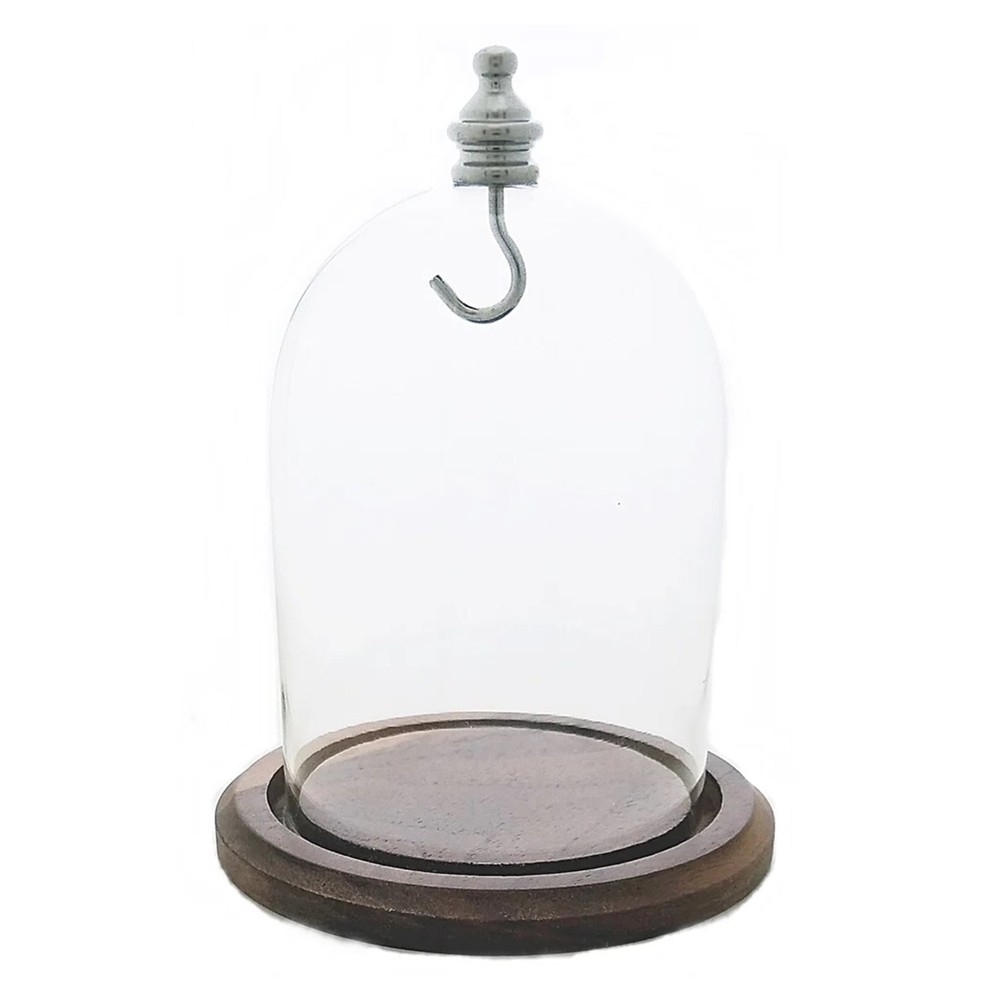
The Dueber dome is my first choice because its maker tells you what fits before you spend anything. The Dueber Watch Co 3″x4″ Pocket Watch Glass Display Dome publishes 70 mm of interior width and an 80 mm ceiling on hanging height. A 48 mm hunter case clears that width by about 11 mm a side, and the height figure covers the bow and pendant that make a hanging watch taller than its case alone.
Overall Ranking: 8.8/10
Individual Rankings: Build Quality 9/10 · Size and Fit 10/10 · Visual Appeal 9/10 · Safety and Protection 7/10 · Ease of Assembly 10/10 · Value for Money 8/10
Stand-out features
- 70 mm interior width: the usable number, published on Dueber’s product page.
- 80 mm maximum watch height: the only height ceiling published in this category.
- Solid walnut base: Dueber states it isn’t particle board, unlike the MDF bases elsewhere here.
Pros
- Interior width and maximum watch height both published before you buy.
- Hand-blown glass over solid walnut, assembled in America.
- Lift the dome, hang the watch, replace the dome. No tools.
Cons
- You lose about a quarter of an inch a side to the glass. The label says 3 inches and the usable width is 70 mm.
- No dust seal, no UV figure, no lock. It’s a glass lid on a walnut disc, and it does nothing about light, humidity, or theft.
- Finish availability moves around. The wood-knob version reads sold out on Dueber’s own store while sitting in stock on Amazon.
Alternatives: the Dueber Watch Co 3″x4″ Dome with Wood Knob has identical numbers. Dueber’s 3 x 4.5 inch size raises the ceiling to 92 mm but isn’t on Amazon today.
2. Plymor 3 x 4 Inch Watch Glass Display Dome Cloche (Best Budget Dome)
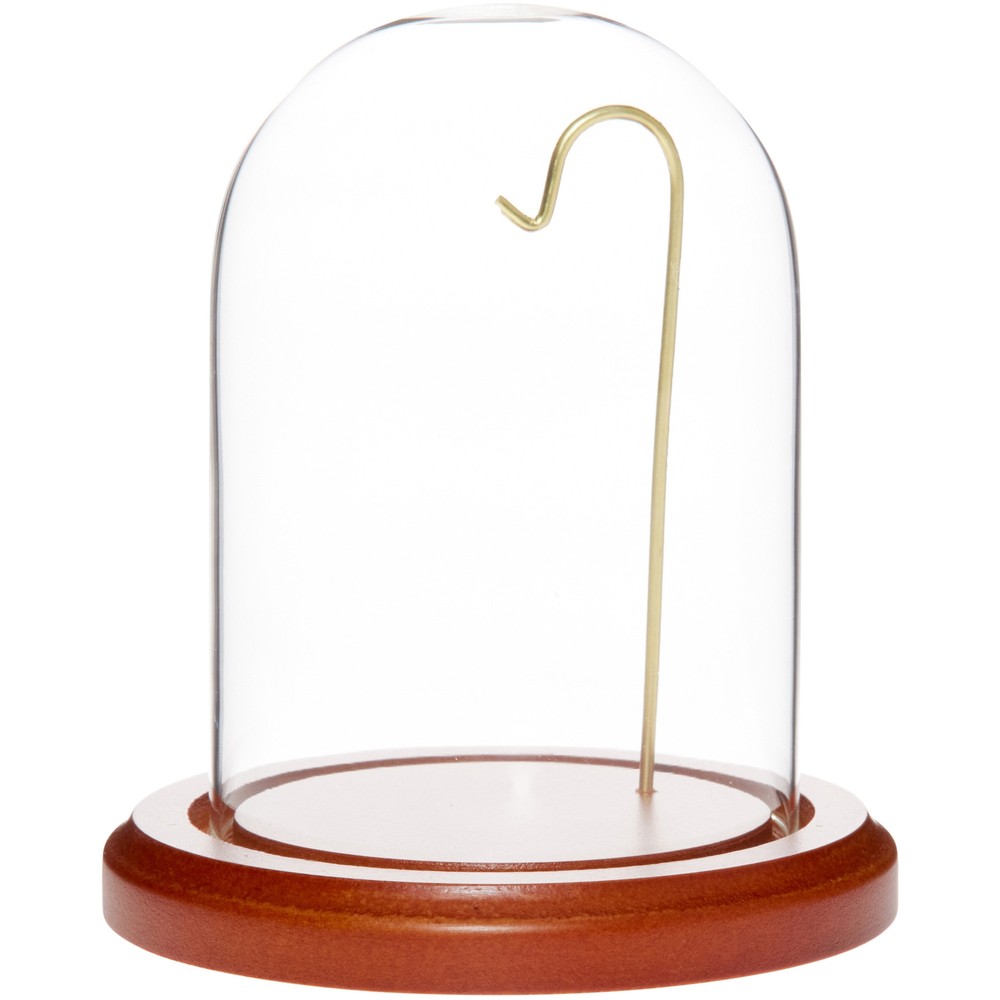
Buy the Plymor dome if you want to size the fit on paper before you spend a cent. The Plymor 3″ x 4″ Watch Glass Display Dome Cloche states exterior and interior in the same bullet, 3 by 4 inches outside and 2.75 by 3.875 inside, then adds two numbers nobody else bothers with. The glass arches at about 2.5 inches, and the brass wire leaves about 3 inches of drop from base to hook.
Overall Ranking: 8.5/10
Individual Rankings: Build Quality 7/10 · Size and Fit 10/10 · Visual Appeal 8/10 · Safety and Protection 7/10 · Ease of Assembly 10/10 · Value for Money 9/10
Stand-out features
- Interior and exterior in one bullet: 2.75 x 3.875 inches inside a 3 x 4 inch dome.
- A published arch point: full width is only there below 2.5 inches of height.
- A removable hook: pull the brass wire and the dome covers a watch on its own stand.
Pros
- The best-published fit numbers of any dome here, straight from the maker.
- The cheapest route into a real glass dome that states an interior.
- Collecting Warehouse guarantees Plymor products arrive free of damage and defects.
Cons
- The base is walnut-colored MDF rather than walnut, and the brand says so in its own bullet.
- MDF is a wood product, and CCI names acidic emission as the main problem with wood in an enclosure, with copper alloys among the most vulnerable materials. A gold-filled watch case is a copper alloy.
- The seller’s own caveat is that handcrafted glass may carry bubbles or thickening at the crown.
Alternatives: for a longer chain, the Plymor 4.5″ x 8″ Watch Glass Display Dome Cloche publishes a 4.375 x 7.5 inch interior, and the cheaper PH PandaHall 3 x 4 inch Pocket Watch Display Case gives 7.5 cm inside with a bendable wire, though its own dimensions field disagrees with its bullets.
3. Beeveer 4 x 7 Inch Two-Hook Pocket Watch Display Dome (Best for Two Watches on Their Chains)
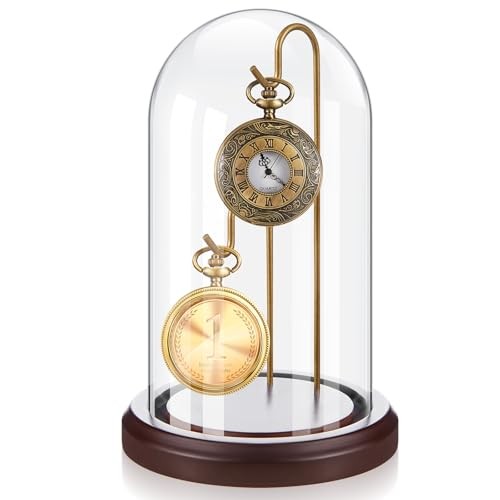
Two watches hanging on their own chains is the one job the Beeveer two-hook dome does that nothing else I found does at all. The Beeveer 4″x7″ Two-Hook Pocket Watch Display Dome carries two gold hooks at fixed heights, about 6.9 inches and 4.5 inches, so a pair hangs staggered under one dome. Seven inches of height is the most vertical room here, and that’s what a chain needs.
Overall Ranking: 8.0/10
Individual Rankings: Build Quality 7/10 · Size and Fit 7/10 · Visual Appeal 9/10 · Safety and Protection 7/10 · Ease of Assembly 10/10 · Value for Money 8/10
Stand-out features
- Two hooks at staggered heights: the stagger keeps two chains from tangling.
- 7 inches of interior height: room to show a length of chain instead of coiling it.
- A 5-inch walnut base: wider than the dome, so it sits steady on a shelf.
Pros
- Displays a matched pair, or a watch and its chain, under one dome.
- The tallest dome here by a wide margin.
- Lift-off assembly, like every dome on this list.
Cons
- No interior width is published anywhere, so you can’t check fit before buying. The 4 x 7 inches is the glass outside. Plymor’s 4-inch dome gives 3.875 inches inside, so this one probably lands near 3.75 inches, but that’s my inference from a sibling brand rather than a spec Beeveer states.
- The hooks are fixed, so the watches hang where the hooks put them.
- No dust seal and no UV figure, the same as every dome here.
Alternatives: the single-hook version uses a composite board base rather than solid walnut, so I’d take the two-hook model even for one watch. For a long chain, go back to the Plymor 4.5 x 8 inch dome.
4. UKIARWT 3-Pocket Watch Shadow Box (Best Wall Case)
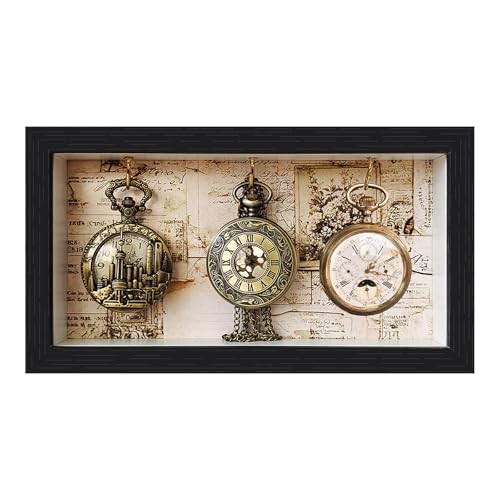
The UKIARWT shadow box is the pick when you want three watches on a wall and you want to check the fit first. The UKIARWT 3-Pocket Watch Shadow Box states its ceiling in both units, watches up to 1.89 inches or 48 mm across, which is rarer on a pocket watch wall display case than a UV percentage. A solid wood shell, glass front, and back panel seal it better than any dome here, and it arrives assembled at 8.3 x 4.5 x 1.77 inches.
Overall Ranking: 7.8/10
Individual Rankings: Build Quality 7/10 · Size and Fit 9/10 · Visual Appeal 8/10 · Safety and Protection 8/10 · Ease of Assembly 7/10 · Value for Money 8/10
Stand-out features
- A published fit ceiling of 48 mm: one number to check your watch against, no arithmetic.
- A closed frame with a back panel: glass in front, wood behind, sealed on all four sides.
- Internal foam padding: the watches stay in their pockets instead of sliding.
Pros
- The cheapest wall case here that publishes a fit number at all.
- Better sealed than any dome here, which matters more for dust than a material claim.
- The 48 mm ceiling matches the figure WLFUJIN published on its own wall case.
Cons
- The interior is 1.18 inches deep and the hook stands about 1.18 inches tall, leaving almost nothing for a bow and crown standing proud. No hunter case goes in there with its lid open.
- The 98% UV protection and 95% clarity figures are the seller’s own, with no test standard named.
- Mount it with screws. 3M’s own content sheet says its Command picture hanging strips are “not recommended for mounting shelves, tapestry or shadow boxes” and that you shouldn’t hang valuable or irreplaceable items with them.
Alternatives: the JINMANWU Pocket Watch Wall Cabinet Shadow Box gives the cabinet look at 6.3 x 4.5 x 1.77 inches and claims 95% UV protection, but it publishes no interior opening and no slot size, so you’re taking the fit on trust.
5. Royal Craft Expertise 4-Slot Rosewood Display Case (Best Wooden Box for a Small Collection)
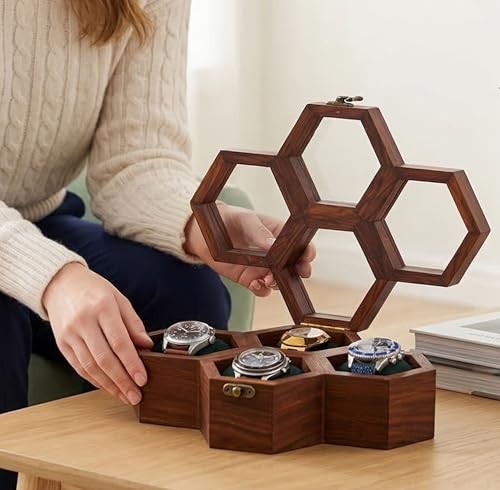
Four watches laid flat with real room for the chains is what the Royal Craft Expertise 4-Slot Rosewood Watch Display Case does that the wristwatch boxes can’t. Its slots measure 7.2 by 7.2 cm and run 7 cm deep, about 2.83 inches a side, so a 48 mm watch drops in with roughly 24 mm to spare and the chain coils beside it. The case is Indian rosewood with a glass lid and a brass catch, and it mounts on a wall or sits on a dresser.
Overall Ranking: 7.7/10
Individual Rankings: Build Quality 8/10 · Size and Fit 9/10 · Visual Appeal 9/10 · Safety and Protection 7/10 · Ease of Assembly 7/10 · Value for Money 6/10
Stand-out features
- 7.2 cm square slots, 7 cm deep: the only published slot geometry that suits a round case and a chain.
- Wall or tabletop: the one pick here that does both.
- Handmade rosewood under glass: the one case here you’d leave out in a living room.
Pros
- Slot dimensions published and corroborated by the case’s dimensions field.
- Deep enough for a watch and its chain in one compartment.
- Mounts two ways without extra hardware decisions.
Cons
- It’s sold as a wristwatch box. The listing’s own bullet reads “2.83 inch/7.2 cm width slots make this a mens watch box for large watches,” so nothing about the cushions, the retention, or the chain routing was designed for a pocket watch.
- Rosewood with no stated sealing. CCI’s fix for wood in an enclosure is a barrier coating or a laminate.
- The brass lock is a catch. The National Park Service’s exhibit-case specification asks for a bolt throw of at least an inch and a captive key, and this claims neither.
Alternatives: if it’s sold through, pick 6 with an 8-slot tray gives the same laid-flat format at twice the capacity, and pick 4 covers the wall half of the job.
6. FindingKing 83-1CBK Glass Top Display Case (Best for a Large Collection)
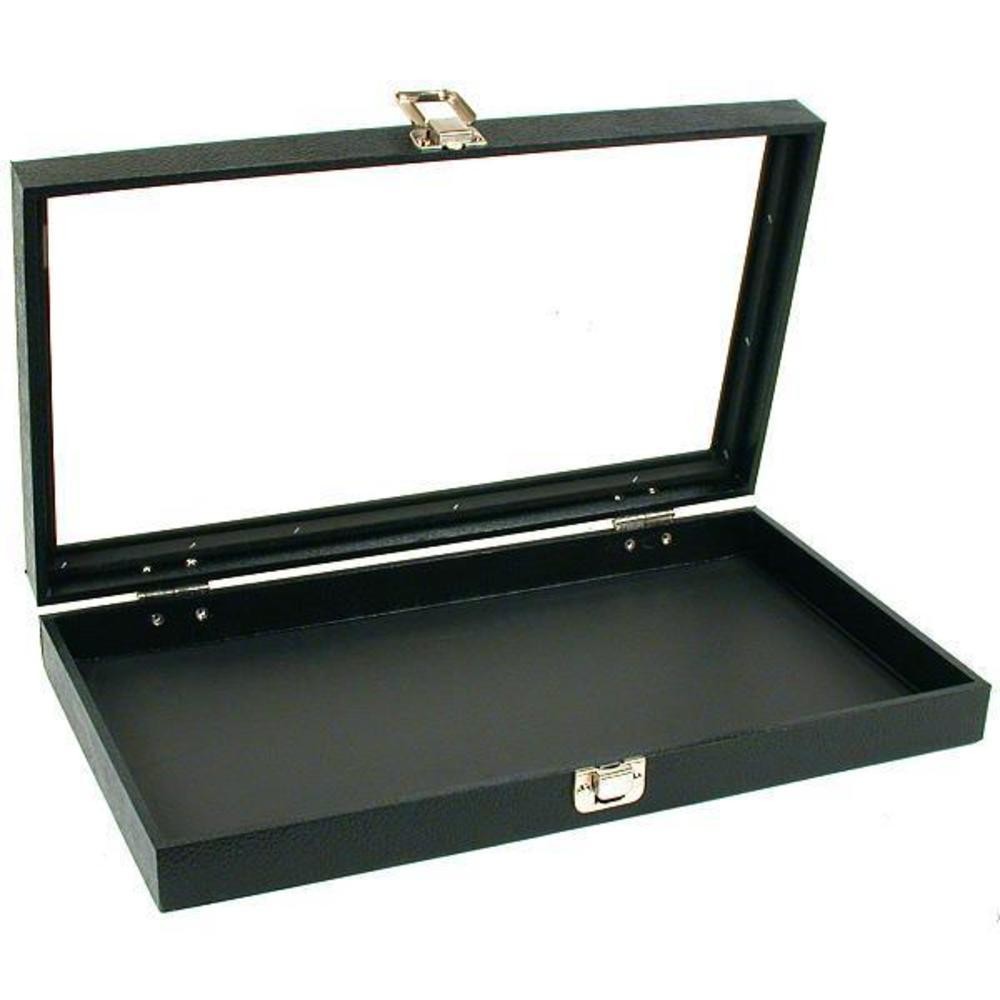
The FindingKing Glass Top Pocket Watch Display Case is a jeweler’s countertop showcase, 14 3/4 by 8 1/4 by 2 1/8 inches with a latching glass lid, and it’s the buy once you own more than a handful of watches. Drop-in trays decide the capacity, and the 8-slot tray gives compartments of 3 1/8 by 3 3/8 inches, 79 by 86 mm, the largest published compartment I found here.
The 10-slot tray runs 2 1/2 by 3 1/4 inches, and two of those make a 20-watch case.
Overall Ranking: 7.5/10
Individual Rankings: Build Quality 7/10 · Size and Fit 10/10 · Visual Appeal 3/10 · Safety and Protection 8/10 · Ease of Assembly 8/10 · Value for Money 9/10
Stand-out features
- 79 x 86 mm compartments: a 48 mm watch sits there with about 30 mm to spare, chain included.
- A latching lid: the only stated latch here, and the best-sealed pick.
- Capacity by the tray: 8, 10, 16, or 20 watches from one case body.
Pros
- The lowest cost per watch of anything here, by a distance.
- Manufacturer and retailer dimensions match exactly, the best spec corroboration here.
- Roughly 1.1 to 1.6 inches of headroom above the tray, enough for a watch lying flat.
Cons
- It arrives empty. The tray is a separate order, so the capacity that makes this pick work is a second thing to buy.
- It’s a trade-show case and it looks like one. Black body, no wood, no UV figure published.
- The headroom won’t take a hunter case propped open, only a watch lying flat.
Required companion: the FindingKing 10-Slot Tray Inserts hold 10 watches a tray, and the FindingKing 8-Slot Pocket Watch Tray Inserts give the bigger compartments.
Alternatives: the FindingKing Acrylic-Lid Pocket Watch Display Case is lighter and cheaper, but uncoated plastic glazing scratches where glass doesn’t. Watch Box Depot’s 18-watch case publishes no material, glazing, or slot size, so I can’t rank it.
7. Charles-Hubert, Paris 3578 Gold-Plated Pocket Watch Stand (Best Open Stand)
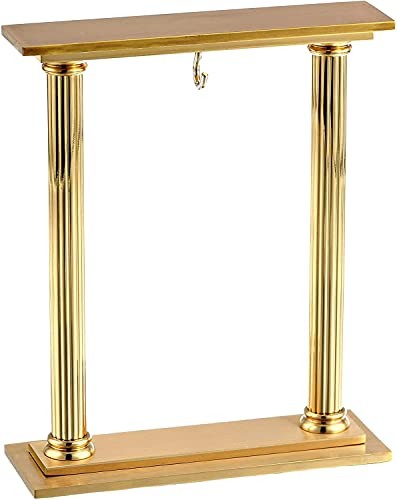
Buy the Charles-Hubert 3578 stand only if you wind and carry the watch rather than storing it. The Charles-Hubert Paris 3578 Gold-Plated Pocket Watch Stand is 14k gold-plated brass and holds the watch upright and visible from both sides, which is the only way a double-glass or skeleton case reads properly.
Overall Ranking: 6.3/10
Individual Rankings: Build Quality 8/10 · Size and Fit 4/10 · Visual Appeal 10/10 · Safety and Protection 1/10 · Ease of Assembly 10/10 · Value for Money 5/10
Stand-out features
- Both sides visible: movement and dial on show at once, which no enclosed case here manages.
- 14k gold-plated brass: the best-looking object in this roundup.
- Pendant-up display: it holds the watch in a position American factories timed watches in.
Pros
- Puts the watch where you’ll actually use it.
- Shows a skeleton or double-glass case from the back as well as the front.
- Ships in a presentation box, so it’s the easy gift here.
Cons
- Zero dust protection, and it’s the only pick where that’s true by design. An enclosure exchanging its air once a day collects about a quarter of the room’s coarse dust. An open stand collects all of it.
- Neither the listing nor the brand’s site publishes an opening size or a maximum case diameter, so there’s no way to verify fit before buying. On a list built around checking that number, that’s the honest thing to say about its prettiest pick.
- You pay the most per watch here and get the least protection.
Alternatives: the Charles-Hubert Paris 3507 Two-Tone Pocket Watch Stand is the same format without the gold plating. For the movement visible and the dust kept off, put a stand under the Dueber dome.
Hanging a Pocket Watch Versus Laying It Flat
Hang the watch from its bow if you want to, because that’s a position the watch was built for. Google’s AI summary of this query says that “hanging a pocket watch requires proper back support to keep the internal mechanism balanced.” A mechanical watch does keep slightly different time in different orientations, so factories adjusted better movements to average those errors across a set number of positions.
The three-position set, per Pocket Watch Database’s reference on adjustments, is dial up, dial down, and pendant up. Pendant up is hanging, so the hanging position is one the factory deliberately timed the watch in. After about 1908 most American railroads required five positional adjustments on service watches, which had to hold time within 30 seconds a week.
So hanging doesn’t unbalance anything, and PatH on the NAWCC board says he’d hang his watches from their bows given a free hand. Laying flat wins on volume. Dial-up in a padded slot puts far more watches on a shelf than a row of domes will, and it’s gentler on a fragile dial than threading a bow onto a hook every time.
Wall-Mounted Pocket Watch Display Cases
A wall-mounted case puts the collection at eye level on the surface that usually catches the most daylight, and daylight is what permanently fades a painted dial. So a wall case is a lighting decision before it’s a space decision.
Depth rules cases in or out. The purpose-built wall frames run about 1.18 inches of interior depth with a hook eating most of it, which handles a closed watch and refuses an open hunter case. Royal Craft’s rosewood box gives 7 cm of slot depth on a wall instead. Past that you’re into what collectors build for themselves, which Kent on the NAWCC board did with 8 by 10 inch picture frames on shallow velvet-lined boxes.
Whatever you hang, hang it on screws. 3M’s own Command strips content sheet rules out shadow boxes by name and says not to hang valuable or irreplaceable items with them.
Display Case Materials for Pocket Watches
Pick glass over acrylic for a watch, and pick it for the scratch resistance. CCI’s glazing guidance notes that glass picks up very little electrostatic charge and resists scratching better than most plastics, while uncoated plastic glazing is prone to scratching and abrasion. Acrylic is the sensible default on big panels like jersey display cases, where a sheet of glass is a hazard, but at watch scale that argument goes away.
Wood needs the most care around metal. Per CCI’s bulletin on products used in conservation, the main problem with wood in an enclosure is acidic emission, oak and cedar are the most acidic species and shouldn’t be used at all, and lead, copper alloys and paper are among the objects most susceptible to acidic vapours. A gold-filled or brass watch case is a copper alloy, and CCI’s fix is a barrier, sealing the wood or buying it laminated.
Lining is where the usual selling point gets complicated. Felt reads as a quality signal on a spec sheet, and CCI’s list of the sources that tarnish silver names wool and wool felt alongside vulcanized rubber and certain paints. Most antique American pocket watch cases are silver, silver-plate, or gold-filled, so treat a wool felt lining as a question for the seller rather than a feature to pay for.
Keeping a Displayed Pocket Watch Safe and Running
An enclosure earns its keep on dust first. CCI’s airtightness bulletin puts a well-sealed case at 0.3 air exchanges a day or fewer, calls anything above 1.0 unsealed, and reports that a case exchanging its air once a day collects about 24% of the coarse dust of the room around it. None of these cases publishes an air exchange rate, so read the listing for whether the case actually closes. A latched lid or a back-paneled frame beats a dome resting on a base, which beats an open stand by a distance.
Light is the damage you can’t undo. Clear glass transmits over 90% of visible light and only cuts ultraviolet below 300 nanometers, so glazing alone is no UV filter. The grades that are, per CCI, are named products like Plexiglas UF-5 and Acrylite OP-2, but none of these cases names one.
Filtering UV wouldn’t finish the job anyway, since CCI’s guidance on light damage puts UV at less than half of fading and often a tenth. On a high-sensitivity colorant at 5,000 lux, CCI’s example for a window or a study lamp, a just-noticeable fade shows in five days to two months. At 50 lux it takes 1.5 to 20 years, so placement does more than glazing.
Put the case where the daylight doesn’t reach, on an interior wall or a low shelf, and light the room with white LED, which CCI’s tables put at very low UV output.
Humidity is the metal problem. CCI calls 30% relative humidity or lower ideal for metal objects, with 40 to 55% the compromise for a cased watch with an enamel dial, and silver tarnishes faster as humidity climbs.
Then decide whether these are running objects or still ones, because running has a bill attached. Icon’s guidance on clocks puts the choice first and says a working movement needs examining and re-lubricating every three years, with a full strip and clean within eight. A case of watches you never wind is storage with a view.
How Pocket Watch Collectors Display Their Collections
The most common answer from people who own a lot of these watches is that the collection isn’t on display at all. On the NAWCC message board, tick talk says his watches are out for three or four days a year and spend the rest in a safety deposit box.
Kent says his stay at the bank unless he’s working on them. darrahg, describing a repurposed hotel key cabinet with a hasp on it, points out that anyone who really wanted the contents would just break the glass. Breaking the glass is the honest ceiling on what a lock does in a display case, and it’s why I’ve scored the brass catches here as catches.
The collectors who do display describe two setups, the wall case at real scale and the dealer’s glass-top showcase. Rob, posting as musicguy, adds the sizing note that matters when you’re buying blind. He sees 18-size and 16-size watches regularly and small ones rarely, so size the slots for the big end.
Vintage and Antique Pocket Watch Display Cases
An antique pocket watch display case is a different object from what that search phrase sells you today. In the period sense, as Greg Frauenhoff explains on the NAWCC board, these were cases glazed on both sides so the movement could be viewed, made for the trade and known as jeweler’s sample cases, skeleton cases, or salesman’s cases at Hamilton.
The period design leaves collectors with the double-glass problem. CentreKeystone puts it plainly on the same board, saying a case hides the movement and prevents display unless it comes off. If you want a movement visible without touching the watch, an open stand does it, and a tall dome over a stand does it with the dust kept off.
Which Pocket Watch Display Case to Buy for Your Collection
Buy a pocket watch display case on the count first and the format second. For one watch that matters, the Dueber 3 x 4 inch dome is my pick, because its maker publishes both a 70 mm interior width and an 80 mm height ceiling. For a pair on their chains, the Beeveer two-hook dome is the only real answer.
For three on a wall, the UKIARWT shadow box publishes its 48 mm fit ceiling and costs less than anything else that does. For four laid flat with room for the chains, Royal Craft’s 7.2 cm slots are the best published geometry in the category.
For a real collection, 10 watches or 20 or a number that keeps climbing, the FindingKing glass-top case with a tray in it is the buy. It has the biggest published compartment, the best-sealed lid, and the lowest cost per watch, and it grows by a tray instead of by another box. If you’d rather have the watch in your hand every day, the Charles-Hubert stand does that and protects nothing.
Whatever you’re choosing between, check the interior number against 48 mm first. The same habit works for display cases for heirlooms of any kind, and it keeps a case from arriving too small for the thing it was bought to protect.
Frequently Asked Questions About Pocket Watch Display Cases
What size opening does a pocket watch display case need?
A pocket watch display case needs an interior opening of at least 48 mm, or 1.89 inches, to take a standard cased watch. Charles-Hubert, Paris publishes 48 mm for its current hunter cases, and two unrelated makers of purpose-built wall cases, UKIARWT and WLFUJIN, cap their listings at the same figure. The widely repeated 3 to 3.5 inch figure describes the outside of a small dome instead, and a 3-inch dome gives about 2.75 inches inside, which still clears 48 mm. Where a listing gives only an exterior, I assume the glass takes an eighth of an inch a side and work from there.
How do you display a large pocket watch collection?
Display a large pocket watch collection in a glass-top showcase with drop-in trays, or in a deep wall case screwed to studs. The FindingKing Glass Top Pocket Watch Display Case takes 8, 10, 16, or 20 watches depending on the tray, and two FindingKing 10-Slot Tray Inserts make a 20-watch case out of one box. Don’t buy a 12-slot box for 20 watches, since stacking is how watches scratch each other.
Is it bad to hang a pocket watch by its bow?
No, hanging a pocket watch by its bow isn’t bad for the movement. Pendant up, the hanging position, is one of the three positions American factories adjusted better movements in, alongside dial up and dial down, per Pocket Watch Database’s reference on adjustments. American railroads required five positional adjustments after about 1908, and service watches still held time within 30 seconds a week. What hanging asks of you is a safe hook and enough interior height for the watch, its bow, and its pendant together.
What is the best display case for a vintage pocket watch?
A glass dome on a solid wood base is the best display case for a single vintage pocket watch, because it shows the watch from every angle and puts no lining against the case. The Dueber Watch Co 3″x4″ Pocket Watch Glass Display Dome is my pick there on published fit numbers. If your watch is silver or silver-plate, be careful with felt-lined boxes, since CCI’s list of tarnish sources names wool felt directly.
Do pocket watch display cases protect against sunlight?
Most pocket watch display cases offer no meaningful UV protection, whatever the listing claims. The Canadian Conservation Institute reports that clear glass transmits over 90% of visible light and only cuts ultraviolet below 300 nanometers, and plain acrylic is no UV filter either. CCI names the grades that do filter, Plexiglas UF-5 among them, but none of these cases names one. Moving the case away from the window does more than any glazing claim here.
Should you keep a displayed pocket watch wound?
Keep a displayed pocket watch wound only if you’re willing to pay for the servicing that running costs. Icon, the Institute of Conservation, recommends that a working movement be examined and re-lubricated every three years and fully stripped and cleaned within five to eight. So decide whether each watch is a running object or a still one, and keep a few in rotation rather than winding all 20 every week.