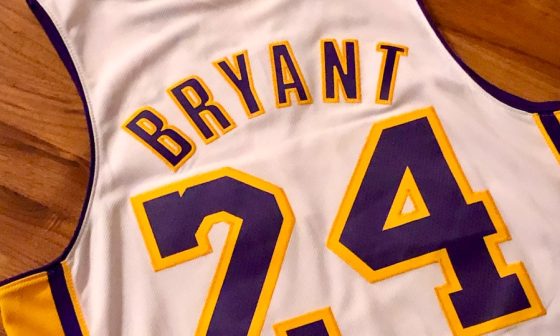
Article Summary
The best jersey frame for most jerseys is the Pro Collector’s Jersey Display Case, the only standard-size pick that publishes an interior dimension. A 1.5-inch frame leaves 1 inch inside, and a folded adult jersey fills most of that inch. The standard 31.25 x 23.25-inch jersey shadow box is a folded-jersey case, since adult jerseys run wider than its 22.5-inch interior. Four of the six picks publish no interior figure, and three publish no UV figure. The Canadian Conservation Institute reports UV usually causes less than half of textile fading, so a shaded wall beats a rated panel. Cases for Collectibles scored every pick on published numbers, not hands-on testing, and sends a signed jersey to a framer.
This article contains affiliate links. We earn a commission if you make a purchase, at no additional cost to you.
The Pro Collector’s Jersey Display Case is my pick for most jerseys. It’s the only standard-size case here that publishes an interior dimension, so you know before you order that a 1.5-inch frame leaves 1 inch of room inside.
The Canadian Conservation Institute says display cases “protect against dust, reduce pollutant exposure and provide a barrier against contact…,” and that light damage to textiles “is both cumulative and irreversible.” Light is the reason UV percentages are the loudest number in this category, and it’s why I rank these six on what each seller prints and you can check.
The Best Jersey Frames at a Glance
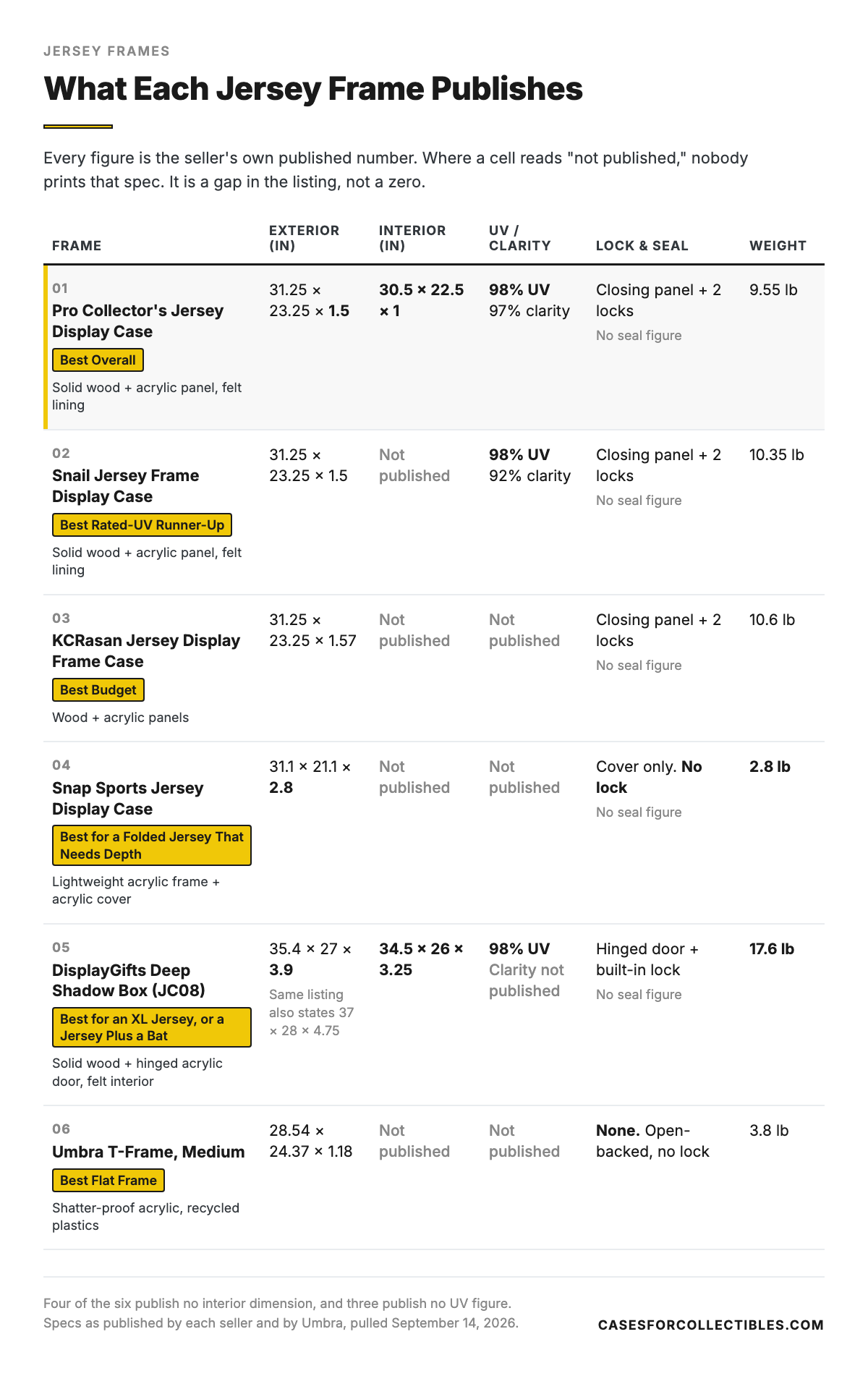
Six jersey frames made the list. Every figure below comes from the current Amazon listing or the manufacturer’s own page, pulled on September 14, 2026.
| Jersey Frame | Best For | Type, Material, and Size | Published UV and Interior | Overall |
|---|---|---|---|---|
| 1. Pro Collector’s Jersey Display Case | Knowing the real fit before you buy | Shadow box case, solid wood and acrylic, 31.25 x 23.25 x 1.5 in | 98% UV, 97% transparency, interior 30.5 x 22.5 x 1 in | 8.7/10 |
| 2. Snail Jersey Frame Display Case | A rated panel and a lock with no assembly | Shadow box case, solid wood and acrylic, 31.25 x 23.25 x 1.5 in | 98% UV, 92% transparency, interior not published | 8.2/10 |
| 3. KCRasan Jersey Display Frame Case | The cheapest route into wood, a door, and locks | Shadow box case, wood and acrylic, 31.25 x 23.25 x 1.57 in | No UV figure, no transparency figure, interior not published | 7.9/10 |
| 4. Snap Sports Jersey Display Case | A folded jersey, or a jersey with a ball beside it | Lightweight acrylic case, 31.1 x 21.1 x 2.8 in, labeled 20 x 30 | No UV figure, interior not published | 7.8/10 |
| 5. DisplayGifts Deep Shadow Box (JC08) | An XL jersey, or a jersey plus a bat | Deep shadow box cabinet, solid wood, hinged door, 35.4 x 27 x 3.9 in | 98% UV, interior 34.5 x 26 x 3.25 in | 7.7/10 |
| 6. Umbra T-Frame, Medium | Wall-art looks and a light hang | Flat T-frame, shatter-proof acrylic, 28.54 x 24.37 x 1.18 in | No UV figure, no seal, no lock | 6.5/10 |
The Four Kinds of Jersey Frame
A jersey frame can be any of four different products, and they don’t protect a shirt the same way. That’s why the size you order and the price you pay swing so wildly on the same search.
The Flat Frame and T-Frame
The flat frame or T-frame runs roughly 1.2 inches front to back, with the shirt folded behind a panel and the frame’s arms showing the sleeves. It reads as wall art, though it gives you no depth for a ball, no lock, and no UV rating.
The Ready-Made Shadow Box Case
The ready-made shadow box case is the 31.25 x 23.25 x 1.5-inch wooden box that four different brands sell at the same footprint, and it’s what most people mean by a jersey shadow box. It closes on a panel, usually carries two locks, and ships a hanger and a pin board.
The Deep Shadow Box Cabinet
The deep shadow box cabinet runs 3 to 4 inches deep, with a hinged door on the front. It’s the shape that takes an unfolded XL jersey, a hockey sweater, or a jersey with a bat beside it, and it costs roughly three times the standard box.
The Custom-Built Frame
In a custom build, a framer mounts the jersey on a fabric-covered board, cuts the mat, chooses the glazing, and builds the frame around it. You can buy the moulding and do that work yourself instead. Either way you’re commissioning or building something rather than buying a box.
How I Evaluated These Jersey Frames
I handled none of these frames, and I’m not going to pretend otherwise. Every spec here came out of the current Amazon listing through the Amazon Creators API on September 14, 2026, out of the manufacturer’s own page where one exists, or out of published conservation guidance from the Canadian Conservation Institute and the U.S. National Park Service. Owner review text was unreachable this run, so you won’t find a star rating, a review count, or any claim about owner consensus anywhere below.
Each pick gets a score out of 10 on the six criteria Cases for Collectibles uses on every display case:
- Build Quality: materials, weight, construction, warranty
- Size and Fit: exterior and interior dimensions, and what jersey size goes in
- Visual Appeal: finish, published transparency, how much of the shirt shows
- Safety and Protection: UV figure, dust seal, shatter resistance, locks
- Ease of Assembly: does it arrive built, and what hardware is in the box
- Value for Money: what the price band buys against the rest of the field
Frame Depth vs. Usable Interior Depth
1.5 inches on the outside of the box gives you 1 inch on the inside. The Pro Collector’s listing says so itself, quoting both figures in the same bullet: “Dimensions: 31.25″ H X 23.25″ W X 1.5″D Interior Dimension: 30.5″H X 22.5″W X 1″D.”
Picture framers call the measurement that matters the rabbet, and webpictureframes.com lists 1 3/4 inches of it on the jersey moulding it sells.
DisplayGifts publishes 3.9 inches outside and 3.25 inside on its deep cabinet, which is a fair trade. Its own X-Large 36 x 26 model publishes “Outer Dimensions: 36.4″L x 26″ W x 1.9″ D Interior Dimension: 35″ H X 24.75″ W X 0.35″ D,” and the same listing adds “There is no lock on this display case” and “This frame has no hanger for the jersey inside.” A 1.9-inch frame holding 0.35 inches of jersey is a mat-and-pin frame wearing a shadow box’s dimensions, and it isn’t a pick here for exactly that reason.
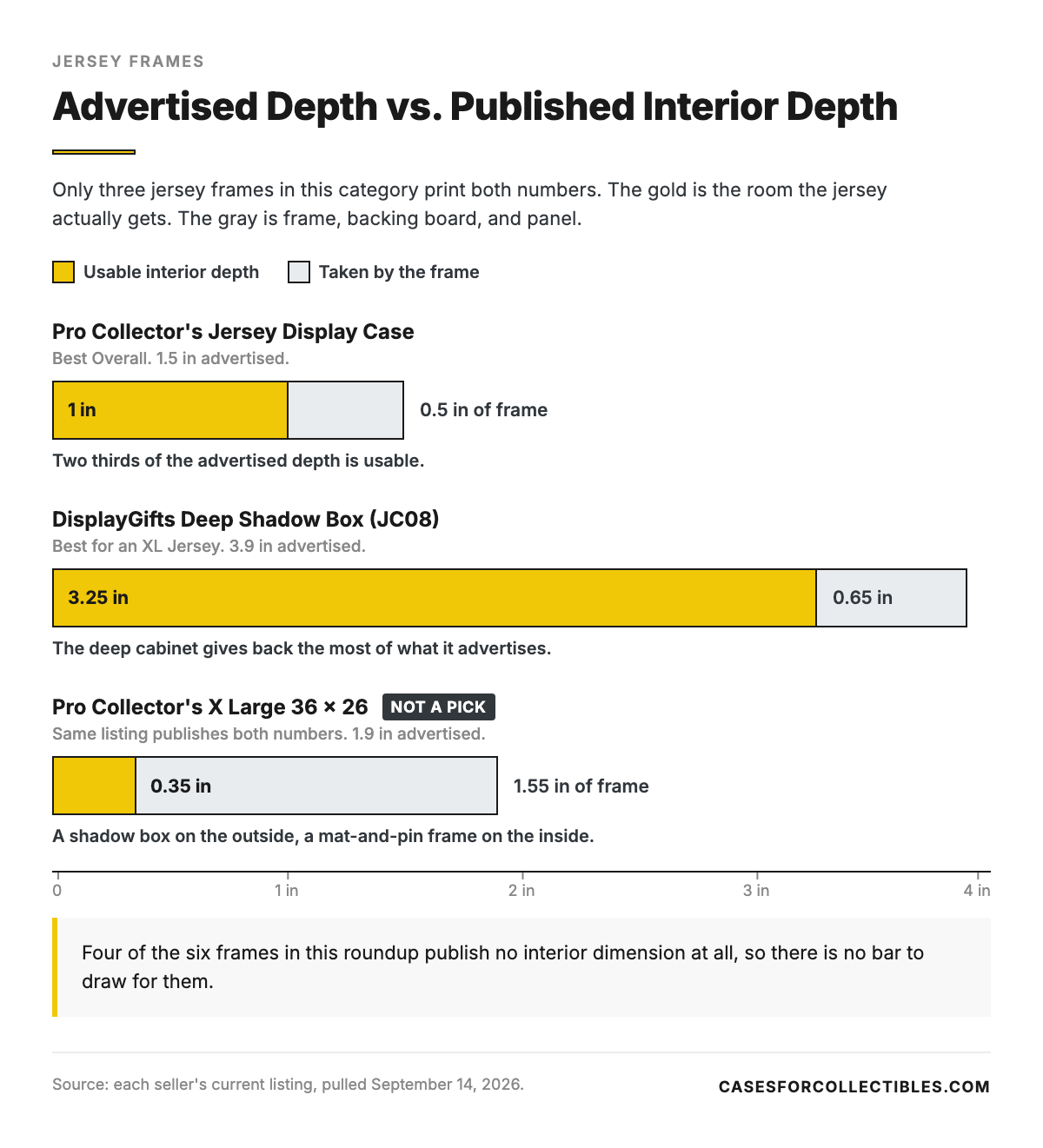
Four of these six frames publish no interior dimension at all. Look for the interior figure on any listing you’re weighing. If it isn’t there, assume a 1.5-inch box gives you about an inch and a 2.8-inch box gives you about 2, then decide whether your jersey folds into that.
Pro Collector’s Jersey Display Case (Best Overall)
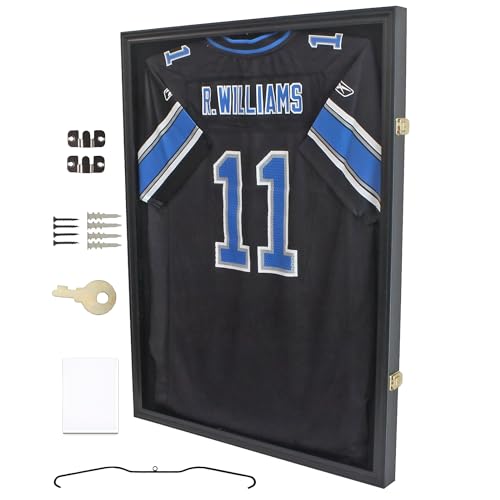
My first choice for a standard adult jersey is the Pro Collector’s case, and it earns the slot on what it publishes rather than on how it looks. The listing prints both numbers, so it settles the fit question before you order rather than after the box turns up. The Pro Collector’s Jersey Display Case is the only frame in the standard tier that does that.
Solid wood, anti-fade matte black, 9.55 pounds, a felt lining, and two gold-plated locks. The acrylic panel is the clearest published in this roundup at 97% transparency with 98% UV protection, and DisplayGifts puts a three-year warranty behind it.
A word of caution on the fit. The listing says outright, “You will need to fold the jersey to fit the frame,” and with 1 inch of interior depth a folded adult jersey fills most of the room there is.
Overall ranking: 8.7/10
Individual rankings
- Build Quality: 9/10, solid wood and felt at 9.55 pounds
- Size and Fit: 7/10, publishes the interior, but 1 inch means folding
- Visual Appeal: 9/10, the highest published clarity here
- Safety and Protection: 9/10, 98% UV and two locks, no seal figure
- Ease of Assembly: 9/10, two mount options, wall hardware included
- Value for Money: 9/10, mid band, most disclosure in the tier
Stand-out features
- A published interior dimension: 30.5 x 22.5 x 1 inch, against a 31.25 x 23.25 x 1.5-inch exterior
- 97% transparency with 98% UV protection on a shatter-proof acrylic panel
- Two gold-plated anti-theft locks on a panel that closes
Pros
- Settles the fit question before you order, not after the box lands
- Shows more of the shirt than anything else here
- The jersey rests on felt, not on bare board
- Locks shut, and hangs whichever way the wall allows
Cons
- Gives 1 inch of usable interior behind a 1.5-inch frame, by the seller’s own two figures
- States on the listing that you’ll need to fold the jersey to fit it
- Ships a hanger and pins, the hardware conservators warn against for knits
- Publishes no panel thickness, no seal figure, and no lock bolt-throw
Alternatives to the Pro Collector’s Case
DisplayGifts sells a near-twin, the Pro Collector’s JC34, at the same band with 95% transparency instead of 97% and one hanger instead of two. Its listing adds a line worth knowing about the field: “Most competing frames uses 1 mm paper thin acrylic.” For a box that arrives assembled, take the Snail. For an XL jersey or a bat, go to the deep DisplayGifts cabinet.
Snail Jersey Frame Display Case (Best Rated-UV Runner-Up)
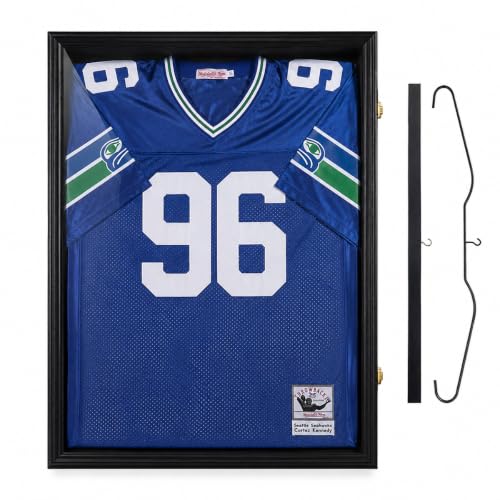
92% transparency and 98% UV protection are both printed on the Snail listing, and the case turns up assembled. That combination is what makes the Snail Jersey Frame Display Case the pick for anyone who wants a rated panel and a lock without a job to do on the kitchen table.
Snail also packs it like it expects the courier to drop it, describing 360-degree foam and thick protective stickering over the panel. The box is the standard 31.25 x 23.25 x 1.5 inches in solid wood at 10.35 pounds, with a felt lining, two gold-plated locks, and a limited three-year warranty.
Snail publishes 92% where the Pro Collector’s publishes 97%, at the same footprint and band, with no interior dimension at all.
Overall ranking: 8.2/10
Individual rankings
- Build Quality: 9/10, solid wood and felt at 10.35 pounds, foam-packed
- Size and Fit: 6/10, standard footprint, no interior figure published
- Visual Appeal: 8/10, 92% transparency, claimed not to yellow
- Safety and Protection: 8.5/10, 98% UV and two locks, no seal figure
- Ease of Assembly: 9.5/10, “COMES ASSEMBLED, easy set up in minutes”
- Value for Money: 8/10, top-pick band, one fewer number published
Stand-out features
- Arrives assembled, which no other wooden pick in this set states on its listing
- Two published panel figures, 92% transparency and 98% UV protection
- An anti-yellowing claim on the acrylic, stated as “won’t turn yellow over time”
Pros
- On the wall the evening it arrives, with nothing to build
- You can compare its panel against a rival’s instead of trusting the word “protection”
- Two hangers and a pin board, so the shirt sits the way you want it
Cons
- Publishes 92% transparency where a same-priced rival at the same size publishes 97%
- Publishes no interior dimension, so the usable depth is unknowable from the listing
- Calls itself “ONE SIZE FITS ALL” while the identical footprint elsewhere says you must fold the jersey
- Ships two hangers plus a thimble and pins, which runs straight into the conservation guidance for knits
- States 98% UV with no wavelength band, and plain acrylic already filters about 90% of UV on its own
Alternatives to the Snail Case
The JDECO Jersey Frame Display Case is the same 31.25 x 23.25-inch box with three mounting options and the same pair of locks, a little above the budget pick. It publishes no UV number, so you’d trade a printed figure for a third way to hang the shirt. The Pro Collector’s case publishes two figures.
KCRasan Jersey Display Frame Case (Best Budget)
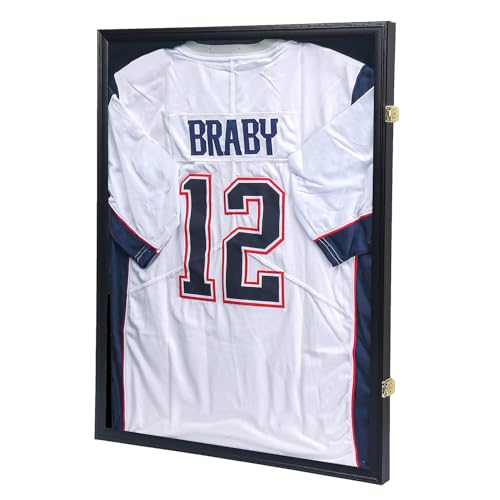
KCRasan is the cheapest route into a wooden jersey shadow box with a door and two locks, and the listing’s build spec isn’t cut to get there. Wood, anti-fading matte black, 10.6 pounds, foam-packed with thick stickering over the panel, and the KCRasan Jersey Display Frame Case comes assembled like the mid-band boxes do.
It gives three ways to mount the jersey rather than two, an iron hanger, a wood hanger, and a pin board. The footprint is the category standard at 31.25 x 23.25 inches, published at 1.57 inches deep where the other three say 1.5.
What you give up is every number. The listing says “Shockproof high transparency and UV protection acrylic glass panel” and stops there. No transparency percentage, no UV percentage, no interior dimension, and no warranty length.
Overall ranking: 7.9/10
Individual rankings
- Build Quality: 8.5/10, wood at 10.6 pounds, no warranty length published
- Size and Fit: 6/10, standard footprint at 1.57 inches, no interior figure
- Visual Appeal: 7.5/10, matte black finish, no clarity figure to check
- Safety and Protection: 6.5/10, two locks, no UV number, no seal figure
- Ease of Assembly: 9.5/10, assembled, with three mounting options
- Value for Money: 9.5/10, the lowest price here for wood and locks
Stand-out features
- The lowest price of the six, carrying a list price above what it sells for
- Three mounting options, an iron hanger, a wood hanger, and a pin board
- Two gold-plated locks on a wooden case that closes
Pros
- You can try the shirt three ways before you settle on one
- KCRasan cuts nothing out of the build to hit the price
- It turns up assembled and well packed, so the saving isn’t in the carton
Cons
- Publishes no transparency figure and no UV figure, only the words “UV protection”
- Ordinary acrylic already filters roughly 90% of UV, so an unnumbered claim may describe the plastic itself
- Publishes 1.57 inches of exterior depth and no interior dimension at all
- Offers three mounting options, two of them hangers, one of those iron, with pins as the alternative
- Calls its hardware “burglar proof locks,” which is a phrase rather than a specification
Alternatives to the KCRasan Case
The IHEIPYE Jersey Display Frame Case is the same box with the same three mounting options and the same locks, at a higher price, and it publishes no UV figure either. Pay the difference only if the KCRasan is out of stock. If a published panel number beats the saving for you, step up to the Snail.
Snap Sports Jersey Display Case (Best for a Folded Jersey That Needs Depth)
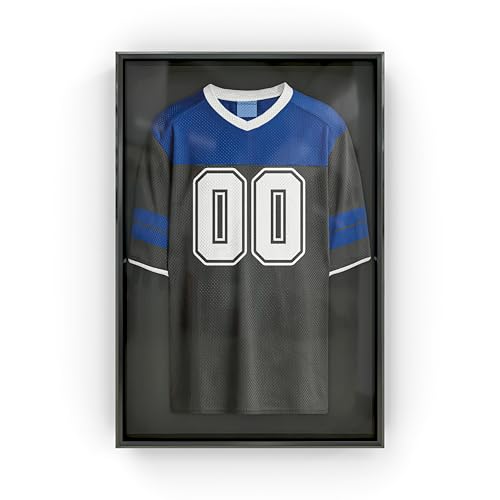
2.8 inches of depth is the whole case for the Snap, and it’s roughly double what the wooden boxes give you. If your jersey is bulky, if it’s a hockey sweater, or if a ball or a puck is going in beside it, the Snap Sports Jersey Display Case is the one shape in the standard size range with somewhere for it all to go.
At 2.8 pounds it’s lightweight acrylic rather than a wooden box, so it goes up without the wrestling match a 10-pound case turns into. The foam board inside lifts out, so you can lay the jersey flat, arrange it, pin it, and drop the whole thing back in.
Read the size line carefully, because the listing carries two. Snap labels the case 20″ x 30″ and measures it at 31.1 x 21.1 x 2.8 inches in the same record, and neither figure is the interior.
Overall ranking: 7.8/10
Individual rankings
- Build Quality: 6.5/10, acrylic at 2.8 pounds, no wood, no stated warranty
- Size and Fit: 9/10, 2.8 inches deep, the most room in the standard size
- Visual Appeal: 7.5/10, an ultra-clear cover with no clarity figure
- Safety and Protection: 5.5/10, no UV figure on the listing, and no lock
- Ease of Assembly: 9/10, a removable foam board you work on flat
- Value for Money: 9/10, mid band buying depth rather than specs
Stand-out features
- 2.8 inches of depth, roughly double the 1.5-inch standard
- 2.8 pounds, the lightest of the standard-size cases by a wide margin
- A removable foam board you pin the jersey to on a table rather than in the frame
Pros
- A folded hockey sweater or a jersey with a puck beside it sits without pressing on the panel
- Goes up on fixings that a 10-pound wooden case rules out
- Swapping in a different jersey later doesn’t mean starting the display over
Cons
- Publishes no UV figure at all, where three rivals here publish 98%
- Has no lock, no hanger, and no pins, so the foam board is the whole system
- Labels itself 20″ x 30″ while measuring 31.1 x 21.1 x 2.8 inches on the same listing
- Uses lightweight acrylic with no wood, no felt, and no published warranty
- Acrylic scratches more easily than glass and holds a static charge that pulls dust
Alternatives to the Snap Case
For more depth again, the Nice C XL Jersey Frame runs 28 x 37 x 4.7 inches with two baseball holders, though it publishes no UV figure, no interior dimension, and no lock, at the highest price of anything I verified. The DisplayGifts cabinet costs similar money and publishes more. If you want a lock and a UV number, the Pro Collector’s case is the better buy.
DisplayGifts Deep Shadow Box (Best for an XL Jersey, or a Jersey Plus a Bat)
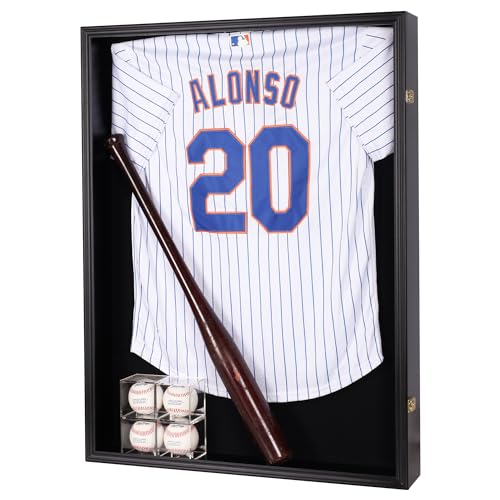
The DisplayGifts JC08 is the only frame here that takes an XL jersey without folding it into a brick, and its interior is the product. The DisplayGifts Deep Shadow Box publishes 34.5 x 26 x 3.25 inches inside, over three times the depth of my top pick and wide enough for a full-size baseball bat, a military jacket, or baseballs in cubes alongside the shirt.
Solid wood at 17.6 pounds, a felt interior, a hinged ultra-clear acrylic door rated at 98% UV protection, a built-in hanger and lock, and no assembly.
Two things to check first. The listing carries two different exterior sizes, 35.4 x 27 x 3.9 inches in the bullets and 37 x 28 x 4.75 inches in its own dimension block, so measure the wall against the larger pair. At a published 17.6 pounds it also needs a stud or a rated anchor.
Overall ranking: 7.7/10
Individual rankings
- Build Quality: 8.5/10, solid wood and a hinged door at 17.6 pounds
- Size and Fit: 9.5/10, 3.25 inches of published interior, takes an unfolded XL
- Visual Appeal: 7.5/10, ultra-clear door on felt, no transparency figure
- Safety and Protection: 7.5/10, 98% UV and a lock, no bolt-throw, no seal figure
- Ease of Assembly: 9/10, “No assembly required, comes in one piece”
- Value for Money: 4/10, three times the standard tier, publishing less
Stand-out features
- A published interior of 34.5 x 26 x 3.25 inches, the deepest verified in this set
- Room for a bat, a jacket, or baseballs in cubes next to the jersey
- A hinged 98% UV acrylic door rather than a fixed panel
Pros
- An XL or XXL jersey goes in unfolded, straight off the hanger
- The door opens on the wall, so changing the display isn’t a dismantling job
- It arrives in one piece, so there’s no 17-pound cabinet to build
Cons
- Carries two conflicting exterior sizes on one listing, 3.9 inches and 4.75 inches deep
- Weighs 17.6 pounds, which rules out adhesive hanging strips
- Publishes a UV figure but no transparency percentage and no panel thickness
- Describes its security as a “Built-in Hanger and Lock” with no bolt-throw
- Costs roughly three times a standard box, close to a framer’s starting quote
Alternatives to the Deep Shadow Box
If the extra room is for a ball rather than a bat, the Snap case gives you 2.8 inches for a fraction of the outlay. If medals, certificates, or a trophy are going on the same wall, a separate cabinet beats one enormous box, and statue display cases are the shape for that job. At this money, a framer is a fair comparison too.
Umbra T-Frame, Medium (Best Flat Frame)
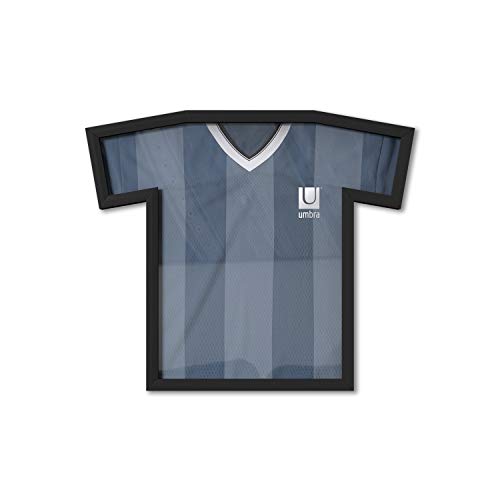
3.8 pounds and a folding template are what set the Umbra T-Frame apart, and the template matters more than it looks. Conservators warn against wire hangers and pins on knitted garments, and the Umbra T-Frame is the only pick in this roundup whose mounting method uses neither. You fold the shirt to the template, and the frame holds it by its own shape.
The T-shaped body shows the sleeves out to the sides instead of tucking them behind the shirt, it’s shatter-proof acrylic made with recycled plastics, and Umbra credits the design to Caleb Ferris and Prakhar Mehrotra, winners of its 2012 competition with the Pratt Institute School of Design.
What the T-Frame gives up is every protection spec in this roundup, which is why I have it last. It publishes no UV rating, no lock, and no seal, because it’s an open-backed flat frame rather than a case. Against CCI’s finding that light damage is cumulative and irreversible, it’s the pick that does least about it.
Overall ranking: 6.5/10
Individual rankings
- Build Quality: 7/10, shatter-proof acrylic at 3.8 pounds, one-year warranty
- Size and Fit: 5/10, flat at about 1.2 inches, no aperture dimension published
- Visual Appeal: 9.5/10, an award-winning design that shows the sleeves
- Safety and Protection: 3/10, no UV figure, no lock, no seal, open at the back
- Ease of Assembly: 8.5/10, folding template, light enough for one person
- Value for Money: 6/10, premium band on Amazon, against Umbra’s own $33.00
Stand-out features
- A folding template instead of a hanger and pins, which is the gentlest mount in this roundup
- 3.8 pounds, light enough for a renter’s fixings
- Shatter-proof acrylic made with recycled plastics
Pros
- The jersey keeps its own shape instead of stretching over a hanger
- One person and one hook put it up, with no stud finder needed
- It reads as wall decor rather than as a specimen in a box
- Umbra publishes full specs on its own site, which is rare here
Cons
- Publishes no UV claim at all, on Amazon or on Umbra’s own page
- Has no lock, no back, and no dust seal, so it sits closer to open display than to a case
- Runs about 1.2 inches front to back, leaving a folded adult jersey nowhere to go
- Publishes no aperture dimension, and Umbra says to measure the part you plan to show first
- Only the Medium is buyable on Amazon, with the Large and Small both out of stock
Alternatives to the Umbra T-Frame
Umbra’s own store lists the T-Frame at $33.00 in Small and Medium, which is the manufacturer’s published price rather than a retail one, and its Medium shows as unavailable there, so Amazon is the live channel. If you want the flat look with the shirt sealed in and rated, the Pro Collector’s case is the nearest compromise. For a thick jersey, take the Snap.
What Size Jersey Frame Fits Your Jersey
Check the jersey before you look at a single frame. Lay it flat, measure armpit to armpit and collar to hem, and write both numbers down.
Imperial Point’s published football size charts give you the ballpark. Fan jerseys run 46 to 48 inches wide by 30 inches high at adult large, 48 to 50 by 31 at XL, and 50 to 52 by 32 at XXL, while a youth large is 35 to 36 by 25. Every one of those is wider than the 22.5-inch interior my top pick publishes, which is why four brands sell the same 31.25 x 23.25 x 1.5-inch box and one still says “You will need to fold the jersey to fit the frame.”
So the standard case is a folded-jersey case. Sleeves tuck behind, the body folds to the frame’s width, and you keep the number and the crest.
- Youth jersey: folds into the standard case with margin to spare, or goes flat in the Umbra T-Frame at 28.5 x 24.5 inches
- Adult S through XL, folded: the standard 31.25 x 23.25-inch case, with 1 inch of usable depth
- Adult XL or XXL unfolded, or a hockey sweater: the DisplayGifts deep cabinet, 34.5 x 26 x 3.25 inches inside
- A jersey plus a ball, a puck, or a plaque: 2.8 inches of depth or more
Two size traps. A listing’s name and its measurement can disagree, and the Snap is the example, labeled 20″ x 30″ and measured at 31.1 x 21.1 x 2.8 inches. Measure the wall too, because the deep DisplayGifts cabinet publishes 35.4 x 27 inches in its bullets and 37 x 28 in its dimension block.
UV Protection and Fading on a Framed Jersey
UV protection is the headline spec on almost every listing in this category, but where you hang the jersey does more for the colors than the panel does. The Canadian Conservation Institute is direct about it in its light-damage guidance. For light-sensitive colors, UV “usually contributes less than half of the fading and often only one tenth.”
CCI’s textile fading tables put a just-noticeable fade on a high-sensitivity color at 4 days to 1 month under 5,000 lux with UV present, and 5 days to 2 months with the UV filtered out. Drop the light to 500 lux and the same color takes 5 weeks to a year with UV, or 7 weeks to 2 years without it. Cutting illumination from 5,000 lux to 50 lux prolongs the colors “by a factor of 100,” while filtering only the UV has “a beneficial but much more limited effect.”
The U.S. National Park Service sets the bar plainly in its museum handbook for textiles: “The maximum illuminance recommended for textiles is 50 lux. All UV light should be filtered.”
Then there’s what “98% UV protection” means on a listing that never states a wavelength band. Röhm’s ACRYLITE knowledge base says general-purpose acrylic already filters about 90% of UV between 200 and 390 nm with no special treatment, while genuine UV-filtering grades filter close to 100%. CCI names those grades by product, Plexiglas UF-5 and Acrylite OP-2 and OP-3, and not one seller in this roundup names the grade it uses.
Three of these six publish no UV figure at all, which puts the wall decision entirely on you.
Acrylic, PC Panel, or Tempered Glass
Three glazing materials compete on this search, and all six of my picks use the same one. Every frame here is acrylic, while the shopping results around them advertise polycarbonate “PC glass” panels and real tempered glass at similar money. Those polycarbonate listings quote a UV percentage without naming a filtering grade or a panel thickness, which is the same gap the acrylic listings have.
Acrylic is light, shatter-proof, and cheap, and CCI lists its three documented weaknesses in its glazing guidance: it scratches, it picks up an electrostatic charge that pulls dust onto it, and it bows, since “Large pieces of plastic must be 3 mm thick to avoid bowing.”
CCI says glass “picks up very little electrostatic charge” and “is more resistant to scratching than many plastics,” at the cost of being heavier and being “sharp, breaks easily, and is a hazard.” Tempering helps but doesn’t remove the risk. The National Glass Association reports fully tempered glass at roughly four times the breakage strength of annealed glass while listing a “Possibility of spontaneous breakage” among its characteristics.
For a frame that already weighs 9 to 17 pounds on a wall, acrylic is the right default, and glass earns its weight only if scratching is your main worry. None of these six publishes a panel thickness, and a published figure would be loose anyway, since ACRYLITE’s thickness tolerance puts a nominal 3.0 mm cast sheet anywhere between 2.3 and 3.7 mm under ISO 7823-1.
Locks, Doors, and Dust Seals
The U.S. National Park Service’s museum security handbook says case locks “need bolt-throws at least one inch in length with ‘captive’ keys,” and warns against warded locks, spring latches, key-in-knob locks, and deadbolts under three quarters of an inch.
Not one of these six states a bolt-throw. When I score Safety and Protection, that kind of silence counts against a case, because the seller had the chance to print a number and chose a phrase instead. Treat the gold-plated locks as a deterrent against a curious hand at a party rather than as security.
No jersey case publishes a dust-seal figure either. CCI’s airtightness bands run from 0.1 air exchanges per day or less for a very well sealed case, through 0.3 for well sealed and 1.0 for moderately sealed, to anything above 1.0 for unsealed, and at 1 exchange a day dust settles inside roughly four times slower than outside. With no figure to read, the check falls to the product photos. Look for a door or panel that closes flush and a back that screws down, the same check that decides a diecast display case.
CCI says “Sharp, gritty particles of silica, commonly found in dust, can cut through fibres,” and that dust can carry trace metals that speed up light damage.
Two mounting notes catch people out. 3M’s own documentation says Command Picture Hanging Strips are “Not recommended for mounting shelves, tapestry or shadow boxes” and “Do not hang valuable or irreplaceable items,” topping out at 7.2 kg for four pairs of Large, so every wooden case here at 9.55 to 17.6 pounds needs a stud or a rated anchor. Pick an interior wall too, because CCI flags high mold risk behind a textile on a cold exterior wall, where mold takes three months or more at 70% relative humidity and a few days at 90%.
Mounting a Jersey Without Damaging the Fabric
Avoid the wire hanger in the box if the jersey is one you can’t replace. CCI Notes 13/5 is unambiguous on all three pieces of hardware these cases ship: “Do not use lightweight wire hangers. They do not adequately support the garment,” “Remove pins and staples. These put stress on the fabric and are almost certain to rust,” and “avoid hanging knits and bias-cut costumes.”
A modern jersey is a knit. CCI’s textile guidance says knits “are easily deformed and can stretch out of shape if they are hung vertically for display or storage. Often, this distortion becomes irreversible.”
Line that up against what’s in the boxes. Five of my six picks ship a hanger, a pin board, or both, and the sixth ships a folding template and nothing else. The Umbra T-Frame is the only pick whose mounting method doesn’t fight the guidance, and it’s also the pick with no UV rating and no lock, so the gentlest mount here comes with the least protection.
Conservators use a board instead. CCI Notes 13/6 describes acid-free 4-ply or 8-ply matboard cut larger than the textile and covered with prewashed cotton pulled taut on the grain, and the NPS handbook adds that a textile should hang in the warp direction rather than on the bias, with the mount spreading the weight rather than loading one point. None of these cases supplies that.
For a retail jersey you could buy again, the supplied hanger is a risk worth taking, and pinning through a seam allowance beats pinning through the body. For a signed, game-worn, or irreplaceable shirt, the board is the whole job, and a framer’s quote is mostly the price of building one.
Ready-Made Frame vs. DIY vs. a Professional Framer
Hall of Frames advertises custom jersey framing starting at $299.99 for sizes up to 32 x 40 inches, which is the figure that makes a ready-made case look like a steal and a framer look like a markup.
A framer’s quote includes mounting the jersey, cutting the mat, the glazing, and the labor. A ready-made case gives you the box and hands you the mounting.
- Ready-made case: the cheapest route, in a band far below a framer’s starting price, delivered in days with a hanger and pins in the carton. You do the mount.
- DIY build: you buy the moulding, the backing, the mat, and the glazing and assemble it. webpictureframes.com sells a jersey moulding with a 1 3/4-inch rabbet height for exactly this. The mount is still the hard part, and the part that decides how the jersey ages.
- Professional framer: Michaels lists jerseys as a named custom-framing category, though it publishes no price. Regional shops like Hall of Frames publish a starting figure and quote up by size and moulding.
Pay the framer when the jersey is signed, game-worn, or irreplaceable, when it’s bigger than about 35 inches, or when you don’t want a knit on a hanger for the next decade. A ready-made case is enough for a retail jersey, a milestone gift, or a youth shirt on an interior wall out of direct sun, and that covers a lot of the jerseys that end up on walls.
Which Jersey Frame to Buy
Most jerseys belong in the Pro Collector’s case, because it tells you what you’re getting before you pay for it. Buy the Snail if you’d rather it turned up assembled and you can live with 92% clarity. Buy the KCRasan if the jersey is sentimental rather than valuable and budget decides.
A bulky jersey or a jersey with a ball beside it wants the Snap’s 2.8 inches. An XL or XXL jersey, a hockey sweater, or a jersey with a bat wants the DisplayGifts deep cabinet. A shirt you want read as wall art, hung light, wants the Umbra T-Frame, as long as you accept that it filters nothing and locks nothing.
And if the jersey is signed or game-worn, take it to a framer and have it mounted on a fabric-covered board. That’s the one answer this page can’t sell you. For everything else, start with more jersey display guides.
Frequently Asked Questions About Jersey Frames
What’s the best way to frame a jersey?
The best way to frame a jersey is to fold it to the frame’s width and support it on a fabric-covered board rather than hanging it on a wire hanger. CCI warns against lightweight wire hangers, against pins that stress the fabric and rust, and against hanging knits at all. Ready-made cases ship hangers and pins because they’re cheap to include, so for anything irreplaceable, a mounted board is the upgrade worth paying for.
How much does it cost to get a jersey framed?
Professional jersey framing starts around $299.99 at Hall of Frames for sizes up to 32 x 40 inches and rises with size and moulding. A ready-made display case costs a fraction of that, and a DIY build sits in between once you’ve bought the moulding, mat, backing, and glazing.
Can I frame a jersey at home?
Yes, you can frame a jersey at home, and most people do it with a ready-made shadow box. Fold the jersey to the frame’s interior width, tuck the sleeves, and pin through a seam allowance rather than through the body. If you’d rather build the frame yourself, moulding profiles made for jerseys carry a rabbet deep enough for a folded shirt.
Will Michaels frame a jersey?
Yes, Michaels frames jerseys. Its custom-framing menu lists jerseys as a named category alongside its other specialty work, though Michaels publishes no price for the job, so you’ll need a quote in store. Independent framers and sports-framing specialists take the same work, and some of them publish a starting figure.
Where can I buy a jersey frame?
Jersey frames sell through Amazon, Walmart, Target, Home Depot, Lowe’s, and Hobby Lobby, plus display specialists like sfDisplay and custom-frame shops like CustomPictureFrames.com. Amazon carries the widest range of ready-made shadow box cases, which is where all six of my picks sit. The IHEIPYE Jersey Display Frame Case is a good example of the standard wooden box every one of those channels stocks a version of.
What are the different types of jersey frames?
There are four types of jersey frame. A flat frame or T-frame holds the folded shirt behind a panel about 1.2 inches deep. A ready-made shadow box case is the 31.25 x 23.25 x 1.5-inch wooden box with a lock. A deep shadow box cabinet runs 3 to 4 inches deep with a hinged door and takes an unfolded XL jersey. A custom build is a framer mounting the jersey on a board and building the frame around it.
How do you display a jersey without a frame?
You can display a jersey without a frame on a padded hanger and a wall hook, over a horizontal rail, or folded flat with the crest showing. Each gives up dust protection, UV filtering, and a barrier against handling, which CCI names as the three reasons display cases beat open display. Hanging is also the worst option for a knit, so keep the jersey flat and out of the light.
How do you choose the right size jersey frame?
Choose a jersey frame by measuring the shirt flat, armpit to armpit and collar to hem, then matching it to the frame’s interior dimension rather than its exterior. Adult jerseys fold into the standard 31.25 x 23.25-inch case, and an XL or XXL displayed unfolded needs the deeper cabinet at 34.5 x 26 inches inside. The interior figure is the first thing I look for on any listing, and four of my six picks don’t publish one. Where it’s missing, assume the frame takes about a third of the stated depth.
Can you put two jerseys in one frame?
Two adult jerseys won’t fit in one standard 31.25 x 23.25-inch case, since a single folded jersey already fills the 22.5-inch interior width. Two frames side by side is the usual answer, and the IHEIPYE 2-pack sells the same box in a pair for exactly that. Hanging one high and one low also looks deliberate rather than crowded.
What are the benefits of framing a jersey?
Framing a jersey protects it from dust, light, and handling, and it turns a shirt in a closet into something you see every day. CCI puts the case simply, saying display cases “protect against dust, reduce pollutant exposure and provide a barrier against contact….” The light protection matters most, because light damage to textiles is cumulative and irreversible, so a panel and a shaded wall buy you years you can’t get back later.