Article Summary
The best display case for Pokémon cards is sized for the holder around the card, not for the card itself. A standard card measures 2.5 by 3.5 inches, and CGC publishes its graded holder at roughly 3.15 by 5.30 inches. PSA publishes no slab size at all, so a ruler on your own holder is the number to trust. Only three of these six cases publish a UV percentage, and none names a wavelength band, grade, or test method. Cases for Collectibles ranks the six by display job, from the sfDisplay 35-card locking cabinet at 8.3 to the QTYORD aluminum show case at 6.3. Placement beats the panel, so keep the case off the wall the sun crosses.
This article contains affiliate links. We earn a commission if you make a purchase, at no additional cost to you.
The best display case for Pokémon cards is the one built around the holder your card already lives in. A standard card is 2.5 by 3.5 inches, and the graded holder around it runs closer to 3.15 by 5.30 inches, which is the figure CGC publishes. PSA never publishes the outside of the slab, so your own ruler is the number to trust.
The second spec is UV, and that’s where these listings get vague. Three of the six cases below publish a percentage, 66%, 98%, and 100%, and not one names a wavelength band, a grade, or a test method.
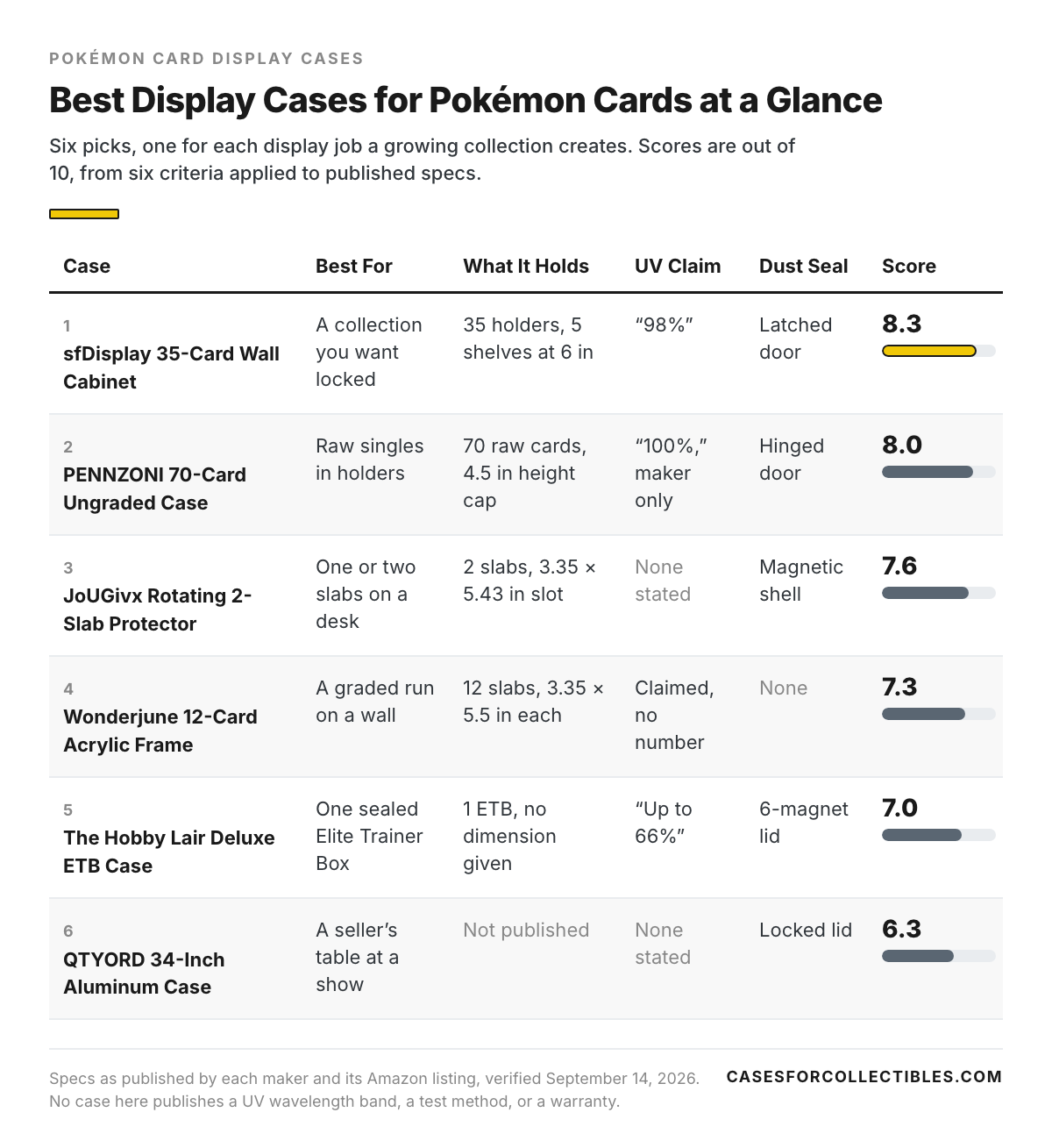
Best Display Cases for Pokémon Cards at a Glance
| # | Case | Best for | Holds | UV claim | Dust seal | Price | Score |
|---|---|---|---|---|---|---|---|
| 1 | sfDisplay 35-Card Wall Cabinet | A collection you want locked | 35 holders, 5 shelves | “98% UV door” | Latched door | Premium | 8.3 |
| 2 | PENNZONI 70-Card Ungraded Case | Raw singles in holders | 70 raw cards, 4.5 in cap | “100% UV,” maker only | Hinged door | Premium | 8.0 |
| 3 | JoUGivx Rotating 2-Slab Protector | One or two slabs on a desk | 2 slabs, 3.35 x 0.31 x 5.43 in slot | None stated | Magnetic | Mid-range | 7.6 |
| 4 | Wonderjune 12-Card Acrylic Frame | A graded run on a wall | 12 slabs, 3.35 x 5.5 in each | Claimed, no number | None | Mid-range | 7.3 |
| 5 | The Hobby Lair Deluxe ETB Case | One sealed Elite Trainer Box | 1 ETB, no dimension given | “Up to 66%,” Amazon | 6-magnet lid | Budget | 7.0 |
| 6 | QTYORD 34-Inch Aluminum Case | A seller’s table at a show | Not published | None stated | Locked lid | Upper mid | 6.3 |
How I Evaluated These Pokémon Card Display Cases
I scored every case here against the six criteria this site uses, and you should know what that scoring rests on. Nobody handled these cases. There’s no teardown and no owner star ratings, because Amazon publishes no review text through the feed these specs came from. This is a spec-and-evidence evaluation, built on listing specs pulled through Amazon’s product API on September 14, 2026 and checked against each maker’s page and published conservation sources.
On the Elite Fourum board, a collector posting as Kh36 wrote out this same checklist unprompted: a lock to keep kids out, the case screwed to wall studs, a glass cover “to keep the dust off the cards,” and “a spot in the house that has very little direct sunshine and stable humidity.” Where a maker and its listing disagree, I count it against the case.
The six criteria:
- Build quality: materials, panel thickness, hardware.
- Size and fit: interior figures, and which holders they seat.
- Visual appeal: clarity and backing.
- Safety and protection: UV claim, dust seal, lock, panel behavior.
- Ease of assembly: assembled or flat-packed, and what ships with it.
- Value for money: what the band buys, and the warranty.
No case here carries a price, because Amazon prices move and a printed one goes stale inside a week. The bands run budget, mid-range, and premium, and the table above puts every pick in one. None of the six publishes a warranty, and the bar I hold a display case to is at least one year.
Slab and Holder Fit Across PSA, CGC, BGS, and Raw Cards
What goes in the case is the holder, not the card, and almost nobody publishes the holder’s size. PSA puts a standard trading card at 2.5 by 3.5 inches and up to 40 pt thick, and its holder page lists the card sizes it grades, up to 2 11/16 by 3 13/16 inches for a standard slab. The one figure it withholds is the outside of that slab, which is what your shelf has to clear.
CGC is the exception, publishing its holder dimensions at approximately 3.15 by 5.30 inches, in five thicknesses. A raw card in a 35 pt toploader is 3 by 4 inches outside. Beckett and SGC publish nothing, so a ruler laid on your own slab is the only figure that covers every case here, and that’s what “measure before you buy” leaves out. It’s the discipline behind buying cases sized by scale.
What a UV Percentage on a Display Case Means
A UV percentage is worth what the seller tells you about how it was measured, but in this category they tell you nothing. The Hobby Lair says up to 66% on Amazon. sfDisplay says 98%. PENNZONI’s own site says 100%, while the Amazon listing for the same cabinet says only “UV protection.”
The wavelength band is what those numbers hide. Röhm, which makes ACRYLITE, publishes that general-purpose acrylic sheet filters about 90% of UV between 200 and 390 nm. The same company, measuring against real sunlight, says general-purpose acrylic and float glass “only filter out a small amount of the UV-light present in solar radiation,” while its UV-filtering sheet absorbs approximately 98%. One manufacturer, two honest numbers, and the difference is which wavelengths got measured.
The Canadian Conservation Institute’s glazing guidance points to Plexiglas UF-5 and ACRYLITE OP-2 and OP-3. No case here names one, and the same unverified figures turn up on jersey display frames.
The slab in your hand may already be doing part of this job. When PSA moved to a new holder polymer in 2024, its mechanical engineering manager, Brian Alvey, called the material “more shatter-resistant, more resistant to UV damage from the sun, and even more scratch-resistant.” PSA publishes no percentage and no wavelength band behind that claim, and it disclaims the outcome anyway, telling submitters it is not “responsible for any type of fading that may occur once a ticket is encapsulated in a PSA holder.”
CGC doesn’t claim UV protection for its holder at all, and the only UV on its holder page is anti-counterfeiting ink in the label. Four of the six cases here hold slabs, so the case you buy is a second layer over protection nobody has quantified.
Filtering UV also does less than these listings imply. CCI’s light damage guidance is that for light-sensitive colors, UV usually contributes less than half the fading and often only a tenth.
A user posting as pfm on the Elite Fourum board won’t display his best cards at all. “Until I have a solution involving museum glass, my cards are staying in a cool, dark, dry place away from UV rays,” he wrote.
Dust Seal, Humidity, and Whether a Case Really Closes
None of these six publishes a sealing figure, so “dustproof” here is a marketing word. CCI runs the real numbers on display case airtightness. A case exchanging its air once a day collects coarse dust about four times slower than the open room, and museums specify 0.1 to 1.0 air exchanges a day for a new display case.
Not one of these six comes anywhere near that, so judge the door. A hinged door with a latch beats a magnetic lid, and a magnetic lid beats an open frame, which sits with the shelves and racks behind most complaints about keeping dust off collectibles. CCI also tells you to keep paper objects below 65% relative humidity.
How Much Security a Lock on a Display Case Buys
A lock on a consumer display case buys delay. The U.S. National Park Service publishes a locking exhibit case specification, which asks for one-inch bolt-throws with captive keys, hidden security screws, and non-removable hinge pins.
NPS also says plainly, “Do not use easily compromised locking systems,” naming spring latches. Two of the cabinets here ship brass latches or locks with a key, and the show case ships two locks it never specifies. All three stop a curious houseguest or a kid. None is a safe, and screwing the cabinet into studs does more than the latch.
1. sfDisplay 35-Card Wall Cabinet, Best Lockable Cabinet
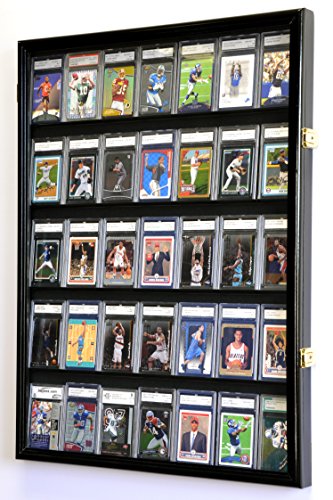
My pick for a graded collection you want behind a locked door is the sfDisplay 35-Card Wall Cabinet, a wall display case that shuts and latches. sfDisplay publishes an interior depth of 0.75 inches and five over-lip shelves with 6 inches of clearance, so you can check before ordering that a slab seats flat and a CGC thick holder clears. The 98% on the door is the only UV figure sfDisplay publishes, and I’d read it as marketing until the company names a band.
Overall ranking: 8.3/10
My scores:
- Build quality: 8.5/10
- Size and fit: 8.5/10
- Visual appeal: 8/10
- Safety and protection: 8.5/10
- Ease of assembly: 9.5/10
- Value for money: 6.5/10
Stand-out features:
- Published interior figures: 0.75 in depth, 6 in shelf clearance.
- Fully assembled: beech hardwood, felt backing, brass latches, hardware included.
Pros:
- Publishes both an exterior and an interior figure.
- A closed, hinged, lockable door, 35 holders on a 31.5 by 23.5 inch footprint.
Cons:
- sfDisplay and Amazon disagree on the numbers that decide the install. Amazon lists 2.25 inches deep and 12 pounds, sfDisplay lists 1.75 inches and 14 pounds.
- The lock is brass latches, nowhere near the NPS specification.
- The most expensive cabinet here, no published warranty.
Alternatives:
- Temgee 36-Card Wall Cabinet: publishes 5.6 in shelf height, 1.1 in interior depth, and a 5.5 in card limit, with two locks.
- Grintus 24-Card Wall Case: two gold-plated locks and 1.2 in of inside depth, but its own bullets and Amazon’s record disagree on its size.
2. PENNZONI 70-Card Ungraded Display Case, Best for Raw Cards
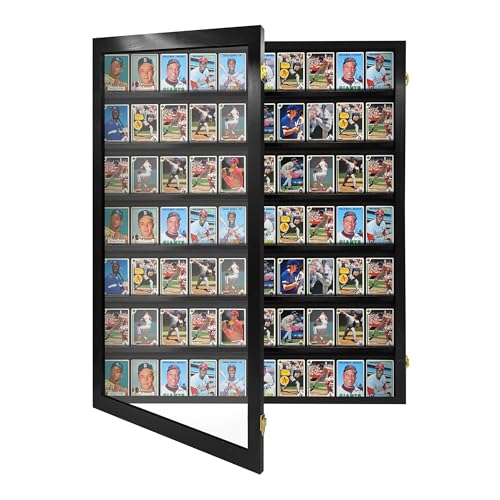
70 raw cards go behind one locking hardwood door in the PENNZONI 70-Card Ungraded Display Case, the only case here designed around a raw card instead of a slab. PENNZONI publishes a 34.5 by 39 inch exterior and a 33 by 36.5 inch interior, so wall space and clearance are separate numbers you can check. The card-height ceiling is 4.5 inches, which a 3 by 4 inch toploader clears and a graded slab does not, since the one holder with a published height, CGC’s, runs 5.30 inches.
Overall ranking: 8.0/10
My scores:
- Build quality: 9/10
- Size and fit: 8.5/10
- Visual appeal: 8.5/10
- Safety and protection: 7/10
- Ease of assembly: 9/10
- Value for money: 6/10
Stand-out features:
- Both figures published: 34.5 by 39 inches outside, 33 by 36.5 inside.
- Real cabinet hardware: brass hinges, two locks with a key, anti-skid shelf, hooks.
Pros:
- Built for raw singles in toploaders and magnetic holders.
- A closed hardwood cabinet, which seals better than any frame here.
Cons:
- PENNZONI claims 100% UV protection on its own site, but a flat 100% names no grade, no wavelength band, and no test method. The Amazon listing for the same cabinet drops the number entirely.
- At 18 pounds it’s past 3M’s Command Hanging Strips, the heaviest adhesive mount on the shelf, which 3M caps at 7.2 kg with a warning not to hang irreplaceable items. Use studs.
- No graded slab fits. PENNZONI publishes no warranty.
Alternatives:
- Ultra PRO ONE-TOUCH Wall Display: one card on a wall, limited to 35 pt holders, sold separately.
- 35 pt UV ONE-TOUCH Magnetic Holder: the holder it needs, non-PVC with UV-blocking additives and no published figure.
3. JoUGivx Rotating 2-Slab Protector, Best for a Graded Slab on Your Desk
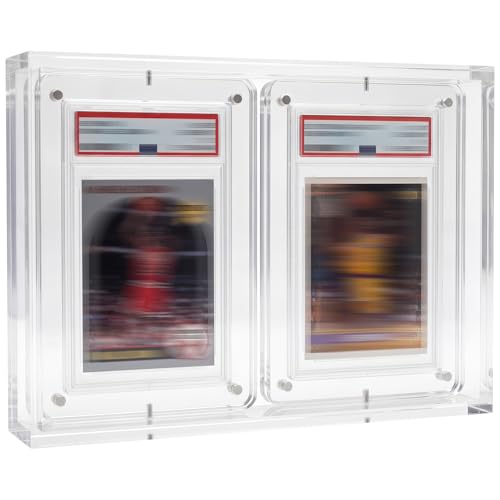
The JoUGivx Rotating Magnetic 2-Slab Protector is my pick for the collector with one or two slabs they want at arm’s length, on a desk or beside the monitor. It publishes both numbers the desktop competition leaves out, a slot of 3.35 by 0.31 by 5.43 inches and 8 mm acrylic throughout. CGC’s 3.15 by 5.30 inch holder seats with room to spare, and the base spins so a double-sided card reads either way. PSA publishes nothing about the outside of its slab, so measure your own and check it against that slot before you order.
Overall ranking: 7.6/10
My scores:
- Build quality: 8/10
- Size and fit: 7.5/10
- Visual appeal: 8/10
- Safety and protection: 6/10
- Ease of assembly: 9.5/10
- Value for money: 6.5/10
Stand-out features:
- 8 mm acrylic, published: the only desktop pick here stating a thickness.
- Exact slot size: 3.35 by 0.31 by 5.43 inches, checkable against your slab.
Pros:
- States the slot size and the panel thickness.
- A magnetic shell per slab, and it arrives ready to use.
Cons:
- The listing never mentions UV across five bullets. It sells scratch-proof and dust-proof construction. On light it says nothing, in a category where rival listings claim 98%. Keep this one away from a window.
- It warns twice that the slab must be no more than 5/16 of an inch thick. That’s 7.9 mm, and CGC’s thick holder takes cards to 7.25 mm before the plastic, so thicker holders don’t seat.
- No warranty published, and the maker has no live product page to check against.
Alternatives:
- Yotakala 3-Slab Magnetic Frame: one more slot and a tabletop stand, but no published thickness.
- WEIMINLI Magnetic Acrylic Slab Case: a single slab, and the only product here publishing a warranty.
4. Wonderjune 12-Card Acrylic Frame, Best Wall Display Case for Graded Slabs
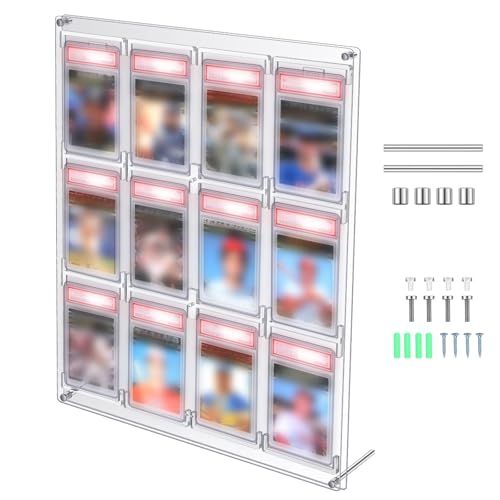
12 graded slabs sit in one frame on the Wonderjune Acrylic PSA Slab Display Case, and its arithmetic is the reason it made the list. Four columns of 3.35 inch compartments is 13.4 inches and three rows of 5.5 inches is 16.5 inches, both inside the published 19.49 by 16.54 inch frame, so a wall plan drawn from this listing holds. A word of caution, though. The compartments are open at the front, so it has no dust seal.
Overall ranking: 7.3/10
My scores:
- Build quality: 6.5/10
- Size and fit: 8.5/10
- Visual appeal: 8/10
- Safety and protection: 6/10
- Ease of assembly: 7.5/10
- Value for money: 7.5/10
Stand-out features:
- Compartments that reconcile: 12 at 3.35 by 5.5 inches, in a 19.49 by 16.54 inch frame.
- Wall or tabletop from the same frame, no second purchase.
Pros:
- The published frame and compartment figures agree.
- 12 slabs visible at once, and it doubles as a shelf piece if you can’t drill.
Cons:
- Wonderjune publishes 92% transparency and no UV number. 92% is exactly the transmission Röhm publishes for plain colorless ACRYLITE sheet between 395 and 1000 nm, the signature of general-purpose acrylic. The listing says the case is infused with a UV protection feature and never names a percentage or grade.
- Open-front compartments, so dust lands on the slabs.
- Stock is thin, down to 12 units when I checked, and the panel thickness is nowhere on the listing.
Alternatives:
- WEIMINLI 5-Card Acrylic Frame: fewer slabs, but a published build of 3 mm panels around an 8 mm center.
- WEIMINLI 9-Card 3×3 Frame: skip it. Nine of its published 5.43 by 3.23 inch slots can’t fit its published 12.99 by 7.48 inch frame.
5. The Hobby Lair Deluxe ETB Case, Best for a Sealed Elite Trainer Box
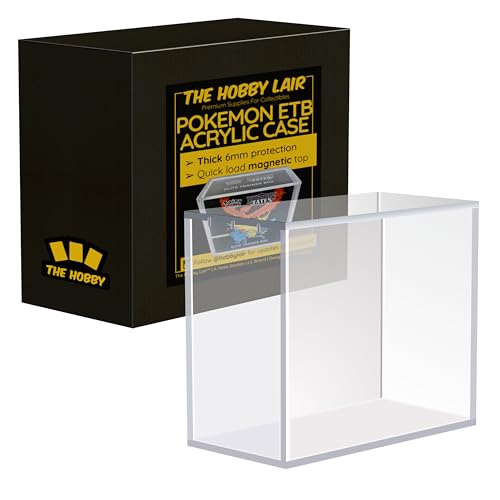
The Hobby Lair Deluxe ETB Acrylic Case is the cheapest pick here and the only one built around a sealed Elite Trainer Box you have no intention of opening. It’s 6 mm acrylic on both the Amazon listing and the maker’s page, with a six-magnet top that loads from above. Both sources call the material non-PVC and acid-free, which matters, because the default holder in this hobby is a toploader Ultra PRO calls rigid PVC, and CCI says to avoid PVC touching an object.
Here’s how the six scores broke down. Build quality 8, for 6 mm acrylic published on both the listing and the maker’s page. Size and fit 4, because neither source gives a single dimension for a case whose only job is fitting one box, and the maker rules out the wider ETB Plus and Celebrations variants. Visual appeal 7, for a clear box that shows the artwork inside and adds nothing of its own.
Safety and protection 7, for a six-magnet lid and non-PVC, acid-free material, against a 66% UV figure with no test method. Ease of assembly 8.5, for a magnetic lid that snaps into place. Value for money 7.5, the cheapest pick here with no warranty. That 4 on fit is what keeps a well-built case out of the top three.
Overall ranking: 7.0/10
My scores:
- Build quality: 8/10
- Size and fit: 4/10
- Visual appeal: 7/10
- Safety and protection: 7/10
- Ease of assembly: 8.5/10
- Value for money: 7.5/10
Stand-out features:
- 6 mm acrylic on every panel, published twice, thicker than most at this price.
- A published UV figure: up to 66%, one of only three in this roundup.
Pros:
- Names its material chemistry, non-PVC and acid-free.
- A top-loading magnetic lid, and the cheapest way to get a sealed box under a lid.
Cons:
- Neither source publishes a single dimension, for a product whose only job is fitting one box. The same brand’s booster-box case publishes its inner dimensions in the first bullet.
- The maker’s page says the case will not fit wider ETB Plus or Celebrations Pokémon Center variants, and that exclusion appears nowhere in the Amazon bullets.
- The 66% figure and the wording around it appear word for word on Ultra PRO’s pages, and neither brand names a test method.
Alternatives:
- Hobby Lair Deluxe Case for ETB Plus: the same case built for the wider box this one excludes.
- Break Tradition ETB Acrylic Display Case: 8 mm side walls at 7.87 by 3.93 by 7 inches, though it never says if that’s inside or out.
6. QTYORD 34-Inch Aluminum Case, Best for a Card-Show Table
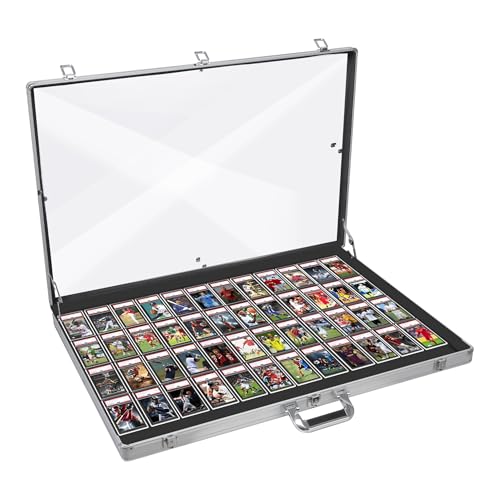
34 by 22 inches of aluminum frame with a carry handle and two locks makes the QTYORD Aluminum Table Top Display Case the only in-stock case I could verify that’s built for a table rather than a wall. At 3 inches high and 10.7 pounds it covers about half the length of a six-foot show table. Elite Fourum user 0ean asked other vendors for the cheapest secure way to show graded cards at an event, and the one reply, from A.P.Speeze, pointed at rentals. Dealers at the 2025 National Sports Collectors Convention rented a showcase at $75 per case with a lock and key, so price that first.
Overall ranking: 6.3/10
My scores:
- Build quality: 6.5/10
- Size and fit: 4/10
- Visual appeal: 7/10
- Safety and protection: 5/10
- Ease of assembly: 8.5/10
- Value for money: 7/10
Stand-out features:
- Built to travel: a carry handle on a 34 by 22 by 3 inch case at 10.7 pounds.
- Two locks on a lidded tray, more than most show cases ship.
Pros:
- The only verified in-stock case here sized for a vendor table.
- Light enough to carry in one hand, with an aluminum frame that survives a trunk.
Cons:
- The listing names a material that doesn’t exist. It calls the case 75% aluminum alloy and 25% tempered acrylic glass, while the title calls the whole thing a glass display case. Tempering is a heat treatment for glass, and the National Glass Association puts tempered glass at roughly four times the breakage strength of annealed glass while warning that small particles may fall out if it breaks. QTYORD publishes no thickness for either.
- No capacity, no slots, and no felt bed published anywhere, so cards lie loose on a flat tray.
- No UV claim at all, on the pick most likely to spend a weekend under hall lighting.
Alternatives:
- Gtouse Portable Trade Show Display Case: the same 34 by 22 by 3 inch format with three locks and a UV-resistant acrylic top.
- Roxy Display counter-top showcase: real tempered glass with a sliding door and a lock, but 38 pounds and no handle makes it a shop counter.
Which Pokémon Card Display Case to Buy for Your Setup
Your display job decides this purchase before brand or price does, so match the case to what you own and where it’s going.
- One or two slabs on a desk: the JoUGivx rotating protector, for its slot size and 8 mm panels.
- A graded run on a wall: the Wonderjune 12-card frame, if you can live without a seal.
- Raw singles in holders: the PENNZONI 70-card cabinet, unless those cards are getting graded later.
- A sealed Elite Trainer Box: the Hobby Lair case, after you check the ETB Plus exclusion.
- A collection you want locked: the sfDisplay 35-card cabinet, my highest-scoring pick.
- A vendor table: the QTYORD aluminum case, with rental priced against it.
If the next display problem is a different shelf, the rest of this site covers display cases by collectible. Measure the holder before you measure the shelf, and treat every UV percentage on this page as a number nobody has tested. Keep the case off the wall the sun crosses and you’ve done more for the cards than any panel here will. Pick the line above that matches what you own, and buy that one.
Frequently Asked Questions About Pokémon Card Display Cases
What are the best ways to display Pokémon cards?
There are four practical ways to display Pokémon cards, and they split by what you own.
A rotating desk stand like the JoUGivx Rotating Magnetic 2-Slab Protector handles one or two slabs. An acrylic wall frame holds a graded run in a grid. A closed cabinet with a lock protects a larger collection and seals better than any frame. A lidded table case travels to a show and back.
What is the best card display case for card shows?
The best card display case for a show is a lockable, low-profile table case with a carry handle, which is what the QTYORD Aluminum Table Top Display Case is. Price a rental against it first, since the 2025 National Sports Collectors Convention rented dealers a locking showcase for $75, and a couple of shows a year costs less than owning one.
What is the best box to store Pokémon cards?
The best box to store Pokémon cards is a plain card box holding sleeved cards in sorted rows, kept in a room with steady temperature and humidity, with toploaders or magnetic holders for the ones you care most about. A display case does a different job, which is putting one shelf of the collection behind a panel. Most collectors need both, because a case showing 12 slabs does nothing for the rest of the collection in the closet.
Do display cases really protect Pokémon cards from fading?
A display case slows fading and doesn’t stop it. UV does under half the damage to a light-sensitive color and often only a tenth, by the Canadian Conservation Institute’s measure, so a perfect filter leaves most of the fading in play. A case on a wall the sun never touches beats a UV-rated case in a bright window.
Will a trading card display case fit a PSA or CGC slab?
Only if the case publishes a slot or shelf figure big enough for the holder, and plenty don’t. CGC publishes its holder at approximately 3.15 by 5.30 inches and PSA publishes no holder size at all, while cases sold for trading cards are often sized for a 3 by 4 inch toploader. The sfDisplay 35-Card Wall Cabinet publishes 6 inches of shelf clearance, a figure you can check a slab against. I skip any listing that says “fits trading cards” and stops there.
Can humidity ruin Pokémon cards in a display case?
Humidity can ruin cards in a display case, because nothing in this price range controls the air inside it. CCI’s guidance for paper is to keep relative humidity under 65% and avoid long stretches above 75%, and it puts paper at 30% humidity at twice the lifespan of the same paper at 50%.
How do you hang a Pokémon card display case on the wall?
Hang anything over about 15 pounds on studs or heavy-duty toggle bolts, never on adhesive strips, which 3M itself caps at 7.2 kg. TOGGLER publishes up to 238 pounds in half-inch drywall for its SNAPTOGGLE bolt. That’s a manufacturer maximum, so derate it for anything you can’t replace. The same rule covers wall-mounted display cabinets.