Article Summary
The best display case for figures for most collectors is the Perfect Cases 1/6th Scale Figurine Display Case. The The Perfect Cases 1/6th Scale publishes a 10 x 10 x 14-inch interior in real glass, with a 50% or a direct-order 99% UV level. I scored the six display cases on build quality, size and fit, visual appeal, safety and protection, assembly, and value, from 8.8 down to 6.5. Interior clearance rules out more display cases for figures than price does, and three of the six picks make no UV claim at all. Clear acrylic is not a UV filter, so moving the case off a sunlit wall does more against fading than any material upgrade.
This article contains affiliate links. We earn a commission if you make a purchase, at no additional cost to you.
My pick for most collectors is the Perfect Cases 1/6th Scale Figurine Display Case.
It’s real glass on a real wood base, the maker publishes the inside dimensions rather than the outside ones, and it’s the only case here that lets you choose the UV level, at 50% standard or museum-grade 99% ordered direct, instead of reading an adjective.
A display case for figures has four jobs. Keep dust off. Keep hands off. Keep damaging light off. Give your tallest piece room to stand up once the frame and the base are counted.
Most listings settle the dust question and leave the other three to the photographs. I ranked six cases on interior clearance, on what the door or lid closes, and on what each maker will put in writing.
Display Cases for Figures at a Glance
A box for one figure and a cabinet for the collection are different purchases, and that choice comes before any product. How much more you plan to buy settles it.
A box is cheaper and protects one piece properly, but you buy another with every new figure. A cabinet costs more once and then absorbs everything after it. The Best for column says which side each case is on, and interior clearance disqualifies more of them than price does.
| Case | Best for | Interior clearance | Dust seal | UV claim | Overall |
|---|---|---|---|---|---|
| 1. Perfect Cases 1/6th Scale | One 1/6 figure or a resin statue | 10 x 10 x 14 in | Lift-off case, one joint | 50% glass, 99% direct order only | 8.8/10 |
| 2. sfDisplay Large 110+ Cabinet | 60 to 110 LEGO minifigures | 23 x 17 x 1.5 in, 2.5 in shelf gap | Hinged locking door | 98% acrylic door, maker’s claim | 8.2/10 |
| 3. Better Display Cases A017-MB | One figure up to a foot tall | 12.85 x 5.10 x 5.10 in | Removable back panel | None claimed | 7.8/10 |
| 4. Perfect Cases 1/10th Scale | 6- and 7-inch action figures | 8 x 8 x 10 in | Lift-off case, one joint | 50% glass, 99% direct order only | 7.7/10 |
| 5. VEVOR 67-Inch 5-Tier Cabinet | A collection that keeps growing | No per-tier interior published. 5 tiers, 40 lb per shelf | Three doors, no gasket | None claimed | 7.2/10 |
| 6. Better Display Cases SP33 | A shallow wall, no floor space | 15.10 x 3.10 x 15.10 in | Removable back panel | None claimed | 6.5/10 |
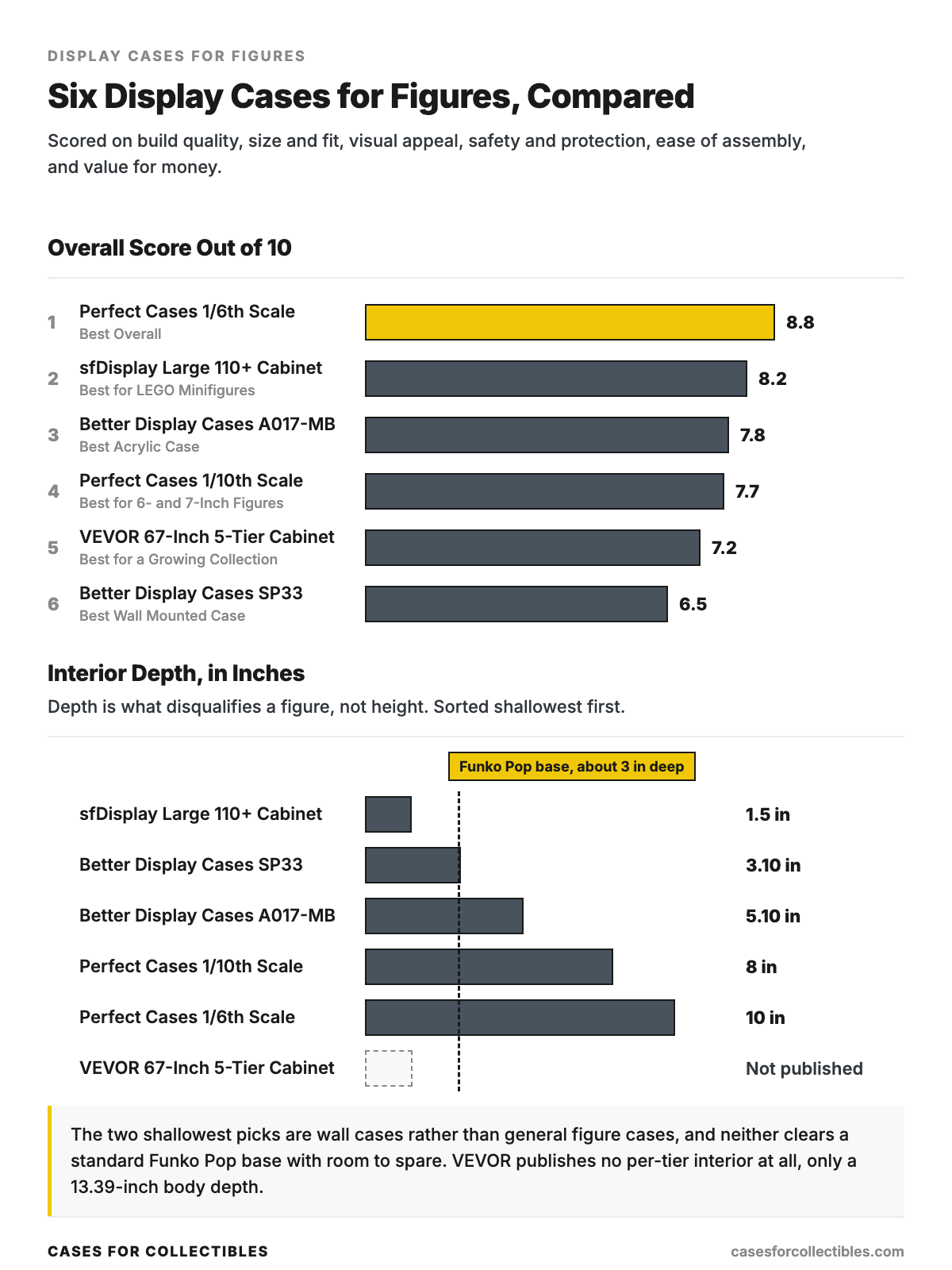
Three of the six make no UV claim at all, and the three that publish a number name no glass or acrylic grade behind it.
How I Picked and Ranked These Display Cases for Figures
Every case was scored against the same six criteria: build quality, size and fit, visual appeal, safety and protection, ease of assembly, and value for money. The scores are mine, and they rest on three things you can check: the maker’s published specs, the Amazon rating and the number of owners behind it, and the material science in the sources linked below. Where a score sits below what the specs alone would give, the reason sits in that pick’s cons.
Where the evidence came from:
- A manufacturer spec page for every pick, at perfectcases.com, sfdisplay.com, betterdisplaycases.com, and vevor.com. That one requirement cut most of this category.
- Live Amazon listings for all six, read on September 14, 2026, including the aggregated “Customers say” summaries Amazon builds from its own owner reviews.
- Conservation research from the Canadian Conservation Institute, a peer-reviewed 2021 study of museum display cases, and tip-over data from the Consumer Product Safety Commission.
Now the limits. I didn’t assemble, handle, or measure any of these cases, so this is a researched evaluation of published specs, owner ratings, and material science. Two picks have almost no owner base: the Better Display Cases SP33 has zero Amazon ratings and the Perfect Cases 1/10th Scale has three, so both are scored on published dimensions and construction rather than owner reports. There’s no independent lab testing in this category either, so every dustproof claim you’ll read, mine included, is a manufacturer’s word.
The 6 Best Display Cases for Figures, Reviewed
Each pick is tied to a named collection and a named spot in the room, because a case sized for LEGO minifigures is useless for a 1/6 Hot Toys figure.
1. Perfect Cases 1/6th Scale Figurine Display Case, Best Overall
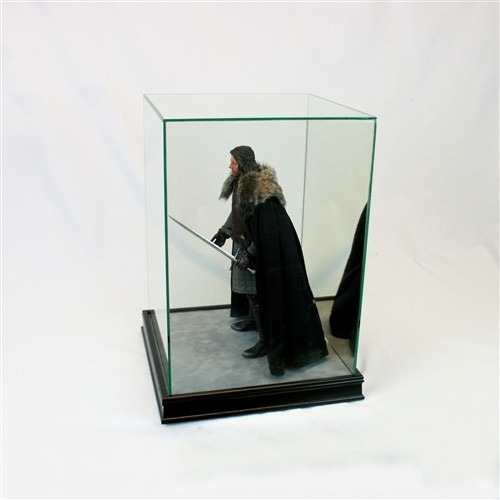
Overall ranking: 8.8/10
The Perfect Cases 1/6th Scale case is my first choice because you choose the protection level here instead of trusting a word on a listing. The maker states it plainly: “You can choose between 50% ultraviolet protection and museum-grade 99% ultraviolet protection glass.”
Inside it’s 10 inches wide by 10 deep by 14 tall, so a 12-inch 1/6 figure stands up with headroom and keeps its arms out. It’s real glass on wood moulding over a mirrored or suede base, made in Apopka, Florida. It holds 4.6 stars across 43 Amazon ratings.
Individual rankings
| Criterion | Score |
|---|---|
| Build quality | 9/10 |
| Size and fit | 9/10 |
| Visual appeal | 9/10 |
| Safety and protection | 9/10 |
| Ease of assembly | 10/10 |
| Value for money | 7/10 |
Stand-out features
- A chooseable UV level: 50% standard glass or museum-grade 99% conservation glass, ordered direct.
- One joint, no hinge: the case lifts off the base, so there’s one perimeter rather than a door frame and a gasket line.
- Glass on five surfaces: four sides plus the top, with no static to pull dust onto the panels.
Pros
- Publishes inside dimensions, which almost nothing here does
- Arrives assembled, with no acrylic panels to snap together
- Glass rather than acrylic, so it won’t haze from cleaning
Cons
- There’s no door. Reaching the figure means lifting an 11-pound glass box straight up off the base, two-handed, over the piece you’re protecting
- The Amazon listing sells one configuration only, described as “Crystal Clear, UV Protected, Real Glass,” which is the 50% glass
- Premium money for a case that holds exactly one figure, tabletop only
A word of caution on that UV choice. The 99% glass only comes direct from perfectcases.com, we earn nothing when you order there, and for a figure that sits near a window it’s still the right call.
Alternatives: the same maker’s 1/4th Scale case runs 12 x 12 x 20 inches inside for a quarter-scale statue. For a large resin piece, one of the best statue display cases is the sized answer.
2. sfDisplay Large 110+ Minifigures Display Case Cabinet, Best for LEGO Minifigures
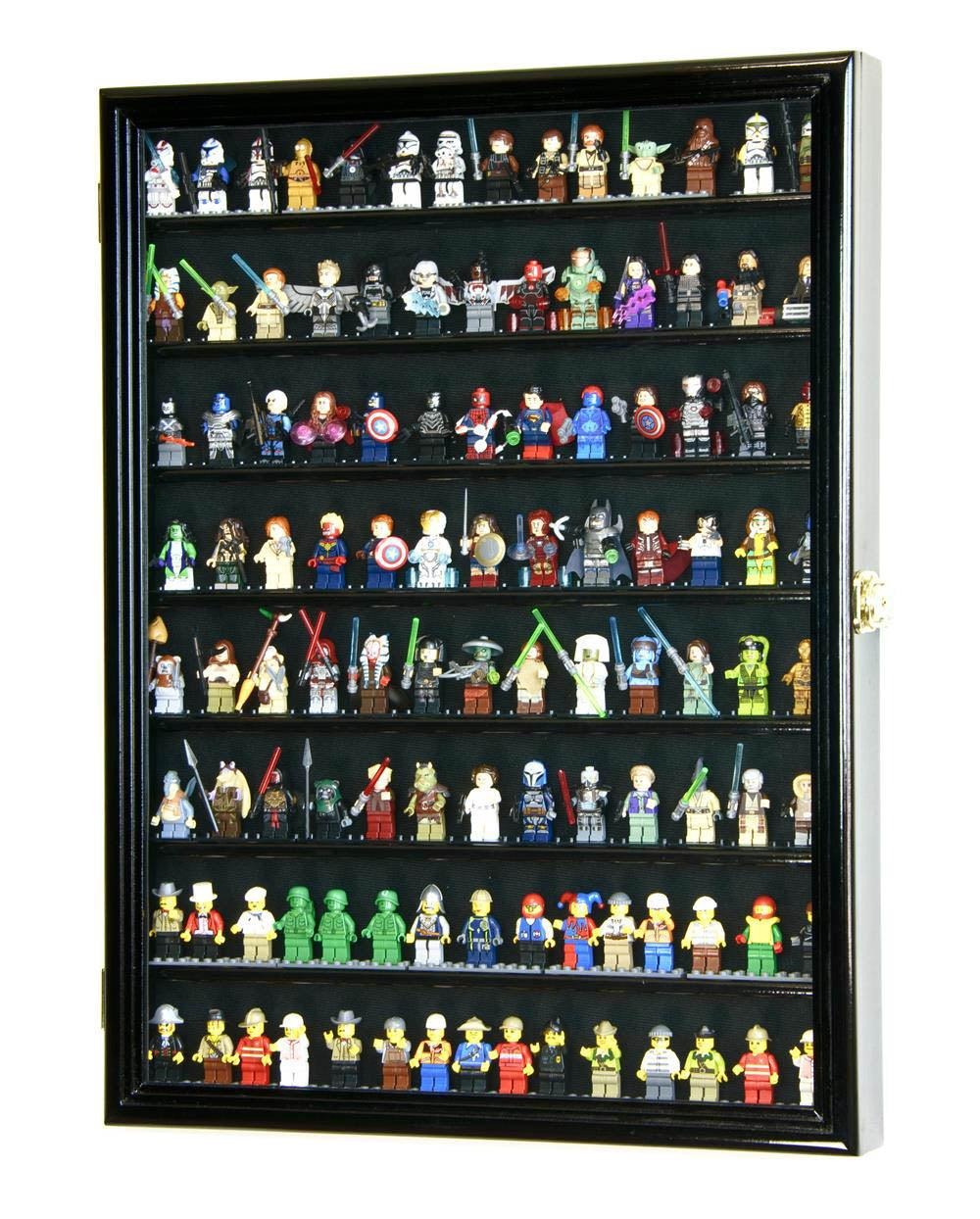
Overall ranking: 8.2/10
If your problem is count rather than height, the sfDisplay 110+ cabinet solves it in one hanging frame. Eight shelves hold 110 or more LEGO minifigures behind a hinged door that locks with a brass latch and key.
The maker’s page and the Amazon listing agree on the numbers, which is rarer than it should be. Outside 24 inches high by 18 wide by 3 deep, inside 23 by 17 by 1.5, with 2.5 inches between shelves. The beech hardwood frame comes from Display Gifts Inc. of South San Francisco, and it ships assembled with the wall hardware.
Individual rankings
| Criterion | Score |
|---|---|
| Build quality | 9/10 |
| Size and fit | 7/10 |
| Visual appeal | 8/10 |
| Safety and protection | 9/10 |
| Ease of assembly | 10/10 |
| Value for money | 6/10 |
Stand-out features
- A published 98% UV-rated acrylic door: the maker’s claim for that specific door, with no acrylic grade named behind it.
- Brass locking latches with keys: the only lock in this roundup.
- One hinged door over one shallow box: the tightest seal geometry of the six.
Pros
- Arrives fully assembled and ready to hang
- Publishes inside and outside dimensions plus the shelf gap
- Beech hardwood and felt rather than MDF and card
Cons
- The 1.5-inch interior depth and 2.5-inch shelf spacing make this a minifigure case and nothing else. A LEGO minifigure is about 1.6 inches tall and fits happily. A 4-inch Funko Pop won’t go in, and neither will an action figure with a base, a cape, or an arm held out
- This listing carries 17 Amazon ratings. The 144 reviews at 98% five-star on the maker’s own site are curated and aren’t independent evidence
- No lighting and no mirrored back on the black variant, and a beech frame makes it a wood enclosure, which gives off acidic vapors that reach card backers and printed boxes before they reach the figures.
Alternatives: the Pro Collector’s case has a deeper 2.25-inch shelf and a much larger review base. For loose 1/64 cars, the slot-and-tier diecast display cases are the shared answer.
3. Better Display Cases A017-MB, Best Acrylic Display Case for Figures Up to a Foot Tall
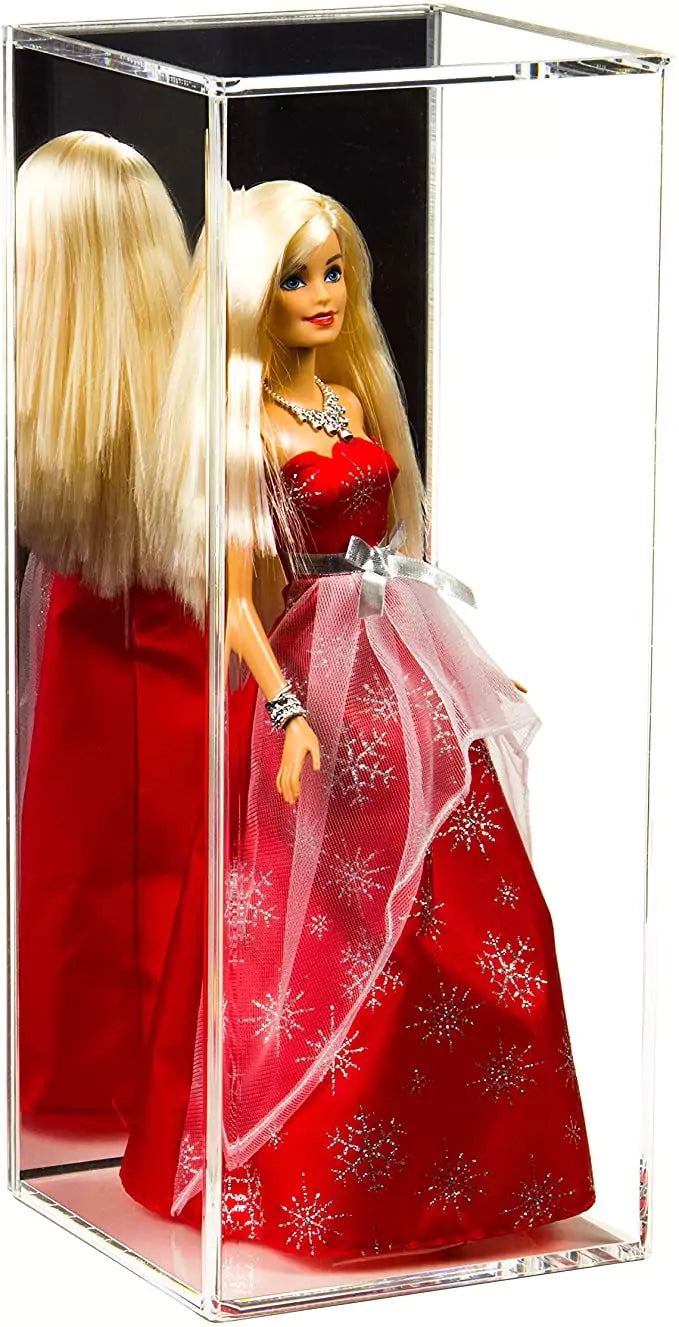
Overall ranking: 7.8/10
If what you want is one clear acrylic display case for figures, with a mirror behind it, the Better Display Cases A017-MB is where I’d start, because the maker prints the inside measurement next to the outside one. Outside 13.25 inches tall by 5.5 deep by 5.5 wide, inside 12.85 by 5.10 by 5.10.
It also prints the sizing rule that decides most of these purchases: “Compare it to the INTERIOR dimensions listed for the case. Leave extra space. A tight measurement match may not work.”
Individual rankings
| Criterion | Score |
|---|---|
| Build quality | 7/10 |
| Size and fit | 8/10 |
| Visual appeal | 8/10 |
| Safety and protection | 6/10 |
| Ease of assembly | 10/10 |
| Value for money | 8/10 |
Stand-out features
- A removable mirrored back: doubles the visible surface and hides the rear seam.
- Interior sizes published across 60-plus cases: a 3-inch cube up to 27 x 15 x 6 inches.
- Fully assembled out of the box: microfiber cloth and rubber feet included.
Pros
- Inside and outside dimensions both published on the listing
- Mid-tier price for a hand-polished acrylic case
- A wall-mount twin exists if you change your mind on placement
Cons
- The interior is 5.10 inches square, and that’s the number that catches people out. A figure clearing the 12.85-inch height still won’t go in on a 6-inch diorama base, holding a weapon out sideways, or wearing a cape
- No UV claim of any kind on this listing. Better Display Cases sells a separate UV-protection line, and this isn’t it
- Plain acrylic scratches from cleaning and holds a static charge that pulls dust onto the panel. The 4.4 average rests on 12 Amazon ratings
Alternatives: for a Gundam kit or a long weapon, the same maker’s A021 tall case gives 18.10 x 4.5 x 4.5 inches of interior. The Perfect Cases 1/10th Scale below is the glass answer at a similar footprint.
4. Perfect Cases 1/10th Scale Figurine Display Case, Best for 6- and 7-Inch Action Figures
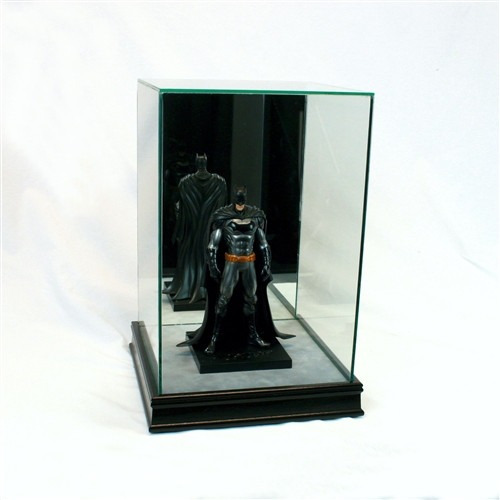
Overall ranking: 7.7/10
Marvel Legends, Star Wars Black Series, and 7-inch McFarlane figures fall into a size gap the 1/6 case above doesn’t cover, and the Perfect Cases 1/10th Scale case is built for it. The maker states the fit verbatim: “The inside dimensions of this display case are 8″ wide x 8″ deep x 10″ high.”
The 8-inch square floor matters more than the height, because it takes a figure with a base and an arm extended, which a 5-inch acrylic box won’t. Construction matches the 1/6 case, down to the lift-off glass and the suede bottom.
Individual rankings
| Criterion | Score |
|---|---|
| Build quality | 9/10 |
| Size and fit | 8/10 |
| Visual appeal | 7/10 |
| Safety and protection | 8/10 |
| Ease of assembly | 10/10 |
| Value for money | 4/10 |
Stand-out features
- An 8 x 8-inch floor: room for a base and accessories around the figure.
- The same 50% or 99% UV glass choice as the 1/6 case, ordered direct.
- Glass on four sides plus the top: a posed figure reads from any angle.
Pros
- Interior dimensions stated in the maker’s own words
- Sized for the 6- to 7-inch figure most action-figure lines are built around
- Arrives assembled, with the same US construction as the top pick
Cons
- Three Amazon ratings. The 5.0 average means nothing at that sample size, and I’ve scored the value accordingly
- No door, and at 8 x 8 x 10 inches inside against the 1/6 case’s 10 x 10 x 14, a posed figure sits closer to the glass on every side with less room before an arm or a cape touches a panel. Access means lifting the glass off the base, and Cherry is the only moulding finish here
- Premium money for a case that holds one mid-size figure, the weakest value here
Alternatives: if price is the sticking point, the A087 acrylic case gives a larger 10.5 x 10.5 x 14.5-inch interior for less, with the scratch and static trade-offs the material brings.
5. VEVOR 67-Inch 5-Tier Display Cabinet with Doors, Best for a Collection That Keeps Growing
Overall ranking: 7.2/10
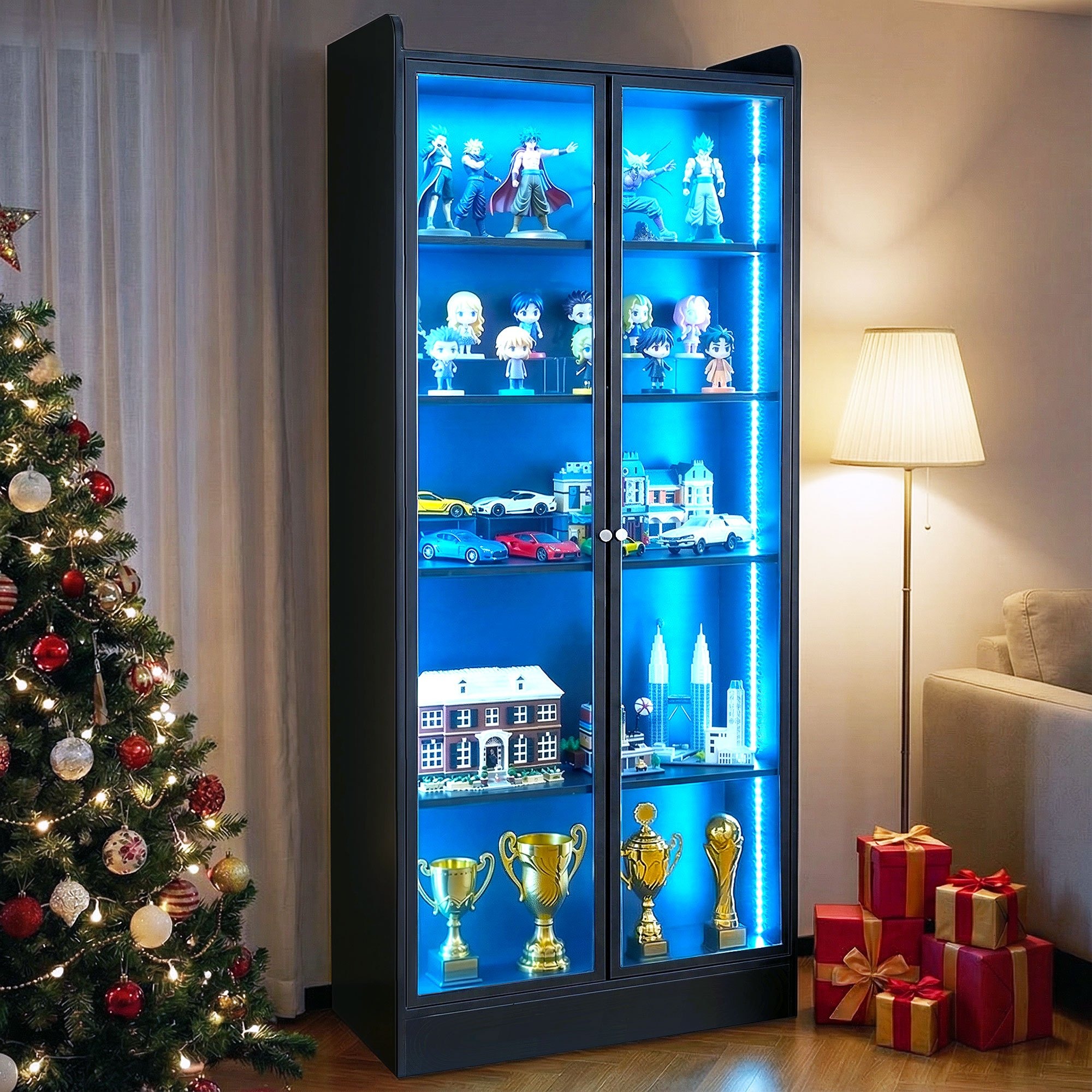
Buy the VEVOR 5-tier cabinet when you’ve already bought three boxes and you’re about to buy a fourth. It’s 27.56 by 13.39 by 66.93 inches, five interior spaces, three-sided transparent doors, and three-color LED lighting.
The number that earns it a place is the shelf rating. VEVOR publishes 40 pounds per shelf, the highest published load here by a wide margin and the only one that carries a row of resin statues. The IKEA BLÅLIDEN, the glass cabinet collectors usually reach for first, rates each of its shelves at 7 pounds.
Individual rankings
| Criterion | Score |
|---|---|
| Build quality | 6/10 |
| Size and fit | 9/10 |
| Visual appeal | 9/10 |
| Safety and protection | 7/10 |
| Ease of assembly | 4/10 |
| Value for money | 8/10 |
Stand-out features
- 40 pounds per shelf: published in the maker’s own spec table.
- Three-color LED lighting in warm, white, and blue, which is a visibility upgrade rather than a fading risk.
- An anti-tip bracket in the box on an 86-pound, 67-inch cabinet.
Pros
- The most display capacity per dollar of anything here
- Published shelf load, which most cabinets in this category never state
- Lit and glass-fronted on three sides, so figures read from the side too
Cons
- VEVOR’s own page contradicts itself. The bullets and title say “clear acrylic doors” while the spec table on the same page reads “Door Material 0.20 inch (5 mm) Glass,” and that table says “Shelves Fixed” while the bullets promise two adjustable shelves. I can’t tell you which is right, and neither can the listing
- Assembly is the recurring complaint. Amazon’s aggregated summary reports that “the instructions are unfinished,” with owner phrases including “a nightmare to follow” and “Not sturdy, it wobbles ever so slightly”
- VEVOR’s own review summary concedes “issues with acrylic reflectivity and dust protection.” The cabinet holds 3.8 stars across 42 Amazon ratings against 4.8 across 31 on vevor.com, same product, same week
Use the anti-tip bracket. The Consumer Product Safety Commission counted an estimated annual average of 17,800 emergency-room injuries from tip-overs of televisions, furniture, and appliances between 2020 and 2022.
Alternatives: at other heights and tier counts, the same cabinet shape turns up among the model car display cases.
6. Better Display Cases SP33, Best Wall Mounted Display Case for Figures
Overall ranking: 6.5/10
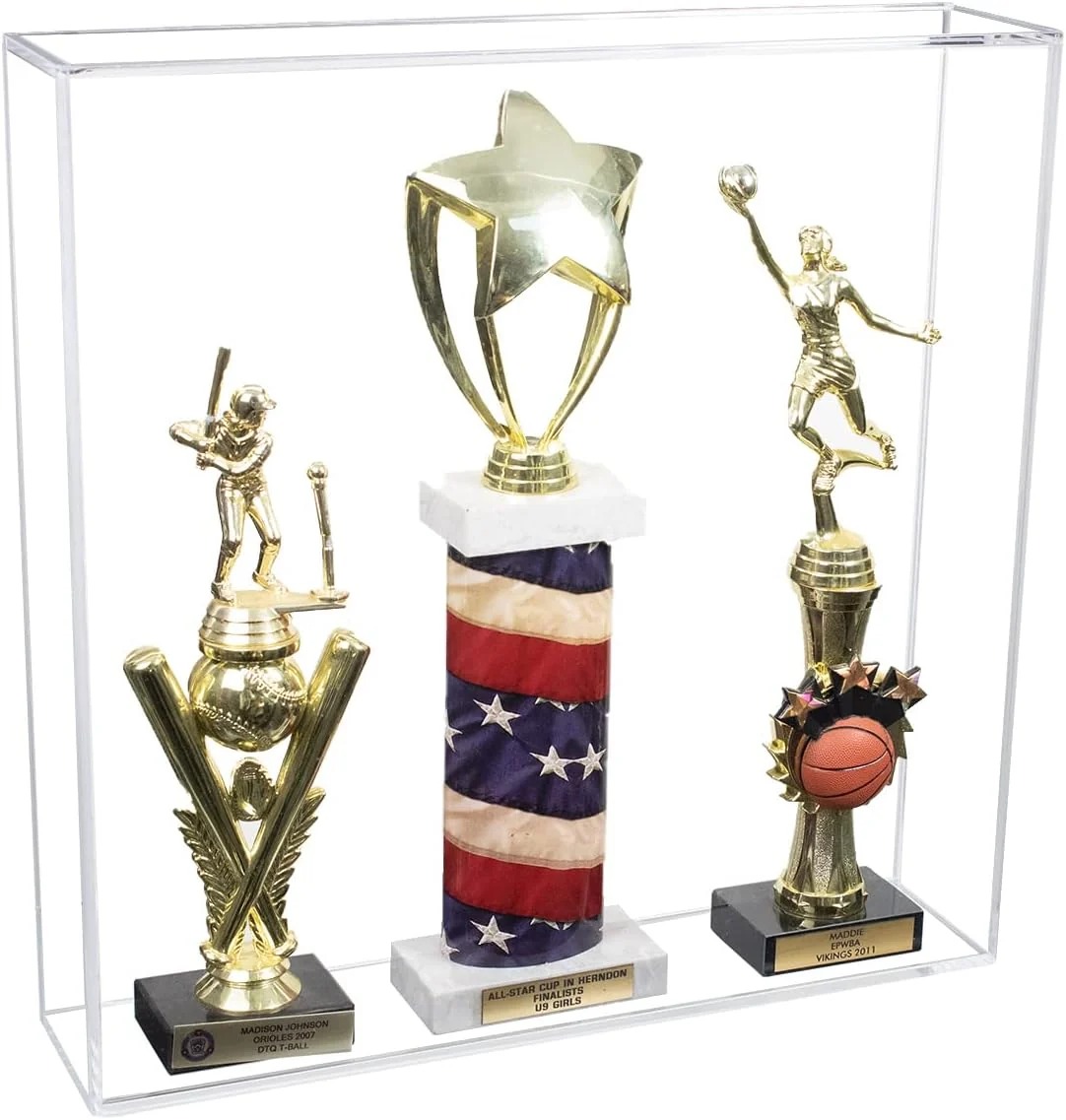
A wall mounted display case for figures solves the problem no other format can. You’ve run out of floor and shelf depth, and a wall is what’s left. The Better Display Cases SP33 is 15.5 inches square and 3.5 deep outside, with a published 15.10 by 3.10 by 15.10-inch interior, and it hangs vertically or horizontally. It ships assembled with the mounts in the box, and rubber feet mean it also sits flat on a shelf.
Be honest with yourself about that 3.10 inches first, because it’s the tightest interior in this roundup.
Individual rankings
| Criterion | Score |
|---|---|
| Build quality | 6/10 |
| Size and fit | 6/10 |
| Visual appeal | 7/10 |
| Safety and protection | 6/10 |
| Ease of assembly | 10/10 |
| Value for money | 4/10 |
Stand-out features
- 3.10 inches of interior depth: shallow enough to live in a hallway without being walked into.
- Vertical or horizontal mounting: hardware included, case already built.
- Clear on five sides including the back: the wall color shows through, so the group reads as floating.
Pros
- Both interior and exterior dimensions published
- Arrives assembled, with no panel-snapping and no mounting kit to buy
- Works on a wall or flat on a shelf, and a black-back variant exists
Cons
- That 3.10-inch depth rules out most of what people mean by figures. A standard Funko Pop is too deep at the base, and a posed 6-inch action figure won’t fit at all
- The removable back gives the enclosure a full-perimeter seam by design, so it keeps dust down without closing it out
- This listing has zero Amazon ratings, and so does the sibling listing for the same case. Nothing here rests on owner consensus, and I’ve scored the value down to match, the same way I did for the 1/10th Scale and its three ratings. There’s no UV claim, no lighting, and no lock
Alternatives: for 3¾-inch carded-scale figures the Protech AFSBM 24-slot case is the better wall answer, at 18 x 15.25 x 2.5 inches with 24 mirrored slots and 4.6 stars across 68 ratings. It isn’t a pick only because Protech publishes no live product page to check against.
What a Display Case for Figures Protects Against
Three of the four things that damage your figure are handled by the case itself. Dust, hands, and knocks are what a closed case is good at. Fading is the fourth, and it has a separate fix that the glazing rarely provides.
How Much Dust a Closed Display Case Keeps Out
Sealing is a property of the whole enclosure, and the listing only ever tells you about the door. A magnetic lid on a stackable acrylic shell closes one face of a box that still breathes at every seam and every stacking joint, which is why a case sold as dustproof still collects dust inside it.
Take the VEVOR 5-tier cabinet. Three transparent doors on three sides, each with a handle, and no gasket named anywhere in its spec table. Every door is a perimeter and every perimeter leaks, which is why VEVOR’s own review summary, on its own site, concedes “issues with acrylic reflectivity and dust protection.”
The tiered acrylic shells most collectors actually buy do the same thing smaller. Garmic, Goowood, NIUBEE and the generic “3 Tiers Clear Display Case” shells put a magnetic door on the front and leave the stacking joints open behind it. Four of the 30 cases that fill this category’s shopping results have a magnetic door and five are tiered.
Then the panel works against you too. LANSCOERY’s owners report that “the protective film creates static that attracts dust and hair,” and one of them says flatly that “static and dust just moves about.”
The Canadian Conservation Institute reports that an enclosure exchanging its air once a day collects coarse dust at about 24% of the open-room rate, and calls 0.3 air exchanges a day or fewer well-sealed and anything above 1.0 loosely fitted. A 2021 study by Chiantore and Poli puts the museum bar at 0.1 air changes a day.
Sealing cuts both ways, though. The same study records that inside a tight enclosure “compounds that originated from the local emissions will easily accumulate,” so a tighter case keeps dust out and holds in whatever its own wood, adhesive, and finish give off.
The Canadian Conservation Institute calls acidic emission the main problem with wooden enclosures, names oak and cedar as the worst species, and scopes who should care: “Lead, copper alloys and paper are commonly known to be among the most susceptible types of objects to acidic vapours.” A PVC anime figure is safe from that. A card backer or a printed box is the one to think about.
Fading, UV, and What Clear Acrylic Does Not Do
If you want the acrylic itself to filter UV, it has to be a specific UV-absorbing grade, and the Canadian Conservation Institute names the ones that work: Plexiglas UF-5 is recommended for eliminating most UV radiation, with Acrylite OP-2 and OP-3 as equivalents. Plain clear acrylic is none of those, and clear glass is barely better. It passes over 90% of visible light and cuts UV only below 300 nanometers, while the wavelengths that yellow a vinyl figure sit above that.
Read the listings and the gap shows. LANSCOERY, one of the biggest sellers here, titles its cases “Upgraded Thickened UV-Resistant Showcase” with no percentage, no wavelength, and no grade named. Moduspace, the premium enthusiast brand, makes no UV claim at all.
Even a filtering grade wouldn’t settle it. For light-sensitive colors the Canadian Conservation Institute’s research on light damage reports that “UV usually contributes less than half of the fading and often only one tenth.” Placement does more than any glazing upgrade.
The same source puts a just-noticeable fade at one day to two weeks in average daylight, five days to two months beside a window, and 1.5 to 20 years at 50 lux. Move the case to the wall the sun never reaches and you’ve solved more of this than any case you can buy. For vinyl figures the same institute’s guidance on caring for plastics is to avoid UV and sunlight entirely, because light damage there shows up as yellowing, chalking, and eventually cracking.
Acrylic, Glass, Wood, and Thin Plastic Compared
Acrylic is light, shatter-resistant, cheap, and probably what you’ve already settled on. It also scratches. The Canadian Conservation Institute records that uncoated plastic glazing is “susceptible to scratching and abrasion” and “readily picks up and holds an electrostatic charge.”
Those two facts combine into what ruins most acrylic cases. The static pulls dust onto the outside of the panel, so you wipe it often, and the wiping is what scratches it. The institute’s note on cleaning acrylic warns that “many household cleaners contain abrasives that may scratch acrylic sheet.” A paper towel and glass cleaner will haze a case, so use a damp microfiber cloth.
In return, shallow scratches come out of acrylic with fine abrasives, where a scratched glass panel stays scratched.
Glass runs the other way. It picks up very little static, resists scratching better than most plastics, and stays rigid at 2 millimeters where acrylic needs 3 to stop bowing. Against it, glass is heavier and it breaks. The National Glass Association puts tempered glass at four times the breakage strength of annealed under ASTM C1048, though it can still break spontaneously.
Wood-framed cases put the money into a carcass that hangs square and hides hardware, and two of my picks are built that way. Thin polystyrene and PVC boxes are most of what sells at the bottom of the range, and they get mislabeled constantly. Protech’s own copy says its cases are made from virgin rigid PVC and are acid free, while the shopping results title the same products “Acrylic Display Case.” If a listing won’t name the plastic, assume the cheaper one.
How to Size a Display Case to Your Tallest Figure
Start with your tallest figure and work back to the case, leaving room at every measurement. Interior clearance decides fit, and almost every listing here publishes only the outside of the box. Once the frame, the door, and the base are counted, the usable space runs a fraction to a full inch shorter in every direction. Better Display Cases prints both numbers on its A017: 13.25 x 5.5 x 5.5 inches outside against 12.85 x 5.10 x 5.10 inside.
Height is the number collectors check, but width is the one that fails them. A 12-inch figure clears that 12.85-inch interior, but the same figure on a 6-inch diorama base, or holding a weapon out sideways, does not go into 5.10 inches square.
Width and height settle the fit. The next question is whether this is one case or the first module of a system.
Two makers build for stacking and both say so in writing. Moduspace claims its Moducase is “load-tested stacking up to five units tall” on aluminum frames “bolted at the corners,” and the Apextime Chaos ULTRA is sold as magnetically attached and stackable. Those are manufacturer claims rather than tested results, neither company sells on Amazon, and none of my six picks stacks with anything, which is exactly why the first box sets the standard.
Modules only mate with their own family, so the case you buy for one figure fixes the module size, the door style, and the brand for every figure after it. Buy the cheapest box first and you’ll end up with a shelf of mismatched heights.
When nothing off the shelf fits, Better Display Cases publishes more than 60 interior sizes, and fabricators like ShopPOPDisplays and T&T Plastic Land cut to size at a price that suits one grail piece.
Where to Put a Display Case for Figures
Placement narrows the shortlist faster than any spec, so settle it before you open a listing.
- Desktop and shelf cases: the default, and the only format where a lift-off glass case works.
- Wall-mounted cases: no floor cost, and the shallow ones at 2.5 to 3.5 inches deep suit flat arrangements of small figures.
- Floor cabinets: the most capacity per dollar and the largest footprint, and anything tall needs anchoring.
The cabinet most collectors get pointed at first is the IKEA Detolf, and it’s gone. Its US product page returns a 404 and the cabinet has left the US range.
The replacement, the BLÅLIDEN, is 13¾ by 12⅝ by 59½ inches with three movable shelves, and IKEA rates each shelf at 7 pounds with a warning that the cabinet must be securely anchored. Seven pounds is a shelf of minifigures. A row of resin statues weighs several times that.
Lighting, Mirrored Backs, and Seeing the Whole Figure
Pick the background before you pick the lamp, because a mirrored or felt back changes how a figure reads more than any light does.
LED is safe to add. The Canadian Conservation Institute puts white LED at 0 to 75 microwatts per lumen of UV against 300 to 600 for daylight, calls that very low, and records the UV filter as “not necessary.” It also calls LED “very useful at short distances, such as display cases” with “no heat in light beam.” The window across the room does far more fading than the lamp inside the case.
A mirrored back does the same job with no wiring, doubling the visible surface and hiding the rear seam. Felt or a black background kills reflections instead, so small figures read as clean silhouettes, and a clear back gives the floating look.
Price Tiers and Where to Buy a Display Case for Figures
Every pick here sits above the middle of the price range for this kind of case, and that’s a direct consequence of the first filter I applied. I only ranked cases whose maker publishes a checkable spec sheet. The cases most people buy and the cases with a published spec sheet turn out to be two different sets of products.
The distance between those two sets surprised me. I went looking for manufacturer sites for 15 of the biggest-selling brands here, including LANSCOERY, NIUBEE, Garmic, Goowood, dofopo, and SVENJBB. I got dead domains, parked for-sale pages, an AI consultancy, and a company that sells yoga mats.
What the money buys as you move up:
- Budget: a plain acrylic box or a flat-pack shell with a magnetic lid, assembled by you and rarely documented.
- Mid: published interior dimensions, polished edges, a mirrored or clear back, and a case that arrives built.
- Premium: real glass, a hardwood frame, a lock, a published shelf load, or lighting.
The budget tier’s recurring problem is assembly and fit, and Amazon’s own aggregated review summaries say so for the three biggest sellers in it.
- LANSCOERY acrylic case: “the assembly process requires significant force to snap panels together,” and the durability “receives negative feedback, with multiple customers reporting it falls apart easily”
- NIUBEE wall and desktop case: it “works well with Labubus” but “doesn’t accommodate standard-sized Funko Pops”
- Rolife dust cover: the door “won’t stay closed and falls off when opening”
Five of my six picks arrive assembled, which is a real differentiator here.
Each channel carries a different slice. Amazon has the widest collector-specific range and is where every link here goes. Walmart, Target, and Muji stock general-purpose display boxes, Michaels and Hobby Lobby carry small keepsake cases, Etsy carries custom and laser-cut ones, and IKEA covers the furniture-grade glass cabinet. Sideshow and BigBadToyStore carry the enthusiast 1/6 systems from Moduspace and Apextime, which never reach Amazon.
Which Display Case for Figures to Buy for Your Collection
Match the case to the collection first and the room second:
- One 1/6 Hot Toys figure or a tall anime figure: the Perfect Cases 1/6th Scale, with the UV level you choose.
- 60 to 110 LEGO minifigures: the sfDisplay 110+ cabinet, if nothing you own is deeper than a minifigure.
- One figure up to a foot tall, in acrylic: the Better Display Cases A017-MB, if nothing on your figure sticks out sideways.
- 6- and 7-inch action figures: the Perfect Cases 1/10th Scale, for the floor space a base and an outstretched arm need.
- A collection that’s still growing: the VEVOR 5-tier cabinet, if you’ll forgive the assembly.
- No floor space at all: the Better Display Cases SP33 on the wall, for flat arrangements only.
Whichever one you land on, measure your figure at its widest point rather than its tallest, and keep the case off any wall the sun reaches.
Frequently Asked Questions About Display Cases for Figures
What is the best display case for figures?
The best display case for figures for most collectors is the Perfect Cases 1/6th Scale case, which gives 10 x 10 x 14 inches of published interior in real glass on a wood base. It’s the only case I found here where you choose the UV level, at 50% standard or museum-grade 99% ordered direct.
The trade-off is that it has no door, so reaching the figure means lifting an 11-pound glass box off its base. For LEGO minifigures a wall cabinet is the better answer, and for a growing collection a floor cabinet is.
Do acrylic display cases protect figures from fading?
No, a standard acrylic display case does not protect figures from fading. UV filtering in acrylic comes from specific UV-absorbing grades, and the Canadian Conservation Institute names Plexiglas UF-5, Acrylite OP-2, and OP-3 as the ones that work. No case I checked here names any of them, and the listings that say UV-resistant carry no percentage, wavelength, or grade. UV is also a minority contributor to fading, so keeping the case out of direct light does more than any material choice.
What size display case do I need for Funko Pops?
For a standard Funko Pop you need 5 to 6 inches of interior clearance, and 11 or more for a Jumbo. Funko’s own size guide puts a standard Pop at about 4 inches, a Super at 6, a Jumbo at 10, a Mega at 18, and a Bitty at 0.9 inches, so “fits Funko Pops” means nothing without a number beside it. Depth catches people more often than height. A Pop is roughly 3 inches deep at the base before you count a box.
What is the best wall mounted display case for figures?
The best wall mounted display case for figures in this roundup is the Better Display Cases SP33, which hangs vertically or horizontally at 15.5 inches square and publishes a 15.10 x 3.10 x 15.10-inch interior. That 3.10-inch depth is the catch, since it rules out standard Funko Pops and posed 6-inch action figures. For a wall of LEGO minifigures the sfDisplay 110+ cabinet is stronger, and the Protech AFSBM 24-slot case suits 3¾-inch carded figures.
Where can I find a display box for figurines?
You can find a display box for figurines on Amazon, at a general or craft retailer, or direct from the maker. Amazon has the deepest collector-specific range and is where every link here points. Go direct when you need an exact interior size or a finish nobody else stocks.